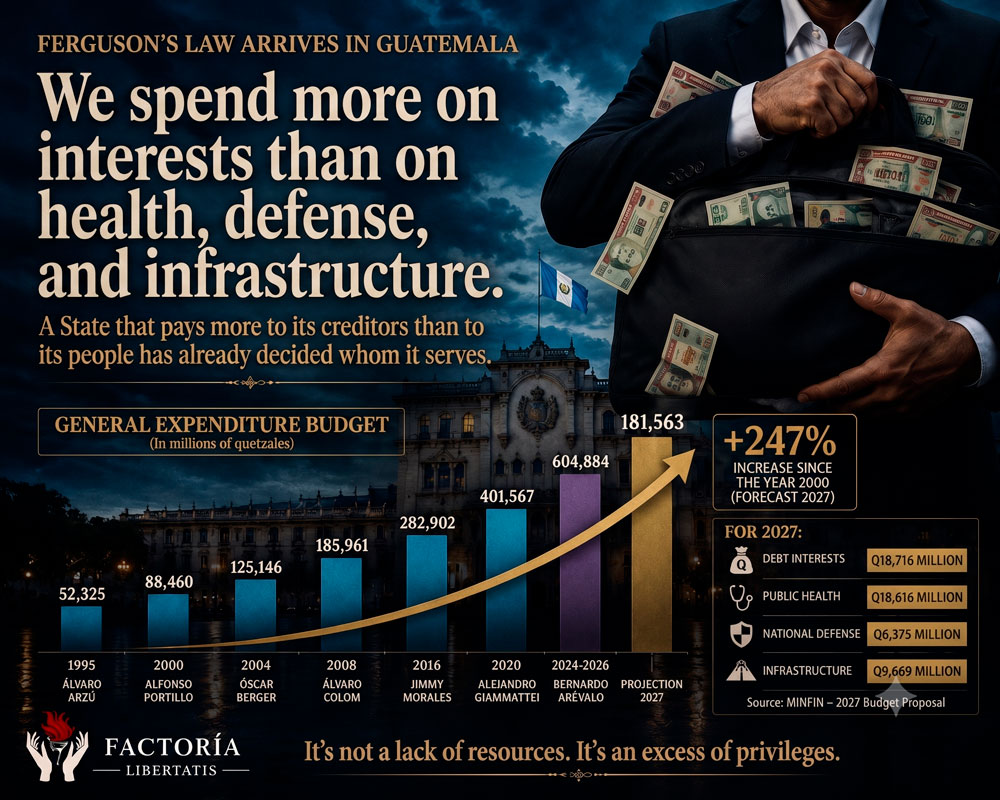
In the Edinburgh of 1767, a military chaplain turned philosopher published a warning that Guatemala would confirm two hundred fifty-nine years later in an official chart from the Ministry of Finance. Adam Ferguson — a contemporary of Adam Smith and David Hume, a veteran of the Black Watch regiment, and one of the great Scottish moral philosophers — devoted a section of his Essay on the History of Civil Society to “national profusion,” portraying states that pawn their credit to disguise the risks they run: “if a nation is to sink at any future period, every minister hopes it may still float in his time.” Debt, he warned, is “extremely dangerous in the hands of a rash and ambitious administration, who, attentive only to the present occasion, thinks the state inexhaustible while capital can be borrowed and interest can be paid.” In 2025, the Scottish historian Niall Ferguson formalized his namesake’s intuition and named it in his honor: Ferguson’s Law holds that any great power spending more on debt service than on defense risks ceasing to be a great power. The United States crossed that threshold in 2024: according to the Congressional Budget Office, net interest reached 3.1% of GDP, surpassing defense spending (3.0%) for the first time in almost a century. If the law compares interest against defense, Guatemala offers an even more revealing case: interest already exceeds not only defense, but also health and infrastructure.
Guatemala crossed its own threshold without anyone announcing it, and this month the Ministry of Finance published it without flagging it. In the official presentation of the 2027 budget ceilings, a table by entity appears: interest on public debt will cost Q18,716 million; the entire ceiling for the Ministry of Public Health will be Q18,616 million. The Guatemalan State will pay more in debt service than everything it will spend on healing its citizens. Moving down the budget allocations, the problem gets worse: the Interior Ministry will receive Q10,490 million and National Defense Q6,375 million; combined, the two portfolios responsible for the country’s external and internal security — Q16,865 million — cost less than interest payments. Infrastructure, at Q9,669 million, doesn’t even reach half. Ferguson’s Law thus admits a Guatemalan generalization: a country that spends more on interest than on defense loses the capacity to defend itself; one that spends more on interest than on health loses the capacity to heal; one that spends more on interest than on infrastructure gives up building its future.
How did we get here? It didn’t happen overnight. It has been a spiral that every government fed, and one the current administration decided to turn from a worrying trend into an acceleration of spending. Jimmy Morales’s four-year term incurred Q283 billion; Alejandro Giammattei’s, Q402 billion; the current one will close at Q605 billion if the ceilings are approved — more than the country spent across the sixteen years of Arzú, Portillo, Berger, and Colom combined. Several questions arise: Have you received more kilometers of road under this government than what was built in those four governments together? Have you seen more hospitals built than under Jimmy’s or Giammattei’s government? Have you noticed a proportional improvement in public services? Is that runaway increase justifiable?
According to MINFIN’s official presentation, the fiscal deficit jumped from 1.0% of GDP in 2024 to 3.8% in 2026, exceeding even the 3%-of-GDP limit adopted by the Maastricht Treaty as the European Union’s fiscal-discipline benchmark. Public debt will go from Q223 billion in 2023 to Q304 billion in 2027: an additional Q82 billion in four years. And the proposed 2027 budget ceiling comes to Q182 billion, 16.6% of GDP, against tax revenue of 12.1%. That gap of four and a half points of GDP can only be closed three ways: more debt, more taxes, or less spending. The first two are already underway: the International Monetary Fund recommended in June a comprehensive fiscal reform that would broaden the tax base and raise tax rates, and the SAT (tax authority) is already assessing the cost of exemptions. The government promises not to raise taxes while approving the ceilings that make raising them inevitable.
The consequence of that trajectory is already before us: a State that pays its creditors more than its doctors and its soldiers has already decided whom it serves. When a State reaches this point, it typically tries to close the hole one of two ways. The first is the French way. France collects 51.5% of its GDP in taxes — the highest tax burden in the developed world — owes 110% of its economy, and still ran a 5.5% deficit in 2023; in 2025 it raised its corporate rate again, from 25.8% to 36.1%. Germany, with a 46% tax burden, has been stagnant for three years. Maximum tax pressure bought neither solvency nor growth: it bought a bigger appetite for spending. The second path is that of small countries that chose to grow. Georgia, after its 2004 reform, eliminated taxes and lowered rates: its tax revenue jumped from 15.5% of GDP in 2003 to 28.5% in 2008, while its debt fell from 61% to 25% of GDP. Bulgaria cut its corporate rate from 40% to 10%, and its tax collection didn’t move: 36% of GDP before and after. The detail our reformers omit: Guatemala, with its 25% corporate rate, charges more than Ireland, Bulgaria, Georgia, Armenia, Singapore, and Hungary. The problem is no longer how much we charge, but how many we charge — and on what base.
According to the SAT’s own data from January to May 2026, of the 835 registered economic activities, 64 pay 80% of all tax revenue, and just 20 pay half. In other words, when the State talks about “taxpayers,” it is almost always talking about the same small group of economic activities. The department of Guatemala contributes 90.7% of the national total. UFM Market Trends, in a study by Olav Dirkmaat, has calculated that while the national tax burden averages 12%, in the department of Guatemala it amounts to 36%: a Swedish-level burden on the capital, next to none on the rest. Raising rates on that structure isn’t reform — it’s squeezing the same 64 for the umpteenth time. The right move would be to decentralize tax collection before further increasing the burden on the department of Guatemala.
Before discussing new taxes, four much deeper problems should be corrected: First, a spending rule preventing the budget ceiling from growing faster than the economy. Second, restoring the original interpretation of Article 61 of the Organic Budget Law, which prohibits borrowing for current spending and which the political class has distorted. Third, full transparency on debt, including the Q110 billion hidden with the IGSS (social security institute) and the Banguat (central bank) that UFM Market Trends has documented. And fourth, the Georgian trade-off: eliminate all privileges by decree in exchange for lowering the general rate. That reform would indeed broaden the base, formalizing the 771 activities and the 21 departments that today barely exist fiscally.
If the 2027 ceilings are approved as they stand, every quetzal of the future upward reform will be born mortgaged: it will not fund hospitals or roads, but the interest on the debt this spending contracted. This government is moving in the wrong direction, and the arithmetic of that direction is well known: by 2030, interest will not only surpass health spending, it will double defense and security combined. Adam Ferguson wrote the verdict back in 1767: spending that fails to yield a due return “must be reckoned among the causes of national ruin.” Ferguson also understood, nearly two hundred sixty years ago, that a nation can mortgage its future long before it goes bankrupt. Guatemala has not yet gone bankrupt. But the 2027 budget shows it has already begun to mortgage it. The country that pays more for its past than for its defense ends up, sooner or later, with no future to defend.
Ramiro Bolaños, PhD.
President of the Centro de Pensamiento y Acción Factoría Libertatis
References
- Dirkmaat, Olav A., and David Corzo, El mito de la deuda pública guatemalteca: ni baja ni buena, Special Report (Guatemala City: UFM Market Trends, 2026).
- Ferguson, Adam, An Essay on the History of Civil Society, 5th ed. (London: T. Cadell; Edinburgh: W. Creech and J. Bell, 1782 [1st ed. 1767]).
- Ferguson, Niall, “Ferguson’s Law: Debt Service, Military Spending, and the Fiscal Limits of Power,” History Working Paper 202502 (Stanford: Hoover Institution, February 21, 2025).
- International Monetary Fund, Public Finances in Modern History Database (Washington, D.C.: IMF, 2025).
- Fundación para el Desarrollo de Guatemala (FUNDESA), “¿Cuál es la magnitud del presupuesto de egresos 2027?,” chart with data from Banguat and MINFIN, total expenditures 1995–2027 (July 2026).
- Gamarro, Urías, “SAT plantea evaluar costo de incentivos fiscales,” Prensa Libre, July 20, 2026, p. 15.
- Ministerio de Finanzas Públicas, Techos indicativos para la construcción del proyecto de presupuesto 2027 (Guatemala City: MINFIN, July 2026).
- Superintendencia de Administración Tributaria, Recaudación de ingresos tributarios por actividad económica y departamento, enero–mayo 2026 (Guatemala City: SAT, 2026).
- Tax Foundation, Corporate Tax Rates Around the World, 1980–2025 (Washington, D.C.: Tax Foundation, 2025).