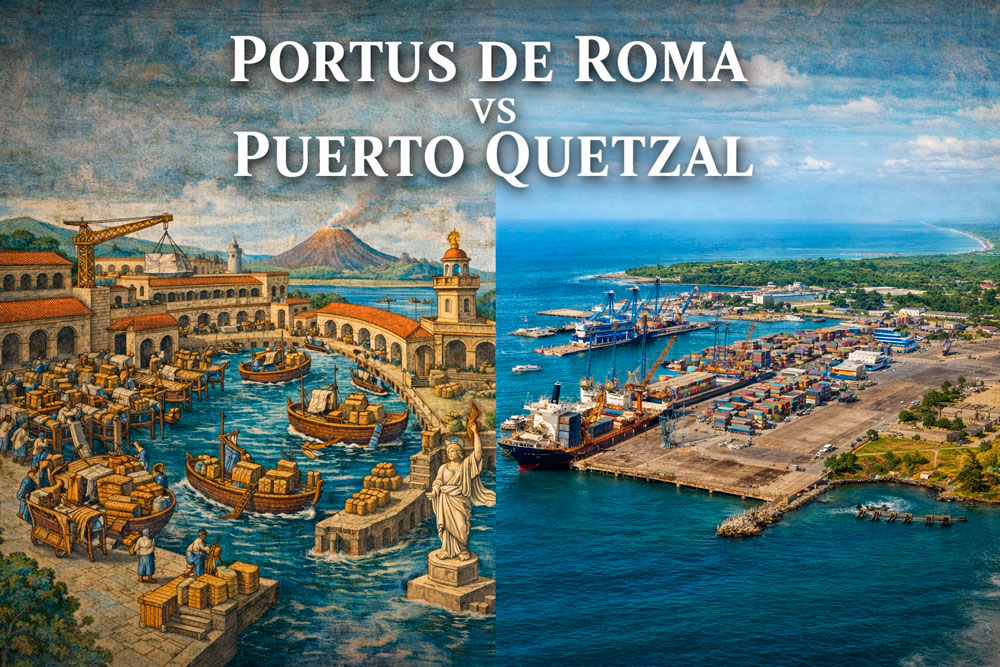
Let us imagine for a moment that the Roman censor Marcus Porcius Cato arrives in Guatemala, already at the peak of his public career. Not as a military commander, tribune, or senator, but as what he was in 184 B.C.: the magistrate responsible for overseeing contracts, customs, and the property of the Republic. He brings no ideology, no government plans, no moral speeches. He brings something far more disturbing: an uncompromising conception of public works as an enforceable contractual obligation, not as a political promise or an act of state goodwill.
At its height, Rome administered nearly 5 million square kilometers and coordinated the production and supply of a population close to 70 million inhabitants. Guatemala, by contrast, occupies just over 108 thousand square kilometers and has around 18 million people. In simple terms: Rome governed a territory 46 times larger and coordinated a population nearly 4 times greater without electricity, without modern machinery, and without a permanent state execution apparatus. It achieved this through a State that acted as a contractual arbitrator, not as a direct builder: financing, execution, and risk fell upon private consortiums organized as societates publicanorum, accountable with their own assets in case of noncompliance.1,2
In the 1st and 2nd centuries of our era, the city of Rome reached nearly one million inhabitants with buildings up to six stories high. Its operation depended on critical infrastructure—aqueducts, roads, and ports—built and maintained through locatio–conductio contracts, with periodic repair obligations (sarta tecta) and severe penalties for service failures. Roads were not intended for rapid inaugurations, but for durability over centuries. The same principle governed port logistics: the complex of Ostia and later Portus—including Trajan’s hexagonal basin of approximately 32 hectares—was conceived as a structural solution, capable of simultaneously operating up to 250 ships, with integrated docking and storage systems (horrea), under public supervision and private financing.3,4
Rome conceived infrastructure as a long-term strategic asset, built under clear economic incentives, with fully internalized private risk and profit recognized as a legitimate driver of efficiency. To govern a vast, densely populated, and commercially integrated territory, the Republic operated under a basic rule: the State should not build, but make others build well; it should not assume the risk, but transfer it contractually; it should not promise works, but demand results under the law.
During his administration, Cato launched a direct offensive against the publicani, private entrepreneurs who contracted works and services for the State. He awarded construction and maintenance contracts (ultro tributa) at the lowest possible price. Dissatisfied contractors managed to annul the contracts; in response, Cato excluded them from new auctions and reassigned the contracts under stricter conditions. His authority rested on the probatio: the power to reject poorly executed work and require it to be entirely redone at the contractor’s expense.5,6 If Cato had needed to summarize the principle in one sentence, it would probably have been this: the State defines, the private sector executes, and payment arrives only when the work functions satisfactorily.7,8
The principle was simple and credible: the State did not advance resources nor negotiate payments; these occurred only after verification of the result (probatio). That contractual credibility—certain, timely, and non-negotiable payment—is precisely what has disappeared today, driving many honest private companies out of public contracting.
From that institutional logic, the first thing Cato would do in Guatemala would be to change the State procurement law. The essential difference is conceptual. The central mechanism of Roman public works was the locatio–conductio: a contractual regime through which the State auctioned in open competition the execution or maintenance of works and services. The awarded contractor—the manceps—assumed financing, execution, and economic risk. The State did not advance resources nor negotiate payments; these occurred only after verification of the result (probatio). Compliance did not rest on warnings or speeches, but on real guarantees. Contractors were required to present praedes, guarantors who pledged land and property before the State. If the work failed, the punishment was not an administrative report, but the immediate execution of the pledged assets.9,10
This legal design explains why the Roman model managed to mobilize private capital on a large scale without inflating the state apparatus. The societates publicanorum—consortiums with a corporate structure—allowed the gathering of resources from multiple private investors, distributing risks and simultaneously executing large projects: roads, ports, aqueducts, urban services, and army provisioning. Profit was not a tolerated side effect, but the explicit incentive aligning speed, efficiency, and quality.
The solidity of the system was proven in its most critical moment. During the Second Punic War against Carthage, three large consortiums, composed of nineteen men from the Roman financial elite, financed and supplied the army in Hispania on credit, with deferred payment and entirely private risk. Rome offered enforceable contracts; private capital sustained the logistics that made victory in the war possible.11,12,13,14
That same contractual design was not limited to war or the city. The Roman model demonstrates its administrative superiority even more clearly in port logistics. Above all, because of its scale, operational density, and institutional design. Rome understood early on that an empire is sustained by constant flows of goods, and that those flows needed to arrive reliably by sea. For that reason, the port system of Ostia and later Portus was designed to absorb peaks in demand without collapsing: its capacity allowed the simultaneous operation of 250 ships, integrating docks, navigable canals, warehouses (horrea), and private operators under public supervision.15 By contrast, Puerto Quetzal barely handles between six and ten deep-draft vessels at the same time.
If ports explain how Rome fed its empire, roads explain how it governed it. The Roman road network was the material condition of its expansion. From the Appian Way in the 4th century B.C. to the network that covered Europe, North Africa, and Asia Minor, Rome built more than 80 thousand kilometers of main roads, integrated into an even larger secondary network. They were not rural paths nor temporary solutions, but strategic infrastructures designed for administrative control, commerce, and military mobility on an imperial scale. Guatemala, by contrast, today has a short-cycle road network: roads are tendered, inaugurated, and deteriorate with barely 6 thousand kilometers of structurally paved highways.16
The durability of Roman roads was the result of a precise institutional design. Built with layered foundations (statumen, rudus, nucleus, summa crusta) to withstand continuous traffic and adverse conditions—such as snow, deserts, and storms—the roads were not abandoned after inauguration, but preserved through periodic maintenance contracts (sarta tecta), whose noncompliance triggered automatic patrimonial sanctions. The secret was not in building well, but in enforcing permanent maintenance. That regime made preservation more efficient than reconstruction and turned premature deterioration into contractual responsibility.17
It is worth saying plainly: Rome was not a morally pure or exceptionally virtuous republic. Corruption existed and, at certain moments, reached serious levels. Abusive governors, predatory tax collectors, and corrupt magistrates were not isolated anomalies. The decisive difference was the existence of institutional correctives applied after the exercise of power.
The case of Gaius Verres is illustrative. As governor of Sicily (73–71 B.C.), he plundered cities, confiscated private property, and systematically abused his power. He was neither protected by the system nor quietly removed from office. He was brought to trial under the leges de repetundis, publicly accused, and exposed before the Republic. Cicero’s prosecution sought personal punishment, restitution for the damage, and the reaffirmation of an essential principle: abuse of power had consequences even after leaving office.18
This principle of posterior control was not exclusive to Rome. Centuries later, the Spanish Empire applied the juicio de residencia to conquistadors, governors, and viceroys at the end of their mandates. Abuses, illicit enrichment, and violations of the law were investigated, and many officials were dismissed, fined, imprisoned, or stripped of their property. The institutional message was unequivocal: power could be exercised broadly, but never without subsequent accountability.19
This nuance is decisive: Roman decline was not born from the size of the empire, but from the concentration of power without effective control. When accountability ceased to be credible, abuse ceased to be corrected.20
Guatemala does not need a larger State, nobler speeches, or more ambitious promises. It needs institutions that make compliance credible, contracts that transfer risk to those who execute, and sanctions that do not depend on the political mood of the moment. History does not demand that we copy Rome, but it does demand that we learn an elementary lesson: there is no possible greatness where ideology replaces the fulfillment of duty.
References
- Silver, Morris. “Roman Economic Growth and Living Standards: Perceptions versus Evidence.” Ancient Society 37 (2007): pp. 191–195.
- Badian, Ernst. Publicans and Sinners: Private Enterprise in the Service of the Roman Republic. Oxford: Basil Blackwell, 1972, pp. 1–12; Silver, Morris, “Roman Economic Growth and Living Standards,” pp. 191–195.
- Fernández de Buján, Antonio. Toward a Treatise on Roman Administrative Law. Madrid: Dykinson, 2010, pp. 65–70, 73–75.
- Rickman, Geoffrey. “Ports, Ships, and Power in the Roman World.” Memoirs of the American Academy in Rome. Supplementary Volumes 6, The Maritime World of Ancient Rome (2008): pp. 5–20. Ann Arbor: University of Michigan Press.
- Badian, Ernst. Publicans and Sinners: Private Enterprise in the Service of the Roman Republic, pp. 1–5.
- Badian, Ernst. Publicans and Sinners, pp. 6–12; with reference to Livy, Ab Urbe Condita, 39.44.7, and Plutarch, Cato the Elder, chap. 19.
- Lara Gamboa, Fernando. “Public Works Concessions in Roman Law.” Constitutional Chamber Review 4 (2022), pp. 90–105.
- Fernández de Buján, Antonio. Toward a Treatise on Roman Administrative Law, pp. 65–75.
- Lara Gamboa, Fernando. “Public works concessions…”, pp. 90–105.
- Pendón Meléndez, Esther. Legal Regime of Public Service Provision in Roman Law. Madrid: Dykinson, 2002, pp. 160–175.
- Badian, Ernst, Publicans and Sinners, pp. 5–8.
- Fernández de Buján, Toward a Treatise on Roman Administrative Law, pp. 45–52.
- Pendón Meléndez, Esther, Legal Regime of Public Service Provision in Roman Law, pp. 150–162.
- Badian, Ernst, Publicans and Sinners, pp. 6–12; Silver, “Roman Economic Growth and Living Standards,” pp. 200–205.
- Rickman, Geoffrey. “Ports, Ships, and Power in the Roman World.”, pp. 5–20.
- Fernández de Buján, Toward a Treatise on Roman Administrative Law, pp. 73–75, 84.
- Badian, Ernst. Publicans and Sinners, pp. 2–4; Pendón Meléndez, Esther. Legal Regime of Public Service Provision in Roman Law, pp. 190–195.
- Cicero, In Verrem, books I–II; Badian, Ernst, Publicans and Sinners: Private Enterprise in the Service of the Roman Republic, pp. 25–35.
- Tomás y Valiente, Francisco. Historical Manual of Spanish Law. Madrid: Alianza Editorial, 2004, pp. 345–352; García Gallo, Antonio. Studies in the History of Indian Law. Madrid: National Institute of Legal Studies, 1972, pp. 463–475.
- Polybius, Histories, book VI; Millar, Fergus. The Emperor in the Roman World. London: Duckworth, 1977, pp. 1–15; Montesquieu, The Spirit of the Laws. Paris, 1777, vol. I, book XI, chap. 6.