Andrés Rodríguez is twenty-three years old and lives in El Poblado, Medellín. Four years ago, when he turned eighteen and was able to vote for the first time in his life, he confidently cast his ballot for Gustavo Petro. He did not do it on a whim. He did it because he believed in the promise of a fairer country, because the speeches resonated with him, because he was young and wanted to believe in someone. He was tired of the unequal and conservative Colombia that the older generation had built.
His father, Hernán, had spent twelve years building an inbound tourism agency in the center of the city—the kind of medium-sized business that supports families, creates formal jobs, and pays taxes to stay current and competitive. Today, that agency no longer exists. It closed last year after surviving the pandemic, undone by a combination of factors including legal uncertainty, aggressive tax reform, and a deteriorating investment climate.
Andrés regrets his vote, but he carries something even heavier: the certainty that, with his first vote, he helped destroy what his father spent years building.
This Sunday, June 21, Andrés returns to the polls. This time, he does so with a different burden. Three weeks ago, his father received a phone call from Fort Lauderdale. A Florida-based tour operator specializing in Caribbean and South American destinations offered to recapitalize the agency and help reopen it—if Colombia’s political environment changes.
The partner in Florida is not asking for extraordinary guarantees or ownership in the company. He is asking for only one thing: legal certainty. He wants to know that the rules of the game will not change by decree halfway through the match.
That investor in Fort Lauderdale does not vote on June 21.
Andrés does.
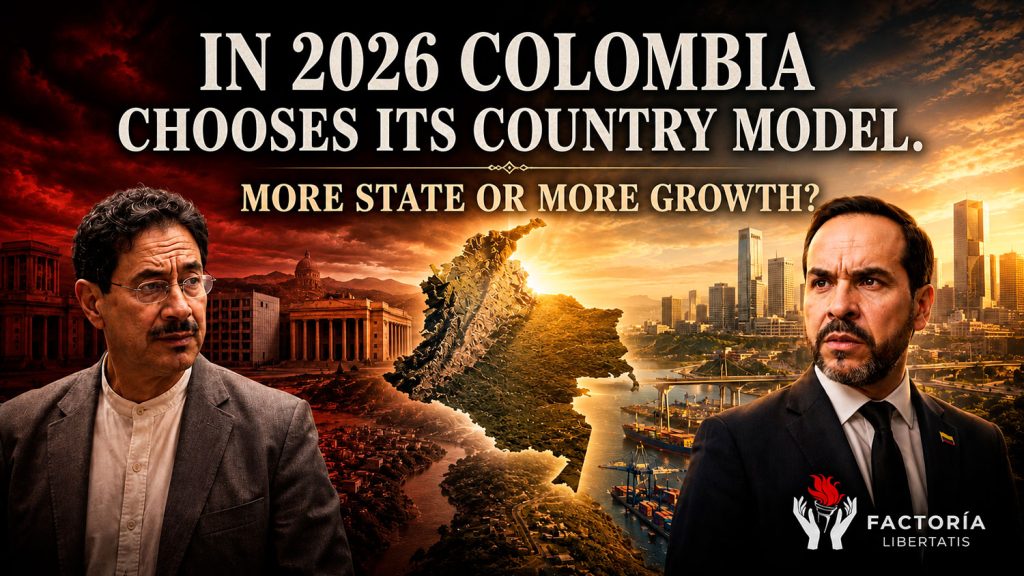
The picture left by the first round of voting on May 31 is clear. Abelardo de la Espriella obtained 43.74 percent of the vote, while Iván Cepeda secured 40.90 percent. A difference of less than three points is not a landslide victory, but it does create a structural advantage that public-choice theory helps explain with precision.
The median voter theorem, developed by Anthony Downs in his analysis of democracy as a political marketplace, states that in a two-candidate election, the winner is the one who captures the voter located at the center of the political spectrum.
That Colombian median voter—the provincial entrepreneur, the middle-class professional, the small business owner who barely survived the past four years—has little rational incentive to bet on the continuation of a model he already knows.
The votes of Paloma Valencia and the traditional right, which together accounted for between six and seven percent of the electorate, are likely to move organically toward De la Espriella. Not because of enthusiastic ideological alignment, but because of the simplest calculation imaginable: fear of reliving what they have already experienced.
Iván Cepeda’s program is not a hypothesis. It is an experiment that has already been conducted, with names, faces, and measurable results.
Its name is Gustavo Petro in Colombia.
Its name is Andrés Manuel López Obrador and Claudia Sheinbaum in Mexico.
And the data do not allow for a generous interpretation.
Petro came to power promising a “Colombia, a power of life.” Four years later, gross fixed capital formation—the real investment businesses make in factories, equipment, and the future—has collapsed. The creation of new companies has declined steadily, and Colombia’s private sector has spent years under the constant threat of reforms arriving like hailstorms: tax reform, labor reform, pension reform, healthcare reform.
Not all of them passed.
But all of them paralyzed investment.
Because uncertainty does not need to become law in order to destroy investment. It is enough for entrepreneurs not to know what comes next.
They wait.
And that is exactly what happened.
Time was lost.
Opportunity was lost.
The chance to create growth and wealth was lost.
And Cepeda promises more of the same—only without the burden of having already tried. The advantage of the candidate who has not governed yet is that he can sell the same product in new packaging.
In Mexico, Claudia Sheinbaum inherited López Obrador’s Morena political machine and deepened it with technocratic efficiency.
The result is instructive: an economy growing below its historical potential, trapped between the dead weight of an unreformed PEMEX and expanding social spending that no one can convincingly connect to sustainable economic growth.
Cepeda imports that same model into Colombia.
His proposed “just energy transition” is a euphemism for halting hydrocarbon exploration without a realistic alternative to replace it—precisely the fiscal suicide Petro attempted and that financial markets punished through a risk premium Colombia is still paying today.
Cepeda’s three “revolutions”—ethical, socioeconomic, and democratic—share a common architecture worth describing precisely.
They are mechanisms for expanding the state, financed by resources someone else must produce.
Redistributive land reform weakens legal certainty around private property.
A “living wage” and pro-worker labor reforms raise the cost of formal employment to the point where hiring becomes a risk employers prefer not to take.
And universal food subsidies—the free food promised on TikTok—do not solve scarcity.
They administer scarcity politically.
A citizen dependent on a food package distributed by the state is not a free citizen.
He is a captive voter.
That is the difference between social policy and state clientelism.
And that is the difference between De la Espriella and Cepeda.
Colombia is not choosing between two individuals.
It is choosing between repeating an experiment that has already failed or giving an opportunity to ideas that have already succeeded—in Colombia and elsewhere.
Abelardo de la Espriella’s program frustrates those who prefer timid reforms and consensus that changes nothing.
And at this moment in Colombian history, that is precisely its virtue.
He proposes reducing the size of the state by 25 percent, implementing a fiscal adjustment of 70 trillion pesos, and enforcing a rule requiring the elimination of two regulations for every new one enacted.
His critics call him reckless.
But Javier Milei was called reckless in Argentina.
He came to power carrying a chainsaw and, within eighteen months, transformed the region’s most scandalous fiscal deficit into a surplus, reduced inflation from more than 200 percent annually to manageable levels, and demonstrated that the Argentine state was not too large to be cut.
Nayib Bukele was called reckless in El Salvador.
He broke with decades of accommodation toward gangs, militarized security, and delivered the lowest homicide rates in Latin America in generations.
Both demonstrated that when the state stops growing and begins stepping aside, the real economy—the economy of entrepreneurs, formal workers, and people like Hernán Rodríguez who simply wanted to run a tourism agency—finally finds the oxygen it needs.
The most powerful elements of De la Espriella’s program are not the reforms that require legislative battles.
They are the measures he can implement without asking permission from a fragmented Congress.
Suspending the “Total Peace” policy toward organizations that the Colombian state itself classifies as terrorist groups can be done by presidential decree on day one.
Reactivating the bilateral agenda with Washington can begin with a single well-intentioned phone call.
Administrative deregulation that simplifies procedures and removes bureaucratic barriers does not require legislation.
It requires a president who understands that every day it takes to register a business is another day an entrepreneur considers registering it somewhere else.
And a policy shift toward the regime of Delcy Rodríguez—the direct heir of the Chavista apparatus—through diplomatic isolation, recognition of the Venezuelan opposition, and stricter militarization of the border against guerrilla smuggling networks requires no constitutional reform.
It requires something Petro never possessed:
The willingness to call a dictatorship by its name.
From Guatemala, we observe this runoff election with a mixture of analytical interest and personal recognition.
Not because we are identical. Colombia’s economy is four times larger, its institutions are more complex, and its political history is different.
But because we know the dilemma from the inside.
We know the cost of decades of bureaucratic capture, poorly executed public investment, and legal uncertainty that scares away capital and perpetuates poverty.
We also know what is lost when the right decisions are not made in time.
This Sunday, Colombia has an opportunity many countries in the region never had:
To choose before experiencing the crisis, rather than afterward.
The experiment has already been conducted in Venezuela, in Kirchner-era Argentina, and in Nicaragua.
The results are visible.
The question is how much Colombia is willing to pay to prove once again that clientelist government does not work.
Andrés Rodríguez goes out to vote this Sunday.
He does so without the enthusiasm of his eighteen-year-old self, but with something he did not have back then:
Experience.
Four years have taught him what economics textbooks describe in the abstract—that good intentions do not pay payrolls, that legal certainty is not a luxury but the oxygen every business breathes, and that when the state grows without limits, it is always ordinary citizens who end up paying the bill.
His father has an offer on the table from Fort Lauderdale.
That offer expires on Sunday night, when the runoff results transform uncertainty into certainty—one way or the other.
The investor in Florida does not vote.
Andrés does.
And with him, millions of Colombians who, like him, learned the hard way that ideas have consequences.
Ramiro Bolaños, PhD
President, Factoría Libertatis Center for Thought and Action
References
Political Theory and Public Choice
Downs, A. (1957). An Economic Theory of Democracy. Harper & Row.
Buchanan, J. M., & Tullock, G. (1962). The Calculus of Consent: Logical Foundations of Constitutional Democracy. University of Michigan Press.
Economic Indicators for Colombia and Mexico
Confecámaras. (2025). Business Dynamics Report in Colombia. Bogotá, Colombia.
International Monetary Fund. (2026). World Economic Outlook Database, April 2026 Edition. Washington, D.C. Available at: https://www.imf.org [Accessed June 2026].
Banco de la República de Colombia. (2025). Monetary Policy Report, Fourth Quarter 2025. Bogotá, Colombia.
Petróleos Mexicanos (PEMEX). (2025). Annual Financial Report 2025. Mexico City, Mexico.
Government Programs
De la Espriella, A. (2026). Firmes por la Patria: Government Program 2026–2030. Bogotá, Colombia.
Cepeda, I. (2026). The Power of Truth: Government Program 2026–2030. Bogotá, Colombia.
Election Results
National Civil Registry of Colombia. (2026). Official Results of the First Round of the Presidential Election, May 31, 2026. Bogotá, Colombia.
Note
Note: Andrés and Hernán Rodríguez are plausible composite characters constructed from representative testimonies of Colombian entrepreneurs affected during the 2022–2026 period. They do not correspond to identifiable individuals.
This article was originally published on RamiroBolanos.phd and republished by Factoría Libertatis as part of its institutional library of analysis and thought.