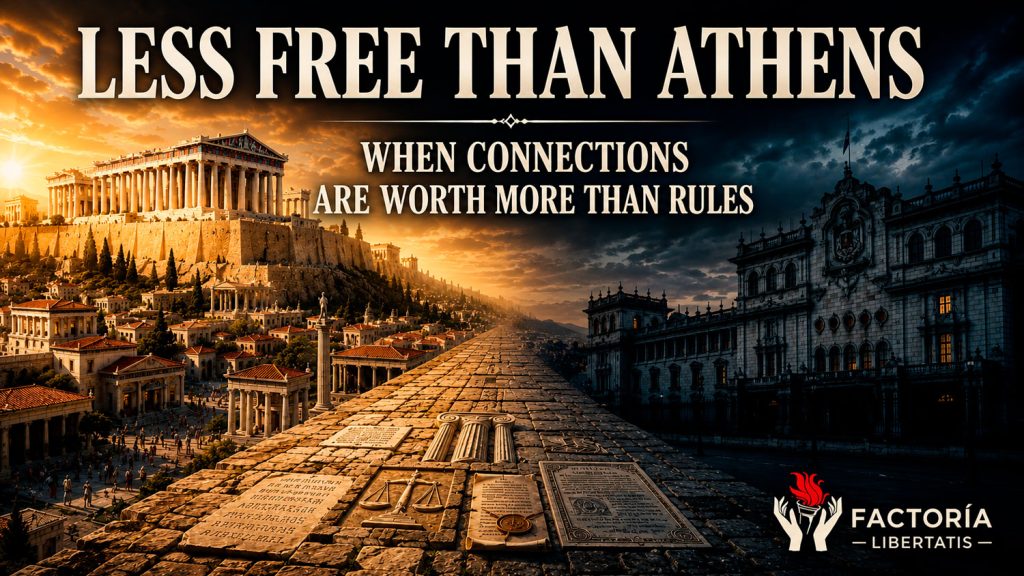
Lisandros was born in Phoenicia but has lived in the port of Athens for twenty years. He rents a workshop where he manufactures amphorae to export olive oil. He hires both free workers and slaves. He asked no one’s permission to open his business. No one demands monthly reports from him. If a trading partner breaks a contract, there is a court that resolves the dispute within weeks — regardless of the fact that he is a foreigner. Lisandros is not an Athenian citizen — and never will be, because he is a metic, a foreign resident — but in fourth-century BC Athens he can buy property, lend money at interest, export to any port in the Mediterranean, and defend his rights before a jury selected by lot. In economic terms, he lives in one of the freest environments in all of history. And this is not a metaphor.
In 2011, economists Andreas Bergh and Carl Hampus Lyttkens of Lund University in Sweden published a study that still challenges many conventional ideas about economic freedom. They took the Fraser Institute’s Economic Freedom Index — the same one that today ranks more than 160 countries — and applied it, component by component, to classical Athens in the fourth century BC. After reviewing historical sources, comparing institutions, and calibrating each variable against modern reference countries, they reached a surprising conclusion: Athens would have scored 8.9 out of 10. In the year used for comparison, Singapore registered 8.75 and Hong Kong 9.02. Classical Athens would have fallen between the two — above nearly every contemporary country.
The authors themselves acknowledge the limits of the exercise. That score applies primarily to male citizens. Slaves, who outnumbered free men, had no civil rights. Women were excluded from public life. If the entire population were factored in, the rating would drop significantly. Here lies one of the study’s most interesting lessons. Athens scored 10.0 on government size. It reached 9.6 on monetary stability and freedom of trade, and 9.1 on regulation of credit, labor, and business. Its worst result was the legal system and property rights, where it scored only 6.0 points — due to slavery and the legal exclusion of much of the population. The lesson is straightforward: markets flourish when there are predictable rules, open trade, and limited government. But even an extraordinarily free society for its time runs into limits when the rule of law does not reach everyone.
Guatemala is not an Athens without democracy. It is a Rome without an Empire. The 2026 Heritage Economic Freedom Index assigns Guatemala 63.5 points out of 100, placing it as a moderately free economy and 72nd among 176 countries. The Fraser Institute, using a different methodology, gives it 7.59 out of 10, placing it among the relatively freer economies in Latin America. At first glance the results seem encouraging, but a closer look tells a different story. Heritage gives Guatemala 91.3 points on tax burden, 94.3 on government spending, and 95.9 on fiscal health — figures typical of a country with low tax pressure and a relatively small state. On property rights it scores just 39.1. On judicial effectiveness, 26.1. On government integrity, 25.2. Fiscally restrained. Institutionally broken.
But there is more in the detail. By various measures, the size of the Guatemalan state represents around 12% of GDP — one of the lowest percentages in Latin America. That figure helps Guatemala rank reasonably well on several international economic freedom indices. Yet the formal employment numbers tell a different story. Of the 1.8 million formally registered workers in Guatemala, roughly 396,000 work for the public sector — more than any single private sector. More than commerce, manufacturing, or construction, and that is without counting those on temporary contracts. Nearly one in four formally employed workers depends directly on the state.
Meanwhile, the national budget grew from Q87 billion in 2019 to nearly Q164 billion in 2026. In just seven years, the state added more than Q76 billion in annual spending. The question is unavoidable: what transformative, nationwide achievement can be pointed to as the result of such expansion? The Guatemalan state is not small. It is fiscally restrained relative to GDP and politically oversized as a mechanism of dependency, patronage, and clientelism. That is why Guatemala scores well when the state is measured against GDP, but delivers disastrous results when measured against the services it actually provides to Guatemalans.
The resulting profile echoes an Athens where slaves and women were factored into the measurement: relatively strong fiscal indicators and a deeply weak legal system. The difference is that in Athens that exclusion was explicit and had a name. In Guatemala it is implicit, and it goes by the name of impunity.
History offers an even less flattering mirror than Athens. The late Roman Republic, during the second and first centuries BC, possessed some of the most extensive markets in the known world. The denarius circulated from Britain to Egypt. Roman merchants financed operations across the entire Mediterranean. Trade in grain, oil, metals, and other goods generated enormous fortunes. If the Fraser Institute were to rate it, Rome would have scored extraordinarily high on trade openness, monetary stability, and government size. On paper it would have looked like an economic paradise. But it was also the era of Lucius Cornelius Sulla — the general who marched on Rome, declared himself dictator, and published lists of political enemies whose property could be seized and whose lives could be taken with impunity. It was the era when contracts came to depend increasingly on proximity to state power. It was the era when institutions still formally existed but had stopped functioning impartially. Large markets. Broken institutions. A predictable ending.
Rome shows that markets can grow for a time even as the rule of law begins to erode. But it also shows they cannot do so indefinitely. In 27 BC, the institutional exhaustion of the Republic became the argument that justified the end of the Republic and the beginning of the Empire under Augustus. The rule of one all-powerful man. Free markets did not destroy the Republic. They simply could not save it.
The common diagnosis holds that Guatemala’s central problem is the capture of the state by big business. But that explanation does not fit the facts well. The business groups supposedly in control pay specific taxes on cement, alcoholic beverages, and soft drinks, and face regulations that no group with absolute power would ever have accepted. Institutional capture seems to come from elsewhere — from the convergence of organized crime, drug trafficking, clientelist politics, and rent-seeking contracting. That coalition does not live by competing. It lives by extracting resources from the budget, trafficking in influence, smuggling, and legal uncertainty.
That is why the central question should be whether Guatemala will ever have a state capable of enforcing rules in a predictable way. Athens shows that markets can thrive under small governments. Rome shows that they cannot thrive without rules. Guatemala learned the first lesson but forgot the second.
The countries that today top the economic freedom rankings have understood exactly this. Singapore built one of the world’s most rigorous anti-corruption systems. Ireland used European rules as an external credibility mechanism to attract investment. Switzerland developed decentralized institutions that hold everyone accountable to citizens. Even Athens, with all its limitations, used juries selected by lot that made it extraordinarily difficult to buy a verdict. In every case the same constant appears: the rules apply to those in power as well.
For Guatemala, this means three concrete tasks. First, make judicial reform a genuine national priority rather than yet another campaign promise. No country builds sustained prosperity with judicial effectiveness of just 26 points out of 100. Second, leverage external credibility mechanisms — CAFTA, investment agreements, and international arbitration — while national institutions rebuild their capacity and public trust. Third, build an explicit coalition among formal productive sectors, civil society, and international allies to confront the criminal and clientelist capture of the state. Not because businesses are virtuous by nature. But because in a country where rules are enforced, all productive actors have more to gain than to lose.
Lisandros, the Phoenician merchant in the port of Athens, did not need to live in a perfect city. He needed the contract he signed today to hold the same value tomorrow. He needed an institution capable of enforcing someone’s word when they broke it. He needed the rules to be predictable. That certainty was the true foundation of Athenian prosperity.
Guatemala already has many of the conditions that other countries would envy — a strategic location, preferential access to the world’s largest market, and a diaspora connected to the leading international economic centers. What it still lacks is something Athens had discovered two thousand four hundred years ago: that contracts should matter more than connections. That rules should matter more than bribes. And that prosperity begins the day justice stops belonging to anyone.