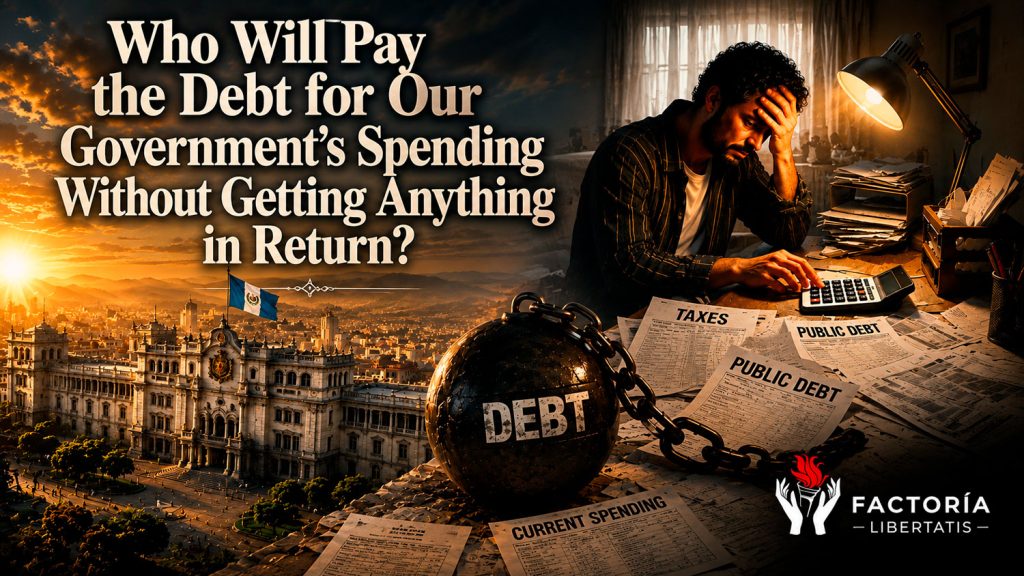
Diego turned eighteen just a few weeks ago. Next year he will vote for the first time and, like thousands of young Guatemalans, he still doesn’t know where he will study, which company will give him his first job, or how much he will earn five years from now. What he hasn’t yet imagined is that a portion of the fruit of that labor already has a destination. The State decided to spend it before he even began to produce it.
A few days ago he asked his father why the national budget was dominating the headlines. His father, an accountant by profession, smiled with a certain resignation before answering: “Because someone will have to pay that bill. And that someone will probably be you.”
The Ministry of Public Finance presented its budget ceilings for fiscal year 2027 in June: Q182 billion. Just eight years ago, the recommended budget stood at Q90 billion. Over that same period, Gross Domestic Product grew from Q594 billion to approximately Q947 billion — a rise of nearly 59 percent. The budget, meanwhile, has nearly doubled. The State grew at almost twice the speed of the economy that finances it.
Yet the size of the budget is not the most worrying figure. What is truly revealing is how it will be financed. The budget projects approximately Q132 billion in tax revenues against Q182 billion in spending. The difference will be covered primarily with new debt. Put in everyday terms: for every Q100 the State expects to collect, it plans to spend approximately Q138. The remainder will be charged to the credit card of future taxpayers — Diego, our children, and our grandchildren.
Diego still doesn’t know where he will study, which company he will work for, or how much he will earn five years from now. But the State has already decided that part of that future will go toward paying for expenditures approved before he even cast his first vote.
Spending priorities also tell a story. Since 2019, the Health budget more than doubled; the Ministry of Social Development multiplied its resources several times over; and Defense increased its allocation significantly. Meanwhile, the Ministry of Communications — responsible for road infrastructure — grew far less, and even so, public investment executed during the first half of 2026 barely reached a fraction of what had been programmed. Guatemala has a State that spends ever more, yet builds relatively little infrastructure.
Public debate tends to focus on a single figure: the deficit as a percentage of GDP. It is a useful measure for comparing countries, but it says little about a State’s real capacity to sustain its spending. In Guatemala, a more revealing metric is to compare the deficit with tax revenues themselves. Under that lens, the projected 2027 deficit is equivalent to approximately 31 percent of all anticipated tax receipts. In other words, nearly one third of what the government plans to spend has not been collected. It will have to be financed with debt.
The need to do so is made even more delicate by the fact that Guatemala’s tax base is extraordinarily narrow. About 80 percent of all revenue comes from just 65 economic activities, and roughly 90 percent originates in a single department of the country. This is not a broad, diversified base; it looks far more like a funnel. It is, largely, the same taxpayers financing an ever-larger State.
The IMF’s historical data series offers unsettling context. Over recent decades, Guatemala has only recorded relative deficits of this magnitude under extraordinary circumstances: Hurricane Mitch, the global financial crisis, and the pandemic. Now the country is projecting three consecutive years — 2025, 2026, and 2027 — with similar levels of indebtedness, without facing a natural disaster, a global financial crisis, or a public health emergency. The exceptional is becoming routine.
Emergencies should produce extraordinary deficits. What is extraordinary is turning those deficits into the new normal. That shift deserves attention, because emergencies, by definition, are temporary. Budgets, on the other hand, create habits. When a State learns to live permanently on debt, borrowing ceases to be an exceptional instrument and becomes a financing model.
There is another signal that rarely enters the debate. Debt service already consumes approximately Q22 billion a year, making it one of the largest items in the national budget — second only to the Ministry of Education. Adam Ferguson warned in the eighteenth century that a society begins to lose its autonomy when the growing weight of its debt displaces the State’s essential functions. It was not merely a financial warning; it was an institutional one.
Three decades ago, the Peace Accords envisioned a State capable of driving development with public spending of roughly 12 percent of GDP, accompanied by annual economic growth of 6 percent. Three decades later, public spending is considerably higher, while average economic growth remains far from that target. The poverty reduction observed during this period is explained far more by family remittances and private-sector dynamism than by any sustained expansion of public investment. In other words, the State has grown faster than the results it promised to deliver.
For Diego, however, the problem is not the debt itself. It is the consequences.
His future can take two paths. Spain illustrates the first: when the State needs more resources, it ends up going after the same taxpayer as always. In some autonomous communities, the top marginal rate on personal income tax approaches 54 percent — more than double what an individual taxpayer in Guatemala pays today under the general regime.
Germany illustrates the second: when a country spends heavily but fails to build sufficient productive capacity, businesses lose competitiveness, stop investing, begin to fail, and cut hiring. In 2025, various measures of German corporate insolvency pointed to tens of thousands of companies in distress and between 170,000 and 285,000 jobs affected by bankruptcies. These are not ideological ghosts; they are visible warnings.
Diego’s future can close in on him from both sides: as an entrepreneur, facing a State that demands ever more from him; as a worker, in an economy that creates ever fewer opportunities.
That evening, Diego’s father finished his explanation. He told him that families can use a credit card to face an unexpected emergency — an illness, an accident, a temporary loss of income. What no family can do indefinitely is turn that card into its primary source of income. Sooner or later, the statement arrives.
Diego has not yet dropped his first ballot into a box. He has not yet decided whether he will one day start a business or look for a job at a company. But the budget has already begun to shape both decisions. If tomorrow the State needs more resources, he could end up paying far higher taxes. If, instead, the economy loses competitiveness and stops attracting investment, he may find that the job he expected simply never came to exist.
Public debts have a peculiarity that sets them apart from political promises. Governments announce them. Congresses approve them. But those who ultimately pay them are usually people who had not yet voted when they were incurred.
Emergencies produce extraordinary deficits. What is extraordinary is converting those deficits into the new normal. Because when a country begins to spend in ordinary times as though it were permanently living through an emergency, it is not only mortgaging its public finances. It is mortgaging the opportunities of those who have not yet even begun to build their future.
It is the future of the next generation.
Ramiro Bolaños, PhD. / President of the Center for Thought and Action Factoría Libertatis
References
- Banco de Guatemala, Producto Interno Bruto medido por el Origen de la Producción, historical series 2001–2025 (Guatemala: Banguat, 2026).
- Ferguson, Adam, An Essay on the History of Civil Society (Edinburgh: A. Millar & T. Caddell, 1767).
- International Monetary Fund, Public Finances in Modern History (Washington D.C.: IMF, February 2025). Ministry of Public Finance of Guatemala, General Budget of State Revenues and Expenditures for Fiscal Year 2026: Global Tables (Guatemala: Minfín, 2025).
- Ministry of Public Finance of Guatemala, Draft General Budget of State Revenues and Expenditures for Fiscal Year 2019 and Multi-Year Budget 2019–2023 (Guatemala: Minfín, 2018).
- Ministry of Public Finance of Guatemala, Budget Ceilings for Fiscal Year 2027 (Guatemala: Minfín, June 2026).
- Reinhart, Carmen M., and Kenneth S. Rogoff, “This Time Is Different: A Panoramic View of Eight Centuries of Financial Crises,” National Bureau of Economic Research Working Paper 13882 (Cambridge MA: NBER, 2008).