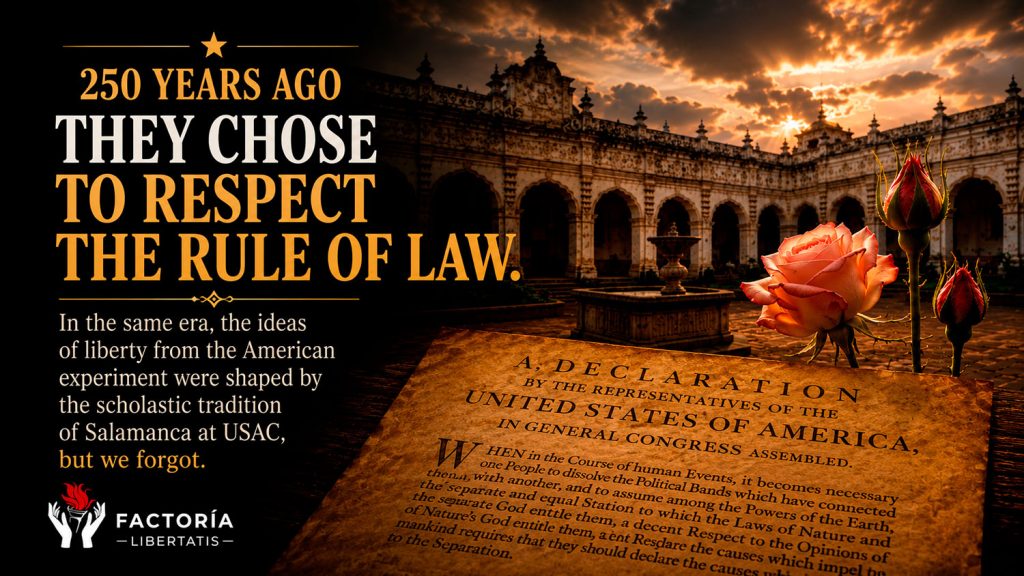
It is the night of July 4, 1776. In a printing shop on Market Street in Philadelphia, a young apprentice sets type letter by letter for a document that has just arrived from the Continental Congress. His employer, John Dunlap, has asked him to work through the night: the text must be printed before sunrise. The boy’s hands are stained with ink and he does not yet know it, but he is producing the first copies of the Declaration of Independence of what would become the Republic of the United States of America. Four days later he will hear it read aloud in front of the State House, to the sound of bells and cannon fire.
It is the morning of July 4, 2026. In Guatemala City, a twenty-three-year-old fills out an online form and schedules an appointment at the United States Embassy. He has a university degree, functional English, and a suitcase that, in his mind, is already packed.
Two and a half centuries separate both scenes. The question that connects them, however, is the same: why do millions of people still want to live under the rules that fifty-six men signed exactly two hundred and fifty years ago?
The usual answer confuses the event with the revolution. The event was independence from Great Britain, and in that respect the United States was not exceptional: dozens of nations have broken free from their colonial powers, ours included. The true revolution was something else, and almost no country had attempted it before: to build a government strong enough to protect liberty and, at the same time, limited enough not to destroy it.
No great idea emerges from nothing. The institutional architecture that gave birth to the United States did not arise from improvisation, nor did it begin in English. Behind it lay an intellectual genealogy that crossed centuries, faiths, and languages. Two centuries before the Declaration, in the lecture halls of the University of Salamanca, Francisco de Vitoria argued that the indigenous peoples of America held rights prior to any papal bull and to any crown; Martín de Azpilcueta observed that the value of currency is not decreed by the king but determined by abundance or scarcity; and Luis de Molina concluded that a just price is not a property of things but an agreement between free persons that no monarch can dictate, any more than he can dictate the weather. Hugo Grotius, a Dutch Protestant jurist, took those Catholic arguments and turned them into a rational science of law. John Locke inherited them and added the decisive piece: government is a trustee that administers a power lent to it by the governed, and when it betrays that trust, the governed retain the right to revoke it. The Scottish Enlightenment completed the edifice: Francis Hutcheson taught that liberty exists for the flourishing of the individual; David Hume, that institutions are worth judging by the results they produce; and Adam Smith published, just four months before the Declaration, An Inquiry into the Nature and Causes of the Wealth of Nations(1776), in which he demonstrated that prosperity is not manufactured by governments — it emerges from free exchange among people pursuing their own projects.
All of this crossed the Atlantic along perfectly traceable paths. Thomas Jefferson borrowed from Locke almost word for word: the phrase “a long train of abuses” that appears in the Declaration is taken directly from the Second Treatise of Government (1690). John Witherspoon, a Scottish Presbyterian who served as president of Princeton, signed the Declaration and was the direct teacher of James Madison. And Madison, the silent architect, turned that genealogy into architecture. If men were angels, he wrote in The Federalist, no government would be necessary; since they are not, ambition must be made to counteract ambition. Checks and balances, periodic elections, independent judges, a free press, protection of property. It was an intellectual genealogy two centuries in the making, translated for the first time at continental scale into institutions.
Two and a half centuries later, the experiment invites every criticism except one: irrelevance. Four out of every hundred people on the planet live in the United States. Yet they produce roughly a quarter of the entire world economy. The dollar still accounts for more than half of the international reserves held by central banks. Its universities occupy the majority of top positions in global rankings; its capital markets are the deepest in the world; no economy invests more in private research; and no country receives more immigrants — over fifty million people born elsewhere have chosen to live under its rules. The founders themselves knew the United States would not be perfect: that is precisely why they designed a system built for imperfect men. The real question is a different one: what did they do that so many other countries have not?
The greatest export of the United States was never Hollywood, Apple, the dollar, or Silicon Valley. It was an idea: that power must obey rules. But that intellectual genealogy did not begin in English — it began in Spanish. The ideas that ended up founding the most prosperous republic on the planet passed through our own world — the same scholastic tradition of Salamanca reached the lecture halls of San Carlos — and flourished somewhere else. We are not strangers to the tradition of liberty. We abandoned it.
That night, John Dunlap’s apprentice did not print wealth. He printed the rules that would eventually make it possible. Because what truly came off that press was not prosperity — it was predictability. The factories, the capital, and the talent came later, drawn by something far more abstract: the certainty that a contract will be honored even if the other party has powerful friends; that a judge rules according to the law and not according to a phone call; that the public budget is accountable to the taxpayer and not the other way around; that the rules of today will still be in force tomorrow.
The young Guatemalan at the embassy is not fleeing volcanoes or the climate. Nor, at bottom, is he fleeing poverty: he is fleeing the lack of opportunity and the unpredictability that produces it. What he is going to find in the United States is exactly what that printer heard in front of the State House: the promise that the rules apply equally to the person who arrives with two suitcases and the person who holds office in a ministry.
Since 1787, the United States has lived under a single constitution, amended just twenty-seven times in more than two centuries. Guatemala, by contrast, has enacted multiple constitutions since independence; the current one, adopted in 1985, is only the most recent in a long series. A country that rewrites its fundamental rules every few years is sending a message to every investor, every entrepreneur, and every young person deciding where to build their life: here, the rules last less time than the people who administer them. And capital, like talent, learns quickly to read those messages.
None of this is guaranteed forever. Americans themselves are engaged today in intense debate about the health of their institutions, and that debate, far from refuting the argument, confirms it: republics are not inherited the way a house is inherited. They are maintained the way a bridge is maintained — inspecting every beam, every day, for two hundred and fifty years.
Two hundred and fifty years ago, fifty-six men signed a declaration. What was truly extraordinary was not the signing. It was that they — and nearly all those who governed afterward — accepted to live bound by it. Nations do not prosper because they find extraordinary leaders; they prosper when they build institutions capable of constraining even ordinary ones. Perhaps the greatest wealth of the United States has been its understanding, earlier than almost anyone, that liberty needs more than fine speeches: it needs a republic where the rules matter more than those who administer them.
The day Guatemala builds that republic, some young person will still be filling out a form on a July morning. But it will no longer be to ask permission to live under someone else’s rules. It will be to register their first business under the rules of Guatemala.
Ramiro Bolaños, PhD. / President of the Center for Thought and Action Factoría Libertatis
References
- International Monetary Fund, “Currency Composition of Official Foreign Exchange Reserves (COFER)” (Washington D.C.: IMF, 2026).
- International Monetary Fund, “World Economic Outlook Database” (Washington D.C.: IMF, April 2026).
- Grice-Hutchinson, Marjorie, The School of Salamanca: Readings in Spanish Monetary Theory, 1544–1605 (Oxford: Clarendon Press, 1952).
- Grotius, Hugo, De jure belli ac pacis libri tres (Paris: Buon, 1625).
- Hamilton, Alexander, James Madison, and John Jay, The Federalist (New York: J. and A. McLean, 1788).
- Locke, John, Two Treatises of Government (London: Awnsham Churchill, 1689).
- United Nations, Department of Economic and Social Affairs, International Migrant Stock (New York: UN DESA, 2024).
- Smith, Adam, An Inquiry into the Nature and Causes of the Wealth of Nations (London: W. Strahan and T. Cadell, 1776).