In 1879, on the Argentine plains, an old gaucho is reunited with his sons after years of frontier life, desert, and loss. He has no land to leave them, no cattle, no home. Martín Fierro, the character created by José Hernández, has been a forced soldier, a deserter, an outlaw, and a fugitive. He has lost everything, including his respectability. And yet, in The Return of Martín Fierro (1879), when he gathers his sons and the son of his friend Cruz, he leaves them the only inheritance he still possesses: some words of advice. Among them, one that ought to be engraved above the door of every school and every public office in Guatemala: “for it is no shame to be poor / and it is a shame to be a thief.” The verse carries weight precisely because of who speaks it. Not a drawing-room moralist or a model civil servant, but a fallen man teaching his own not to fall. Hernández understood something we have forgotten: virtue is not preached from perfection; it is passed on from the experience of one who knows the price of losing it.
Fierro was not alone. Seven years later, Edmondo de Amicis published in Italy Heart (1886), the school diary of a boy from Turin that shaped entire generations in Italy, Spain, and Latin America. In one of its most memorable pages, the little bricklayer’s son — Antonio Rabucco, an apprentice alongside his mason father — visits Enrico’s home and inadvertently leaves a smear of plaster on the back of the sofa. When Enrico moves to wipe it off, his father stops his hand, and that evening writes to him: it is dust, it is lime, it is paint, call it what you will, but it is not dirt; work does not make a man dirty; never say of a laborer leaving his job that he “goes home filthy” — say he “carries on his clothes the marks, the traces of his work.” And the father, so as not to embarrass the boy, quietly cleaned the stain himself afterward, when no one was watching. The lesson is twofold. The laborer’s son is taught the dignity of his trade; the well-off son is taught to honor it. Two poor countries at the same historical moment — rural Argentina and newly unified Italy — made the same deliberate choice: to teach their children what should make them ashamed and what should make them proud. Shame for theft. Pride for work.
This was not innocent literature. It was a national character-building project, constructed through public schools, reading primers, and memorized verse. Japan did it with method: the Imperial Rescript on Education of 1890 was committed to memory in every classroom, and when the Belgian jurist Laveleye asked Nitobe Inazō how a country without religion in its schools taught morality, the answer took him an entire book: Bushido (1900), the code in which shame weighed more heavily than punishment. Each people formulated the same moral code in its own way. For the Argentine, it was shameful to be a thief and a layabout; for the Italian, to look down on the dust of the man who works; for the Spaniard, to break a pledged word — the honor of Calderón de la Barca, which the nineteenth century rescued from the Golden Age and returned to the classroom: his bicentenary, in 1881, was a national celebration; for the Japanese, to fail in one’s duty, a dishonor more feared than death. Different languages, identical moral grammar.
And it had measurable consequences. The generations shaped by that pedagogy absorbed two world wars and their catastrophes: hyperinflations, military occupations, and cities reduced to rubble. From those men and women came the miracles that followed: the Italy that multiplied its industrial output; the Japan that rose from ruin to the front rank of nations; and the Spain of the 1960s, which grew at nearly seven percent a year for more than a decade — second only to Japan — an agrarian country turned industrial by the generation educated in that ethic of duty. Economists explain those miracles with stabilization plans and monetary reforms, and they are partly right. But no Marshall Plan works on a population that regards theft as cleverness and honest work as naivety. Physical capital can be imported; character cannot. It must be said plainly: nearly all of these countries later fell into the totalitarian temptation — Italian fascism, Japanese militarism, the Spanish and Argentine dictatorships — when the State seized control of character formation and put it in the service of the cult of power. The lesson is not to abandon moral pedagogy for fear of its abuse, but to draw the line: there is a difference between teaching a child to be ashamed of stealing and teaching a child to be ashamed of thinking differently. The first produces citizens; the second produces subjects.
The wealth of a nation is measured first by what its children learn to find shameful.
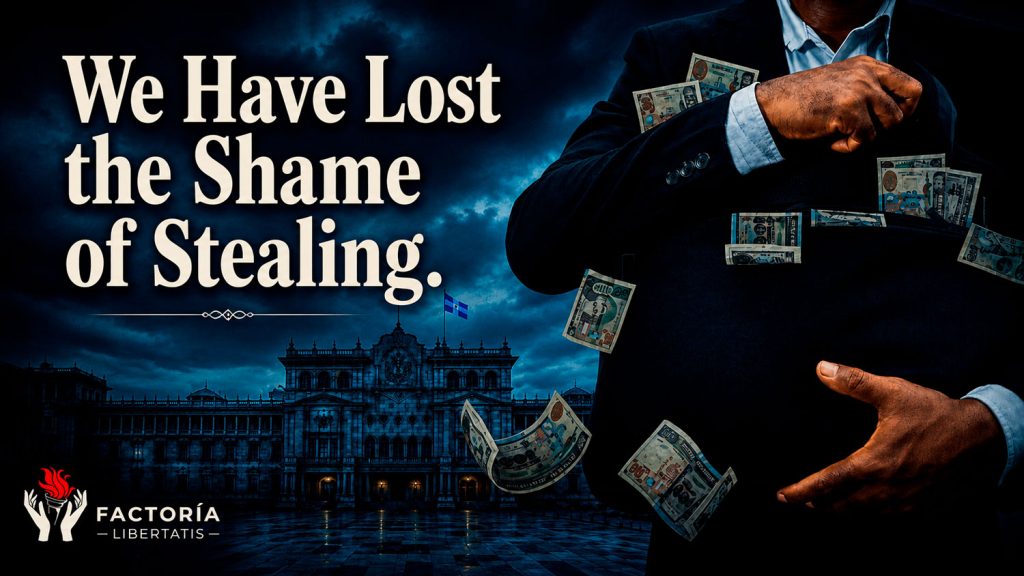
Guatemala has inverted the equation. Here, the person who steals and goes unpunished displays intelligence; the person who works honestly for an entire lifetime and dies without a fortune seems to have wasted the opportunity. The contractor who inflates the budget, the official who pockets his percentage, the judge who sells his ruling — none of them carries any social shame. They carry privileges. Our children grow up watching the shortcut work and the pledged word treated as a rhetorical ornament. And the problem is not a shortage of laws — there is no shortage of those. The problem is that law only functions when it rests on a conviction that precedes the criminal code: that there are things a reasonable person simply does not do, even when he can do them with impunity. Pedro Calderón de la Barca put it with a precision no legislator has surpassed, in The Mayor of Zalamea (1651): “To the King one owes / one’s estate and one’s life; / but honor is the patrimony of the soul, / and the soul belongs to God alone.” To power one may owe one’s estate and even one’s life; but honor — dignity, if the modern term is preferred — is the one thing no one can take from us, except ourselves. A society in which no one feels they lose anything by stealing is a society that has already been plundered from within, long before the first quetzal disappears from the budget.
The predictable objection is that morality cannot be legislated. That is true, and no one is proposing it. What can be decided — and what was decided in 1879 and 1886 — is what children read, which stories are discussed in the classroom, and which models of life are held up as admirable. Guatemala spends more than 25 billion quetzals a year on education and devotes virtually nothing to the deliberate formation of character. The civics that survives in the curriculum amounts to memorizing national symbols, not discussing moral dilemmas. The proposal is concrete: restore moral literature to the center of the school. Not sermons, but stories — Fierro, the little bricklayer’s son, Pedro Crespo — read and discussed in the Socratic manner, where the child does not recite the correct answer but discovers, through argument, why the shame of stealing is the invisible foundation of all prosperity. Here, too, lies the boundary that protects us from repeating the error of the twentieth century: a memorized creed indoctrinates; open discussion forms judgment. It teaches two things at once — what is right, and the independence to defend it. It is the cheapest education reform available: the texts are in the public domain and the method has worked for centuries. The only thing it requires is the decision to take seriously the fact that a republic is not sustained by clever citizens, but by citizens who can tell the difference between being clever and being honest.
Fierro closes his counsel knowing he will not live to see the fruit of it. He speaks as countries speak when they have lost almost everything and can only leave words as a legacy. Guatemala has also lost much — decades, generations, opportunities — and has, like the old gaucho, the obligation to counsel its children. The question is what we are counseling them with our silences, our complicit laughter, and our own examples. A country begins to rebuild itself on the day its children once again know, without anyone having to remind them, that it is no shame to be poor and it is a shame to be a thief.
Ramiro Bolaños, PhD. / President of the Center for Thought and Action Factoría Libertatis
In response to my friend Sebastián Palou, who reminded me that it was a gaucho who spoke of the shame of stealing.
References
- Amicis, Edmondo de, Cuore: Libro per i ragazzi, 98th ed. (Milan: Fratelli Treves, 1889).
- Bolt, Jutta, and Jan Luiten van Zanden, Maddison Project Database 2023 (Groningen: University of Groningen, 2024).
- Calderón de la Barca, Pedro, El alcalde de Zalamea, ed. Ida Farnell (Manchester: Manchester University Press, 1921), p. 37.
- Hernández, José, Martín Fierro: Poema argentino (Madrid: Calpe, 1924), p. 285.
- Ministry of Public Finance, Draft General Budget of State Revenues and Expenditures, Fiscal Year 2026, Global Tables(Guatemala: MINFIN, 2025).
- Nitobe, Inazō, Bushido: The Soul of Japan, 13th rev. ed. (Tokyo: Teibi Publishing Company, 1908), pp. v–vi.
This article was originally published on RamiroBolanos.phd and republished by Factoría Libertatis as part of its institutional library of analysis and thought.