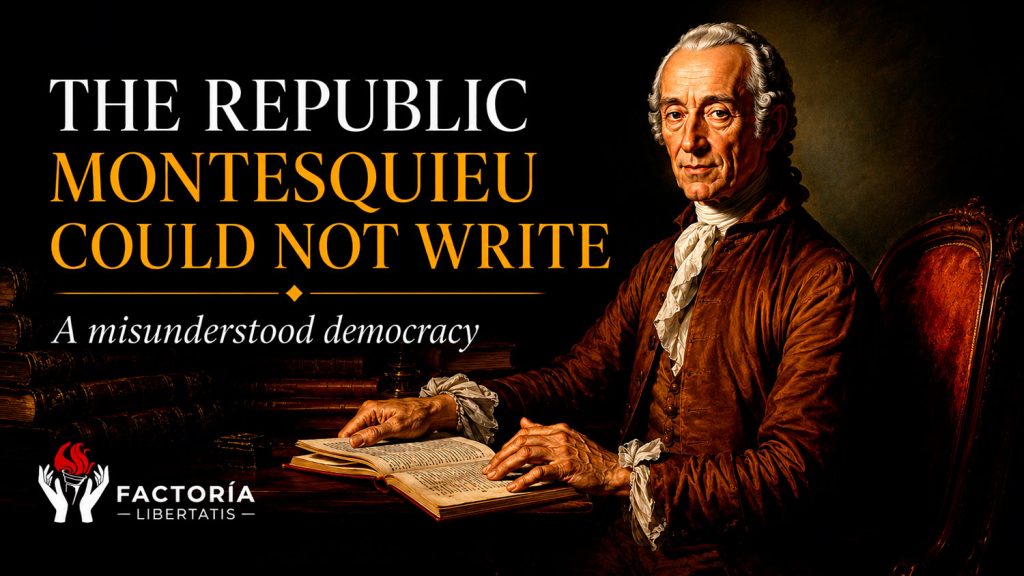
In the autumn of 1748, a book with no author’s name left the presses of Geneva. Its creator had spent twenty years writing it and did not dare sign it. The magistrate of Bordeaux, Charles-Louis de Secondat, Baron de Montesquieu, already knew what imprudence cost: his Persian Letters (1721) had also been published anonymously, printed outside France in the Amsterdam of the Republic of the United Provinces. With The Spirit of the Laws (1748), caution was not enough: the Sorbonne in Paris examined the work, and the Catholic Church placed it on the Index of Forbidden Books in 1751. The man who theorized political liberty had spent twenty years on his book and still was not free to put his name on the cover. Whoever cannot sign a book is much less free to write in it what he truly thinks about the power of his king. Louis XV ruled: the absolutism inherited from Louis XIV, the Sun King, censorship or the Bastille for the imprudent — the same dungeons that, four decades after that book, would burn in the French Revolution of 1789.
The republican tradition Montesquieu inherited came from Aristotle and Polybius: mixed government. In the Roman Republic, functions were not separated; real social forces were balanced. The consuls, the Senate, and the tribunes of the plebs did not represent functions of the State, but social forces: monarchy, aristocracy, and the people. Each had its own teeth, each capable of harming the others if the pact was broken. Montesquieu, who in that France could not propose living counterweights against an absolute king, translated that balance of powers into an organizational chart of functions: legislating, executing, judging. Even his declared model contradicts his proposal: Montesquieu admired England, whose real system — the Crown representing Monarchy, the Lords representing Aristocracy, the Commons representing the people — was classic mixed government, estates with their own interests, not boxes within a diagram of State functions. Functions organize power, but unlike forces, they do not defend themselves.
Spanish America bought the mutilated version, and bought it twice. They Frenchified our name — “Latin America” was the concept embraced by Napoleon III’s pan-Latinism to justify French tutelage over Spanish America against the Anglo-Saxon world after independence from Spain. Maximilian’s Empire in Mexico was its first political expression. French troops withdrew in 1867, but the idea remained, and they Frenchified our constitution too. The results speak for themselves. According to the study by Ginsburg, Melton, and Elkins on the endurance of constitutions, the average lifespan of a constitution worldwide is barely 19 years; France has gone through a decade and a half since 1789: among five republics, two empires, and several constitutional monarchies, perhaps heading toward a sixth republic. On the other side, a single U.S. constitution in over two centuries, with only 27 amendments, and English continuity without a written constitution since 1689. Guatemala has gone through seven: 1825, 1851, 1879, 1945, 1956, 1965, and 1985 — not counting those of Bayonne and Cádiz, nor those of the Central American Federation. The study tells us that constitutions that endure are those that include a broad range of social actors with their own interest in defending the pact. Paper travels easily; what does not travel is the society that sustains it.
A constitution lasts as long as the forces willing to defend it.
The founding fathers of the United States understood this better than anyone, and left it written in The Federalist: the series of newspaper articles that Alexander Hamilton, James Madison, and John Jay published in 1787 and 1788 to defend the new Constitution. Their critics accused the project of violating Montesquieu’s sacred maxim, because it mixed powers instead of separating them completely. Madison responded in three moves. In Federalist 47, he invokes the Frenchman’s authority and explains that what is forbidden is that all the power of one department fall into the same hands that already concentrate all the power of another. In 48, he explains that written limits do not stop power, because paper does not defend itself. And Federalist 51 resolves to give those who administer each power the constitutional means and personal motives to resist the encroachments of the others; in his words: “to make ambition counteract ambition.” That is: the boxes of the org chart are not enough — each box must be inhabited by real interests eager to be defended. More than following MontesquiAlexander Hamiltoneu, they returned to Polybius. That is why their work endured. But longevity does not mean immunity. The balance began eroding since Andrew Jackson in 1829 and kept weakening through executive decrees, undeclared wars, and a Congress increasingly unwilling to defend its own prerogatives. Or as happens in Guatemala, when the Executive and the Legislature strike deals in the dark to approve the largest budget in history.
The comparative picture confirms the pattern. According to Freedom House 2025 data, the eighteen Spanish American presidential systems average 64 points of political freedom out of 100; Western Europe’s parliamentary democracies, 95; parliamentary monarchies — the mixed government that survived — 96. Guatemala: 48, “partly free.” And the exceptions that prove the rule: Uruguay (96), Chile (95), and Costa Rica (91) are presidential systems and score above France (89) — precisely the three countries in the region with real parties, press, and social counterweights. What saves or condemns is the social force that inhabits the State, or the vacuum that surrenders it.
Guatemala has known that vacuum from very early on. In the years of Mariano Gálvez — who pushed them from his arrival in government in 1831 — we imported the Livingston Codes, implemented in 1836: juries, modern criminal justice, and other reforms ahead of their time. But no one had built, and probably has still not built, the social forces capable of sustaining such reforms. And here is the irony that the history we know keeps silent: it was Rafael Carrera — the caudillo whom liberal historiography paints as a barbaric, illiterate conservative — who founded the Republic in 1847, reunified the country, and defended it from its invaders. Today we repeat the pattern with more decorum: three textbook branches of power, courts hobbled or steered, a unicameral congress — and no organized social force defending each institution as its own. After elections, citizens hand over power, and social checks practically disappear. When counterweights fail, whoever captures an appointment captures the whole institution. Our institutions do not fail despite the design; they fail, in part, from reading Montesquieu without asking what censorship kept him from saying. Democracy has stayed at the level of how representatives are chosen; it has not reached the way power is exercised.
The solution, then, is not another paper transplant. It is the question the classical tradition forces us to ask, and which a future constitutional reform should answer: what real social forces — estates, universities, guilds, territories — can inhabit and defend each institution as their own? The alternatives Guatemala does not seriously discuss already exist: a second chamber with roots different from those of the executive in power. Candidacies that depend neither on payment nor obedience to a party, because today parties end up representing mostly themselves. Districts where the representative has a name, a face, and neighbors who demand accountability, honor, and performance. Some propose limiting the vote according to knowledge — epistocracy. I prefer the classical answer: the problem is not that there are too many voters, but that there are too few counterweights. We will discuss that senate and its limits soon in this column.
At the end of his life, blind and dictating to secretaries, Montesquieu burned much of his papers at his castle of La Brède. We will never know what was in them. We know what remained: an unsigned book that half the world copied without asking what was missing. The giant wrote what censorship allowed him. We, who can sign what we think, have no such excuse: it falls to us to write the pages he burned — the ones that remember that liberty does not live in the boxes of a diagram, but in peoples organized to defend it.
Ramiro Bolaños, PhD. / President of the Centro de Pensamiento y Acción Factoría Libertatis
References
- Betten, Francis S., The Roman Index of Forbidden Books, 2nd ed. (St. Louis: B. Herder, 1909), p. 65.
- Freedom House, Freedom in the World 2025 (Washington: Freedom House, 2025).
- Ginsburg, Tom, James Melton, and Zachary Elkins, The Endurance of National Constitutions, John M. Olin Law & Economics Working Paper No. 511 (Chicago: University of Chicago Law School, 2010).
- Hamilton, Alexander, James Madison, and John Jay, The Federalist (New York: J. and A. McLean, 1788).
- Montesquieu, Charles-Louis de Secondat, Baron de, De l’esprit des lois (Geneva: Barrillot & Fils, 1748).