February 2023, a television studio in Buenos Aires. Javier Milei, then a presidential candidate, holds up a book in front of the camera and waves it. He repeats the gesture on another show, and another, and hands out copies to the journalists interviewing him. The book is called La inflación como delito (“Inflation as a Crime,” 2022), and it proposes something that at the time sounded like a professor’s exaggeration: that issuing money without backing should send the official who orders it to prison. Three years later, that idea is a bill in the Argentine Congress.
The author is named Ricardo Manuel Rojas, and he is no armchair theorist. He was a criminal judge in Buenos Aires for more than forty years, served as a clerk at the Supreme Court, and left the bench in 2020. He then came to Guatemala. Today he teaches at the Universidad Francisco Marroquín, in zone 10, less than four kilometers as the crow flies from the building where every September we debate our budget.
In February 2024, an Argentine journalist asked him the question that separates theory from practice: how do you write into a penal code that an official committed a crime by signing an economic decision? Rojas answered with an example, and the example wasn’t Germany or Switzerland. It was Guatemala. He said the constitution of the country where he lives forbids the central bank from financing the government’s spending, that it can’t even lend it money, and he attributed three decades of monetary stability to that lock. That sentence was spoken by an Argentine. His country closed 2023 with prices rising close to 300% a year, and inflation dominated its presidential election.
He is right about the essentials. Article 133 of our Constitution establishes that the Monetary Board cannot authorize the Bank of Guatemala to finance the State, either directly or indirectly, nor to give it a guarantee or backing. And it closes the back door too: it also cannot buy bonds from the State when the State issues them. The only exception is for catastrophes or public disasters, and it requires two-thirds of the total members of Congress.
Where that lock came from is the part almost no one remembers. In May 1993, Jorge Serrano dissolved Congress and the Constitutional Court, and the country removed him from power in eight days. Ramiro de León Carpio took the presidency with the task of rebuilding what remained and pushed through a package of constitutional reforms: Legislative Agreement 18-93. There were thirty-seven changes, and Guatemalans ratified them in a popular referendum in January 1994. Among them was the reform to Article 133. The best economic arrangement in our recent history was born of a failed coup.
Did it work? The numbers from the Bank of Guatemala show a change that’s hard to ignore. Between 1985 and 1996, inflation averaged 18.16% a year, and ten of those twelve years closed in double digits. In 1990, the last full year of Vinicio Cerezo’s government, prices rose 59.81%. Since 1997, the annual average has been 5.27%, and in 29 years no December has closed in double digits. The worst was 2008, at 9.40%.
Let’s take that to the market, where it’s easier to grasp. Today a dozen large white eggs costs around Q30 at La Terminal. If we reconstruct that price backward using the country’s general inflation, in 1985 it would have been about Q1. By 1996 it would already have reached Q6.90. In those twelve years, the price level multiplied almost sevenfold. In the 29 years that followed, with the lock in place, it multiplied by four. The accumulated inflation of those twelve years was greater than that of the nearly three decades that came after.
Locking the door on the money-printing machine doesn’t end the deficit: it forces it to be financed by borrowing instead.
On September 2, the 2027 budget bill entered Congress. It requests Q192,045.1 million, 13.8% more than the current one and the highest amount in our history: more than a sixth of everything the country produces in a year. The taxes the State expects to collect next year total Q131,635.9 million. The projected deficit is Q48,300 million, 4.4% of GDP — almost three times what the Ministry of Health receives. Put the way you’d do the math at home: for every Q100 it expects to collect in taxes, it has to finance Q37 in deficit.
That deficit doesn’t come from a printing press, because since 1993 that door has been locked. Part of it is financed through Treasury bonds, and the bill requests authorization to issue Q42,750 million: about Q117 million in new debt for every day of the year. A bond isn’t new money: it’s a promise to pay that will be honored by the taxpayers of years to come, with interest. There’s no inflation, but there is a bill that keeps growing.
Someone will ask the obvious question: if the hole is that size, why isn’t it felt? There are at least two reasons, and neither is a credit to fiscal policy. The first is remittances: the amount of dollars entering the country helps sustain the quetzal’s stability. The second is harder to swallow. The government doesn’t spend the money it borrows.
In July 2025, the Treasury’s Single Account held a balance of Q31,837.3 million, compared to Q12,044.2 million at the close of 2024. That’s the highest balance recorded between 2010 and 2025. It amounts to nearly two-thirds of the deficit now proposed for 2027. While the State accumulates liquidity it doesn’t spend, it keeps issuing debt and paying interest. The money sits dormant in a bank account; the interest doesn’t.
The departmental development councils are the best portrait of the same problem. This year they have Q15,425.4 million available. As of July 1, 2026, they had executed Q2,338.8 million: 15.16%. Twenty-two councils held more than Q15 billion in their hands and, halfway through the year, had spent barely 15 cents of every quetzal.
The only thing that moves forward punctually is debt payment. The approved 2026 budget allocates Q21,368.7 million to debt service. That’s more than the Ministry of Health receives, at Q16,537.7 million, and more than the Interior and Defense ministries combined, at Q14,281.3 million. The 2027 bill raises that figure to Q24,601 million. We pay more to owe than to heal and to protect.
And here is where the Argentine bill gives us back something that was already ours. The prohibition on the central bank financing the Treasury, included in the bill Milei sent to Congress on July 30, is, in essence, our Article 133 written thirty-three years later. We already have that. What we lack is what they wrote to go along with it.
The National Commitment Law for Fiscal and Monetary Stability does two things. The first is to write the limit into law. Its Article 1 requires the budget to be projected with a balanced or surplus financial result and prohibits passing a budget law with a deficit. In plain terms: the State cannot authorize itself to spend more than it expects to take in.
The second is to attach a consequence to that limit. Article 11 adds a new article to the Penal Code, Article 248 ter: one to six years in prison, plus disqualification from office for double the length of the sentence, for the official who approves, authorizes, or executes rules that increase spending without securing the resources to finance it. And it adds a second crime: up to ten years for the central bank official who orders money issued in violation of the bank’s own charter. The penalties double if the official sought to enrich himself or a third party. Without a limit written into law there’s no way to identify who violated it, and without that there’s no crime to prosecute.
Someone will say that imposing fiscal discipline by law is an idea for radical libertarians. Let’s look at Sweden, then. In 1997 its parliament set itself the goal of saving the equivalent of 2% of national output every year. In 2019 it lowered that target to 0.33%. And starting in 2027, the target will simply be that the budget close without a deficit. Six of the Riksdag’s eight parties agreed to this, Social Democrats included.
Our proposal fits into two ordinary laws and doesn’t touch a comma of the Constitution. First: reform the Organic Budget Law so that no budget can be approved spending more than it expects to receive, with no averages and no exceptions for the economic cycle. Second: criminalize, in the Penal Code, the violation of that limit — both in approving the budget and in executing it — with one to six years in prison and disqualification for double the length of the sentence.
Someone will say that public works need debt. The answer is in the till: the Treasury’s Single Account held more than Q31 billion while the State kept taking on debt. The problem isn’t only a lack of financing, but the inability to turn it into actual works while we pay interest on the debt. Debt that builds a port leaves behind an asset capable of generating wealth for decades. Debt that finances current spending leaves the bill for our children to pay out of their wages.
Criminal penalties only work if someone enforces them, and that’s a Guatemalan problem no fiscal law can solve on its own. But the rule works before a judge ever gets involved. Today, voting for a budget increase costs the legislator who approves it nothing, because fiscal discipline depends on the virtue of each of the 160 members of Congress. No serious institution is built on that bet.
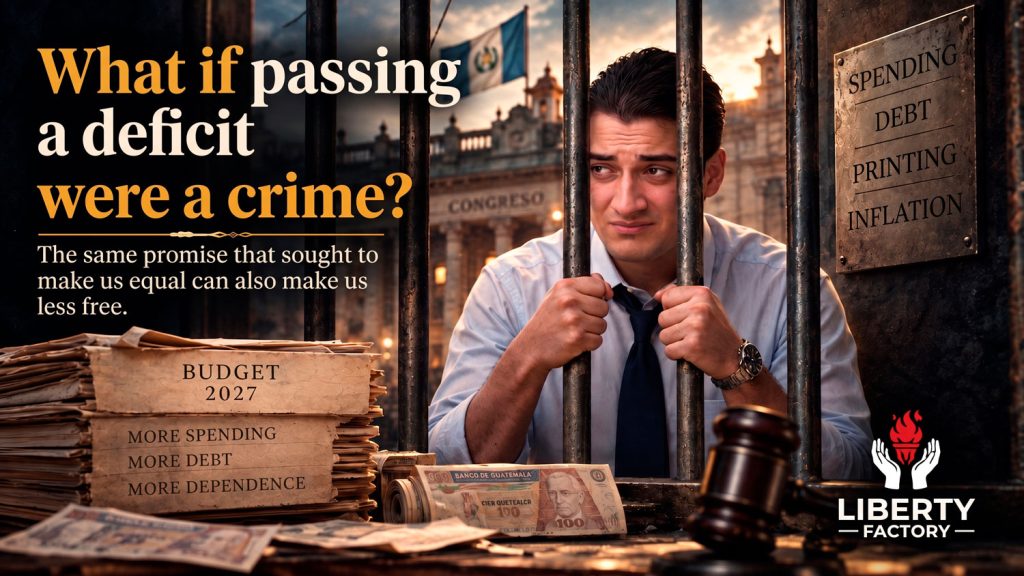
Congress has until November 30. It can approve Q192,045.1 million with a Q48,300 million hole in it, or it can start debating the two laws that would turn approving that hole into a crime. The question for each legislator fits in one line: is he willing to let his vote cost him something?
Ramiro Bolaños, PhD.
President of the Centro de Pensamiento y Acción Factoría Libertatis
References
- Argentina, Poder Ejecutivo Nacional, Proyecto de Ley de Compromiso Nacional para la Estabilidad Fiscal y Monetaria, Message 29/2025, file 0011-PE-2025 (Buenos Aires: Honorable Cámara de Diputados de la Nación, 2025).
- Banco de Guatemala, Ritmo inflacionario anual, 1980–2025 (Guatemala: Banguat, 2026).
- Congreso de la República de Guatemala, Acuerdo Legislativo 18-93. Reformas a la Constitución Política de la República (Guatemala, 1993).
- Ministerio de Finanzas Públicas, Proyecto de Presupuesto General de Ingresos y Egresos del Estado, Ejercicio Fiscal 2027 (Guatemala: Minfin, 2026).
- Sweden, Ministry of Finance, The Swedish Fiscal Policy Framework (Stockholm: Government Offices of Sweden, 2018).