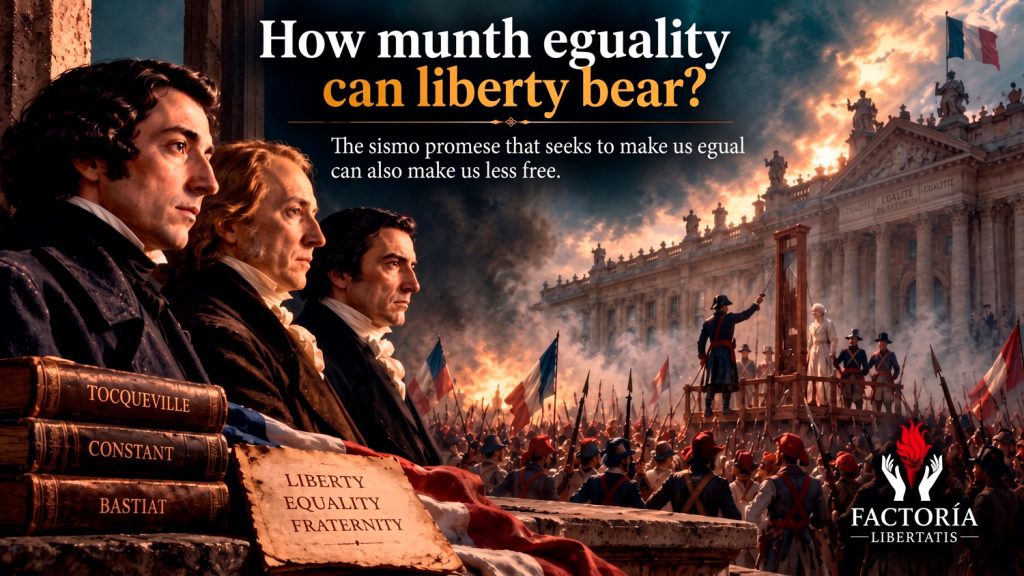
In the winter of 1854, in the archives of a French province, a forty-eight-year-old man asks for old files to be brought up. His chest is ill, he works slowly, and he is looking for a date. His name is Alexis de Tocqueville, and he wants to find the exact year in which the Revolution built what he sees every day around him: a State that decides, from Paris, down to the smallest detail of life in every village. He takes it for granted that it was born in 1789 and that in those files he will find the exact moment.
In letters written long before the Revolution, scenes like this begin to appear: the priest of a village asks for authorization to raise his church’s bell tower and has to wait two or three years for an official of the king to answer yes. The letters are dated before 1789: the State Tocqueville believed to be a child of the Revolution had already been running for decades when the Revolution arrived. The Revolution inherited it, but did something the monarchy had never managed: it perfected it in the name of equality.
The Revolution had torn Tocqueville’s family apart. His great-grandfather Malesherbes came out of retirement to defend Louis XVI during his trial, and ended up guillotined in 1794. His parents awaited their turn in a Paris prison and were saved only because Robespierre fell first. His father left prison with his hair completely white, at the age of twenty-two. From someone like that one might expect a reckoning against equality. But he wrote the opposite.
He wrote that equality had been advancing through French history for seven hundred years and that there was no longer any way to stop it: gunpowder had equalized the peasant and the armored knight on the battlefield, and that change had no way back. It wasn’t a political fad; it was the deep current of modern history. That’s why his question was never how to stop it, but a harder one: how to remain free within it.
Before, when a bridge collapsed in a village, the neighbors decided among themselves whether to repair it and with what money, without consulting the capital. The French called such bodies, standing between the individual and power, cuerpos intermedios — intermediary institutions. When central power eliminates them one by one, citizens end up equal, but also defenseless: none of them has anything of his own left from which to resist. That equality ends up producing dependence, because what neighbors used to settle among themselves now has to be requested from that same power.
I think we should separate two things we call by the same word. The first is equality before the law: the rule is equalized, not the outcome; the same standard for the minister and for the woman selling tortillas on the corner. To achieve it, one doesn’t need to ask the State to do something, but to stop handing out exceptions. Results will differ, because two people under the same rules can do different things with them. And this kind of equality has an additional virtue: we know when it’s reached — the day not a single exception before the law remains.
The second is equality of outcomes. Now it’s no longer the rule that’s equalized, but what each person ends up with. The State isn’t asked to abstain, but to intervene every single day, because differences reappear every single day. And since the outcome depends on a thousand things — the home one was born into, the school one attended — intervention finds no place to stop: the day never comes when we can say equality has been achieved. Equality didn’t defeat freedom in a single battle: it kept replacing it until we stopped noticing the difference.
A State tasked with an outcome that is never reached ends up spending more than it collects. It borrows the difference. The limit, then, does exist: it’s set by the creditor, on the day he stops lending. Spain, once the richest empire in the world, defaulted on its creditors thirteen times, seven of them in the nineteenth century alone. France repudiated its debts nine times between 1500 and 1800, and on some of those occasions its kings settled the matter by having the creditors executed.
In 1819, Benjamin Constant explained in Paris that the revolutionaries had gotten the wrong kind of liberty. They had copied that of the Greeks: the citizen took part in the city’s decisions, but that same city could then decide how it educated its children and which god it believed in. The modern Frenchman, by contrast, worked, traded, traveled, and asked liberty simply to be left alone. Confusing one liberty with the other lets the State dispose of each person while repeating to him that he is the State.
Thirty years later, Frédéric Bastiat took the problem to the law itself. In 1850 he published The Law: if the law’s function is to prevent people from being deprived of what is theirs, then tasking it with also equalizing outcomes forces it to take from some to give to others. Defense then turns into an instrument of plunder. Bastiat called it legal plunder, and warned that once one group discovers the law can be used that way, everyone else discovers it too. All three were French and all three liberals: some of the harshest critiques of Jacobinism were written by men who had seen its consequences firsthand.
All of this arrived in Guatemala on December 9, 2014. The United Nations committee that monitors economic, social, and cultural rights recommended that the Guatemalan State adopt a tax policy that was “adequate, progressive, and socially just,” one that would raise revenue to guarantee sufficient resources for those rights. It’s a doctrine two centuries in the making, and the cooperation framework signed with Guatemala in December 2025 asks for the same thing again.
The recommendation says more must be collected because there are rights to finance. Today we collect 11.8% of what the country produces. So let’s ask the question no one answers: how much would be enough? 13%? 18%? France collects 43.6% of its output and still closed 2025 with a 5.1% deficit. Even that isn’t enough. If the rights that must be financed have no limit, then neither can the revenue needed to finance them.
The SAT (tax authority) measured how much revenue the State forgoes through the exemptions and special treatments that the law itself grants: in 2025 it came to Q22,586 million, 2.4% of everything the country produces in a year. But what matters is where those exceptions come from. Barely a quarter comes from the Constitution; the rest comes from ordinary laws, passed one by one in Congress.
While those exemptions were being approved, the other side of the same building was going up. Tobacco was taxed in 1977; petroleum, in 1992; cement, in 2000; and beverages, in 2004. Four governments, four Congresses, nearly thirty years, and the same method: single out certain products and charge them what isn’t charged to everyone else.
The four combined will contribute Q7,236 million this year, while exemptions total Q22,586 million: more than three times that figure. The same law exempts with one hand what it pursues with the other.
None of this is explained by geography, or Spanish heritage, or the Guatemalan character: these are decrees with a number and a date, voted on by people who are still around today. And what was done by decree can be undone by decree. The proposal fits in one line: a single rule for everyone, eliminating at the same time both the exemptions created by ordinary laws and the taxes that single out particular products. Because eliminating only one side of that would not be reform — it would be just another sectoral favor. Article 4 of our Constitution has said since 1985 that we are all free and equal in rights, with equal opportunities and responsibilities. Equality before the law was already written down; on top of it we built privileges and punishments.
The whole discussion comes down to this: how many rights can a society sustain when it hasn’t even agreed on a single duty, and who ends up paying the difference.
The problem isn’t just how much is spent, but what it buys. Central government spending went from Q112,246 million in 2023 to the Q192,045 million proposed for 2027: 71% more in four years, when no previous government had exceeded 50%. And in that time, malnutrition didn’t drop a single point, the line at Puerto Quetzal didn’t move, and bridges appeared in critical condition that hadn’t been before. What did grow was the bill.
This year’s approved budget allocates Q21,369 million to debt service — more than the Ministry of Health’s Q16,538 million, and one and a half times what the Interior and Defense ministries receive combined. To finance it, Congress authorized Q25,599 million in Treasury bonds: we borrow more than we pay. That is where a promise with no number attached ends up: not a State that gives more, but one that owes more.
Next week we’ll see what happened when equality stopped being measured by law and started being measured by identity. For that we no longer need to go back to 1789. We need to get to 1968.
Ramiro Bolaños, PhD. / President of the Centro de Pensamiento y Acción Factoría Libertatis
References
- Asamblea Nacional Constituyente, Constitución Política de la República de Guatemala (Guatemala, 1985), art. 4.
- Bastiat, Frédéric, La Loi (Paris: Guillaumin, 1850).
- Congreso de la República de Guatemala, Decreto 61-77, Ley de Tabacos y sus Productos; Decreto 38-92, Ley del Impuesto a la Distribución de Petróleo Crudo y Combustibles Derivados del Petróleo; Decreto 79-2000, Ley del Impuesto Específico a la Distribución de Cemento; Decreto 21-2004, Ley del Impuesto sobre la Distribución de Bebidas.
- Constant, Benjamin, De la liberté des anciens comparée à celle des modernes (Paris, 1819).
- Congreso de la República de Guatemala, Decreto 27-2025, Ley del Presupuesto General de Ingresos y Egresos del Estado para el Ejercicio Fiscal 2026 (Guatemala, December 12, 2025).
- International Monetary Fund, Public Finances in Modern History, 2025 database (Washington: IMF, 2025).
- Fundesa, ¿Cuál es la magnitud del presupuesto de egresos 2027?, with data from Banguat and Minfin, total expenditures 1995–2027 (Guatemala, 2026).
- Insee, Le compte des administrations publiques en 2025, Insee Première 2106 (Paris, 2026).
- Instituto Centroamericano de Estudios Fiscales, Guatemala: análisis del presupuesto aprobado para 2026 (Guatemala: Icefi, November 12, 2025).
- Ministerio de Economía, Informe Económico Semanal (Guatemala: Mineco, May 4, 2026).
- Ministerio de Finanzas Públicas, Proyecto de Presupuesto General de Ingresos y Egresos del Estado, ejercicio fiscal 2027 (Guatemala, September 2, 2026).
- United Nations, Committee on Economic, Social and Cultural Rights, Concluding Observations on the Third Periodic Report of Guatemala, E/C.12/GTM/CO/3 (Geneva, December 9, 2014), para. 8.
- Reinhart, Carmen M., and Kenneth S. Rogoff, This Time is Different: Eight Centuries of Financial Folly (Princeton: Princeton University Press, 2009).
- Sistema de las Naciones Unidas en Guatemala, Análisis Común de País y Marco de Cooperación de las Naciones Unidas para el Desarrollo Sostenible 2026-2030 (Guatemala, December 2025).
- Superintendencia de Administración Tributaria, Intendencia de Recaudación, Informe de gasto tributario 2025 (Guatemala: SAT, 2026).
- Tocqueville, Alexis de, De la démocratie en Amérique, vol. I (Paris: Gosselin, 1835), “Introduction.”
- Tocqueville, Alexis de, L’Ancien Régime et la Révolution (Paris: Michel Lévy, 1856).