To pay my way through university I taught French classes. I taught them once my own day was already over: after university, after the classes I gave my own students at the Alliance Française, came the notebook of irregular verbs, an hour paid in cash that stretched just far enough to cover what it had to cover. I don’t tell this as a sacrifice. I tell it because with the language came something bigger than the language. France came with it.
For the young man I was, France was the place where the important things had been thought through. From there had come liberty, equality, fraternity, and above all that dazzling idea that one is born with rights no one can take away. I repeated it with admiration, and the admiration was real.
More than thirty years have passed, and at some point one stops looking at the speeches and starts looking at the results. What one sees today in some of the societies most devoted to rights is not what that young man expected: they are extraordinary countries, cultured, generous, but they owe more than they can probably pay. The problem was never rights themselves. It was separating them from duties. And that separation has a history.
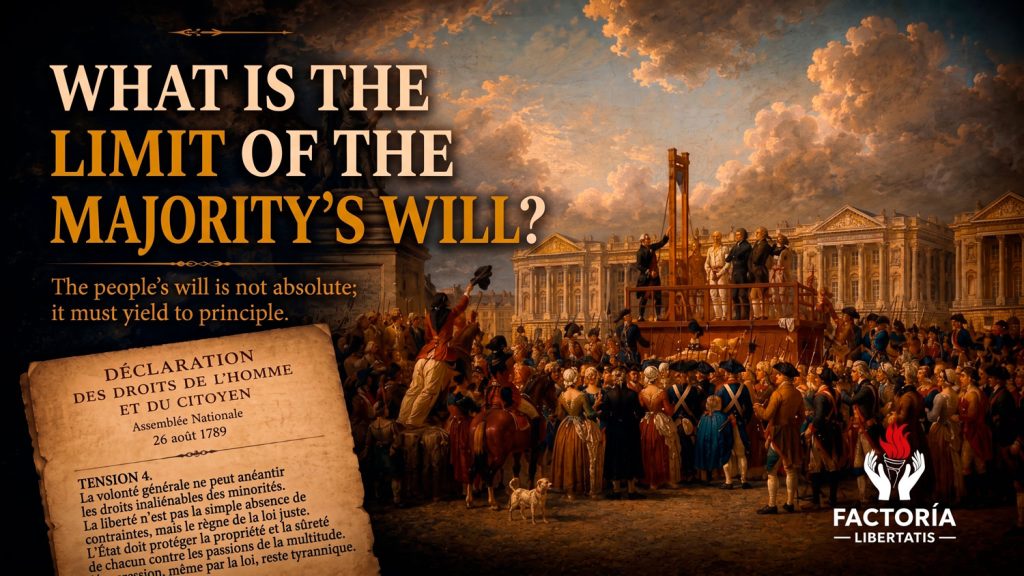
In 1689 John Locke wrote that rights precede government: one does not receive them from power, one is born wearing them, and government exists to protect them. Seventy years later Jean-Jacques Rousseau introduced a different idea: the citizen surrenders himself to the general will and becomes part of a collective body. The center of gravity began shifting from the individual toward the collective. And in August 1789 the National Constituent Assembly approved, in Paris, the Declaration of the Rights of Man and of the Citizen, which in its second article lists four: liberty, property, security, and resistance to oppression. Notice something: none of them is framed as a right to receive a material benefit from the State. They are, above all, limits on power, not bills addressed to one’s neighbor. The only thing that text expressly asks of the citizen to sustain public spending is to contribute to the common burden.
So where did the bill appear? Four years later, with a different assembly and a different regime. It’s worth not confusing them: 1789 is the Constituent Assembly; the Terror belongs to 1793 and 1794, to Robespierre, to the Committee of Public Safety, and to tens of thousands of deaths. But it is in the 1793 declaration that a phrase appears announcing a profound shift: “public assistance is a sacred debt; society owes subsistence to unfortunate citizens.” Here the turn happens: a right no longer merely limits power; it can now also obligate it to provide.
And there’s a detail in that text that keeps me up at night. The word “duty” appears four times across its 35 articles, and three of those are duties of the magistrate, the legislator, and the official. The only one assigned to the ordinary citizen is in article thirty-five: insurrection, “the most sacred of rights and the most indispensable of duties.” Rights to demand, and a single duty: to rise up. Ancient history? The main movement of the French left today is called La France Insoumise (“Unbowed France”), and its leader still calls for “citizen insurrection.” Two centuries later, the language has survived.
And the revolutionaries themselves noticed. In 1795 Boissy d’Anglas warned that liberty without duties had contributed to the Terror. That August, the same generation rewrote the declaration and even changed its name. It was no longer just about rights: it became “of the rights and duties of man and of the citizen.” Twenty-two articles of rights, followed by nine of duties. The duties come at the end, but for the first time they have a place of their own. And the fourth one says something that today sounds like it was written on another planet: “no one is a good citizen if he is not a good son, a good father, a good brother, a good friend, a good husband.” Posterity kept 1789. In school we learned the rights; the duties gradually faded from memory.
A hundred fifty years later, another Frenchwoman got to the bottom of it. In 1943, while her country was occupied, Simone Weil was writing in London a report on how to rebuild a nation from scratch. She begins with a radical idea: a right isn’t worth anything on its own, only through the obligation that corresponds to it. And she closes with an image one doesn’t forget: a man alone in the universe would have no rights at all, but he would have obligations. Translated into everyday terms: a right with no obligation attached to a specific name isn’t a right, it’s a wish. Weil didn’t write from comfort either: while working for Free France she refused to eat more than she believed her compatriots could eat under the occupation. She died at 34, on August 24, 1943.
What remained was to turn that idea into a bill passed between generations. Léon Bourgeois introduced the income tax in 1895 as head of the French government; the Senate rejected it and his government fell. He then wrote the book that would give his solidarism its foundation: we are born debtors to those who came before us, because we inherit a civilization we did not build. Each generation receives what it did not build and leaves part of the bill to the next. The income tax arrived in France in 1914, initially with a top rate of two percent. For decades it helped finance some of the most protected societies in history. But that contract concealed a clause no one could guarantee: someone had to be born to pay it.
Today France spends, through the State, about 57 of every 100 euros it produces; its public debt is around 116 percent of GDP, and it pays in interest a sum comparable to — and recently greater than — its defense budget. Spain exceeds 100 percent debt-to-GDP, and the United Kingdom is close to that level too. Meanwhile, in 2025 France recorded its lowest fertility rate since the end of the First World War — just 1.56 children per woman — and, for the first time since the end of the Second, more people died than were born. The debtor who was supposed to settle the account decided it wasn’t worth showing up.
And here this stops being a column about France. Because the declaration that tried to reconcile rights and duties wasn’t written by Europe: we wrote it. On May 2, 1948, in Bogotá, eight months before the United Nations approved the Universal Declaration, the countries of the Americas — Guatemala among them — signed the American Declaration of the Rights and Duties of Man. It has an entire chapter of ten duties and a line in its preamble that’s worth this whole discussion: “the fulfillment of the duty of each one is a prerequisite to the rights of all.” The Universal Declaration also recognized, in its article 29, that everyone has duties to the community. But there’s a telling difference: we put duties in the title and gave them an entire chapter. Afterward we learned to talk a great deal about rights and less and less about what sustains them. There’s still time to remember.
And to pay for those rights, Guatemala’s problem isn’t solved simply by collecting more. Of the 835 economic activities into which the SAT (tax authority) classifies tax collection, barely 64 contribute 80 percent of the total, while 599 — seven out of ten — together don’t reach one percent. That’s where you find the person who doesn’t ask for a receipt, who rents out an apartment without declaring it, who evades on purpose; and often it isn’t some faceless big company, but the neighbor or friend we know. On the other side is the highest budget in our history, more than 163 billion quetzales, while 33 bridges remain in critical condition on the main highways. There’s now talk of raising the budget ceiling to 181 billion. Duty has broken down on both ends: the citizen wants to receive without contributing, and the State wants to collect without answering for it. Our own Constitution lists seven civic duties in its Article 135. We wrote them down. Living as though they mattered is another matter.
But not everyone chose the same path. In Switzerland, 85 percent of voters imposed on themselves in 2001 a constitutional brake on public debt, and in 2012, 67 percent rejected giving themselves six extra weeks of vacation. In Singapore, worker and employer together contribute up to 37 percent of salary into accounts held in the worker’s own name, earmarked to finance housing, health, and retirement: personal responsibility institutionalized, not simply a bill sent to one’s neighbor. Though no one is immune to contradiction. In March 2024 the Swiss approved an additional pension, and that same Sunday rejected, by 75 percent, working one more year to help fund it. Yes to the right, no to the duty that sustains it, in the same ballot box.
That young man who taught French classes thinks differently today. Not because he stopped believing in rights, but because he came to understand that none of them survives long without a duty holding it up. Every right we demand has an obligation on the other side, and every obligation we turn into debt ends up being paid by someone. An indebted people does not entirely choose its own destiny: it also administers the one it was left.
Freedom has never consisted of others owing us something. It also consists of making ourselves responsible for our own lives, fulfilling what we owe to others, and leaving those who come after us something other than a bill to be paid. Perhaps that is the most forgotten obligation of all: to receive a society, sustain it during our turn, and hand it over a little better than we found it.
Next week, the question that follows: what happens when two rights collide, and equality begins to devour freedom.
Ramiro Bolaños, PhD. / President of the Centro de Pensamiento y Acción Factoría Libertatis
References
- Declaración Americana de los Derechos y Deberes del Hombre, IX International American Conference (Bogotá, May 2, 1948).
- Déclaration des droits de l’homme et du citoyen du 24 juin 1793, Constitution of Year I.
- Déclaration des droits et des devoirs de l’homme et du citoyen, Constitution of Year III (August 22, 1795).
- Declaración de los Derechos del Hombre y del Ciudadano (Paris: National Constituent Assembly, August 26, 1789).
- Asamblea Nacional Constituyente, Constitución Política de la República de Guatemala (Guatemala, 1985), art. 135.
- Bergounioux, Alain, “À l’origine de l’impôt sur le revenu: Léon Bourgeois et le solidarisme,” Fondation Jean-Jaurès.
- Bourgeois, Léon, Solidarité (Paris: Armand Colin, 1896).
- Burke, Edmund, Reflections on the Revolution in France (London: J. Dodsley, 1790).
- Central Provident Fund Board, CPF Overview (Singapore, 2026).
- Chancellerie fédérale suisse, federal referendum results of March 11, 2012 and March 3, 2024.
- “Estos 33 puentes en el país están en estado crítico a semanas de las lluvias de 2026,” Prensa Libre, April 9, 2026.
- Eurostat, “Government debt at 88.9% of GDP in euro area,” press release 2-21072026-AP (Luxembourg, July 21, 2026).
- Insee, Bilan démographique 2025, Insee Première 2087 (Paris, 2026).
- Insee, “En 2025, le déficit public s’élève à 5,1 % du PIB, la dette publique à 115,6 % du PIB,” Informations rapides, 78 (Paris, 2026).
- La France insoumise, L’Avenir en commun, section “Faire la révolution fiscale.”
- Locke, John, Two Treatises of Government (London: Awnsham Churchill, 1689).
- Office for National Statistics, Public Sector Finances, UK: June 2026 (London: ONS, 2026).
- Ortega y Gasset, José, La rebelión de las masas (Madrid: Revista de Occidente, 1930).
- Rousseau, Jean-Jacques, Du contrat social (Amsterdam: Marc-Michel Rey, 1762).
- Superintendencia de Administración Tributaria, Recaudación de ingresos tributarios por departamento y actividad económica, enero–mayo 2026 (Guatemala: SAT, 2026).
- Weil, Simone, L’Enracinement: prélude à une déclaration des devoirs envers l’être humain (Paris: Gallimard, 1949 [written in 1943]).