Anyone in Guatemala who wanted to buy something as simple as imported chocolate, before 1986, had three doors available. The Comisariato Militar, if you had a military ID and knew someone inside: a “passport to paradise” of imported consumer goods. Selectas or Exclusivas, if you had the money of the capital’s upper class. For everyone else, foreign goods barely existed. That isolation began to break down with the democratic opening of 1985 and 1986. And in 1989 Guatemala made a more specific decision: to become an exporting country. The free-trade-zone and maquila decrees were written that year with that explicit ambition.
It worked, for a while. In 2001 Guatemala exported the equivalent of 28.7% of everything it produced in goods and services, the highest point in the historical series. Today we export 15.9%: almost half that, and below the average of the last sixty-five years. It’s not that we never achieved it. We achieved it once and let it go.
The problem wasn’t only that we stopped sustaining that opening. In 2016 we redesigned the regime and repeated the same mistake. The Norwegian economist Erik Reinert, one of the leading contemporary scholars of industrial policy and economic development, distinguishes twelve contrasts between two types of protectionism: the kind that helped build productive capacity, and the kind that ended up protecting backwardness. What matters is what gets protected and for how long; whether there’s a genuine learning curve; whether internal competition is preserved; whether technology is controlled locally; whether there’s investment in education and knowledge transfer; and whether capital and privileges are distributed by merit or discretionarily. Applying those twelve contrasts to the 37 years of Guatemala’s free-trade-zone and maquila regime, Guatemala falls, on all twelve, on the side of protectionism that failed. We protected mature assembly work instead of an infant industry. We sought to preserve jobs, not create value. The 2016 law itself says so in its very name: the Emergency Law for the Preservation of Employment.
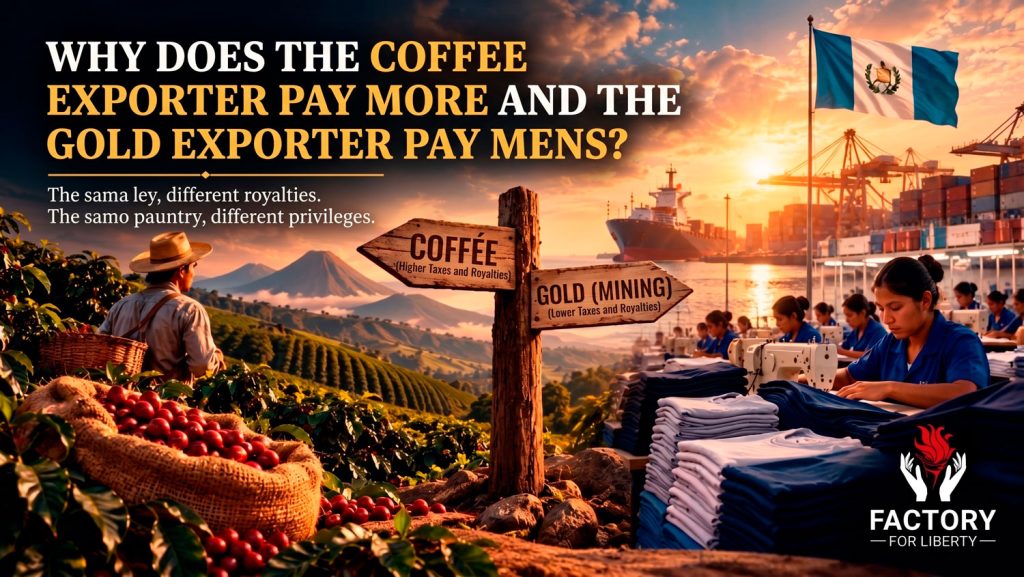
But an exporter friend made me see something, regarding the September 7 column: calling for the elimination of every exemption without distinguishing one case from another leaves no room for those who export in good faith. He’s right. And the answer lies in the decree itself. In 2016, an international commitment forced Guatemala to eliminate benefits conditioned on exporting. Guatemala reformed the regime, but didn’t stop picking winners: it just changed the criterion. Before we chose by the product’s destination; now we choose by the sector’s category. Article 12 bis of Decree 29-89 exempts two categories from income tax for ten years: apparel and textiles, and technology services — call centers, BPO, and software development. A coffee exporter doesn’t receive that exemption for being an exporter. Neither does one exporting cardamom or snow peas.
Here it’s worth not confusing three things. A tax is an obligation established by law; an exemption releases one category from a burden that everyone else keeps paying. And a VAT refund is something else entirely. VAT is charged where the product is consumed: if the product leaves Guatemala, it’s consumed abroad. Refunding the exporter the VAT already paid isn’t giving away money; it’s preventing the tax from ending up levied on an export. As of December 31, 2017, the State owed exporters Q3,880 million in pending refunds: 0.7% of that year’s GDP and 13.6% of everything exporters had paid in VAT. That’s where the contradiction shows up: the State delays what it owes back while granting, by category, tax breaks that others must still pay.
The asymmetry can already be seen clearly. In 2025, apparel overtook coffee as Guatemala’s leading export product: US$1,543 million against US$1,307 million. During those years, the regime granted apparel an income-tax exemption it did not grant coffee. And it’s not that coffee lacks the capacity to compete. In August of this year, a lot from the Finca El Injerto, in Huehuetenango, fetched US$449.10 per pound at the Cup of Excellence auction, the highest price since that competition arrived in the country in 2001.
But El Injerto is the ceiling, not the average. It shows how far Guatemalan coffee can go, not the conditions under which most small coffee growers compete, without the same access to credit, infrastructure, or knowledge. The answer isn’t to give them another sector-specific exemption either: that would repeat the same mistake. What they need are general conditions that let any exporter compete. Honduras offers a clear contrast. In the mid-1970s it was Central America’s smallest coffee exporter; today it’s the region’s largest and the world’s sixth. Behind that shift were decades of investment in quality, coffee-sector institutions, and specialty coffee.
Nor is it necessary to invent the regime that could replace today’s exemptions. Costa Rica has already done it. It reformed its free-trade-zone regime in 2010 and eliminated the export requirement. Instead of a full exemption, it set a positive, staggered rate: 6% on profits for the first eight years and 15% for the following four, within the metropolitan area. Baxter, which has made medical devices in Cartago since 1987 and employs around 1,200 people, stayed on after the reform. The cluster it helped build also kept growing: in 2024, medical devices accounted for 44% of Costa Rica’s goods exports. If the export-conditioned exemption had been indispensable to that cluster, eliminating it in 2010 would have started destroying it. Sixteen years later, the opposite has happened.
The size of the problem isn’t what we usually imagine either. Guatemala invests the equivalent of 16.7% of its GDP, about US$20,604 million a year, but saves 19.3%. The gap is around US$3,700 million: capital that could find more productive opportunities within the country. The problem, then, isn’t only attracting money from abroad. It’s getting more of our own money to want to be invested here. And that requires opportunities, security, and a level playing field. Our analysis of countries that managed to accelerate their growth reveals another gap: during those episodes they invested, on average, around 25% of their output. Guatemala is at 16.7%.
The alternative can be built without breaking existing promises. First, legally close the door to new qualifications under the current regime. Second, honor existing qualifications until they expire. What was agreed gets fulfilled. And third, replace the regime with a positive rate: that is, reduced and staggered, with no export requirement, open to anyone who invests, hires, and trains. The Costa Rican model offers the principle: charge something instead of exempting everything, and set from the start when the benefit ends. That same design would later allow moving toward lower general rates: a corporate income tax below 15%, VAT from 12% down to 10%, and elimination of the solidarity tax. But not before growth allows reaching the zero deficit I proposed last week. First the accounts get put in order; then rates come down.
There’s one measure that doesn’t even need to wait for that reform: transparency. The State should publish how much each exemption regime costs and when each beneficiary company’s qualification expires. Publishing both figures on a consolidated basis would make it possible to know how much the taxpayer pays for each exception, and for how long.
Guatemala already has the desire to start businesses. Our analysis of GEM data places Guatemala in the top global quintile both in admiration for entrepreneurship and in early-stage entrepreneurial activity. But that energy doesn’t translate into the same perception of opportunities or expectations of creating jobs. We have entrepreneurs; what many still don’t see are the conditions to grow. And there, once again, we return to the problem of design.
I come back to the exporter friend who made me revisit my argument. He’s right: the answer isn’t to punish exporters or disregard what the State has already promised. But it also can’t be a law that decides, category by category, which of us deserves to compete. If a Guatemalan company can produce better, hire more, innovate, and sell to the world, its opportunity shouldn’t depend on whether an official had previously put its sector on a list.
In 1989 Guatemala wanted to become an exporting country. For a while, it succeeded. Thirty-seven years later, the ambition is still the right one; what we need to change are the rules. The next leap isn’t about choosing which companies deserve to export, but about building a country where anyone who can compete has the chance to do so.
Ramiro Bolaños, PhD. / President of the Centro de Pensamiento y Acción Factoría Libertatis
References
- Anacafé, Cup of Excellence: Seleccionan los mejores cafés de Guatemala para la subasta internacional 2026 (Guatemala City: Asociación Nacional del Café, June 4, 2026), https://www.anacafe.org/resultados-premiaci%C3%B3n-coe-2026/ [accessed September 16, 2026].
- Asamblea Legislativa de la República de Costa Rica, Ley N.º 8794 (San José: La Gaceta, January 12, 2010).
- Banco de Guatemala, Guatemala en Cifras 2021 (Guatemala City: Banguat, 2021), https://banguat.gob.gt/sites/default/files/banguat/Publica/guatemala_en_cifras_2021.pdf [accessed September 15, 2026].
- Banco de Guatemala, Informe Resumido de Comercio Exterior — Comercio General, Table 1: Value (FOB), volume, and average price of the top 25 export products, 2024–2025 (Guatemala City: Banguat), https://banguat.gob.gt/page/informe-resumido-comercio-general [accessed September 16, 2026].
- Banco de Guatemala, Serie histórica: Exportaciones por producto, 1994–2025 (Guatemala City: Banguat), https://banguat.gob.gt/sites/default/files/banguat/estaeco/comercio/sercom/2_POR_PRODUCTO/X_PROD_1994_2025.htm [accessed September 16, 2026].
- “Cierra el Comisariato del Ejército en 1997,” Prensa Libre, Hemeroteca (January 2, 1998), https://www.prensalibre.com/hemeroteca/cierra-comisariato-del-ejercito-en-1997/ [accessed September 15, 2026].
- Congreso de la República de Guatemala, Decreto Número 19-2016, Ley Emergente para la Conservación del Empleo (Guatemala City: Diario de Centro América, February 25, 2016).
- Congreso de la República de Guatemala, Decreto Número 29-89, Ley de Fomento y Desarrollo de la Actividad Exportadora y de Maquila (Guatemala City: Diario de Centro América, June 13, 1989).
- Congreso de la República de Guatemala, Decreto Número 65-89, Ley de Zonas Francas (Guatemala City: Diario de Centro América, November 22, 1989).
- Global Entrepreneurship Monitor, GEM Guatemala 2021/2022 National Report (London: GEM Consortium, 2022).
- Instituto Centroamericano de Estudios Fiscales (ICEFI), Nota de Coyuntura 01-2018: Crédito Fiscal del IVA (Guatemala City: ICEFI, May 2018), https://icefi.org/sites/default/files/nota_de_coyuntura_01-2018_credito_fiscal_del_iva.pdf [accessed September 14, 2026].
- Instituto Hondureño del Café, Informe de cierre de cosecha 2024–2025 (Tegucigalpa: Ihcafé, August 2025).
- Reinert, Erik S., How Rich Countries Got Rich and Why Poor Countries Stay Poor (London: Constable, 2007).
- Reinert, Erik S., “Development and Social Goals: Balancing Aid and Development to Prevent ‘Welfare Colonialism,'” DESA Working Paper, No. 14 (New York: United Nations Department of Economic and Social Affairs, July 2006), pp. 21–22.
- World Bank, “Exports of Goods and Services (% of GDP) — Guatemala,” World Bank Open Data, indicator NE.EXP.GNFS.ZS, https://data.worldbank.org/indicator/NE.EXP.GNFS.ZS?locations=GT [accessed September 15, 2026].
- World Bank, “GDP per Capita (Constant 2015 US$),” World Bank Open Data, indicator NY.GDP.PCAP.KD, https://data.worldbank.org/indicator/NY.GDP.PCAP.KD [accessed September 14, 2026].
- World Trade Organization, Agreement on Subsidies and Countervailing Measures, art. 3.1(a) and Annex I, https://www.wto.org/spanish/docs_s/legal_s/24-scm.pdf [accessed September 14, 2026].