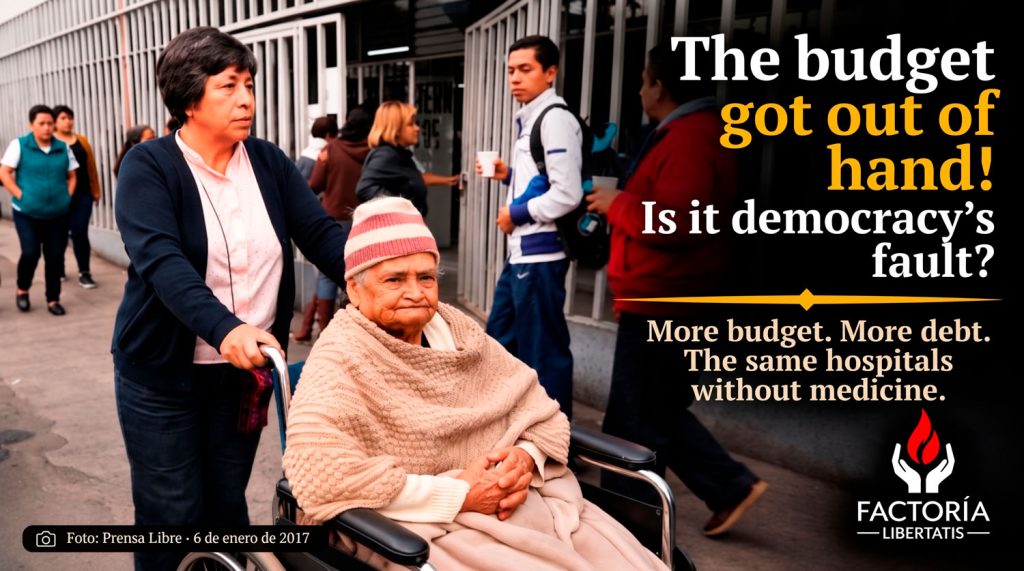
You sit down for breakfast, set your coffee cup beside the plate, and open your phone. The first video is of a hospital where patients bring their own syringes. The second, on YouTube, is of a highway that has collapsed again at the same stretch as always. The third, on Instagram, is of someone shouting at the camera that all politicians are the same and that voting is pointless. You put the phone face down and ask yourself the question thousands of Guatemalans ask every morning: what is failing?
A good part of the country already has an answer. According to the 2026 Latinobarómetro, which surveyed more than 19,000 people in 17 countries between May and June, barely 35% of Guatemalans believe democracy is preferable to any other form of government, compared with 52% for the Latin American average. Guatemala ranks last among the 17 countries.
The same survey offers a clue to understanding that disenchantment. Barely 14% of Guatemalans consider that the State has done a lot or something for them and their family, compared with 26% for the Latin American average. Guatemala shares last place in the region with Panama.
These two figures reveal a problem we rarely distinguish. When Guatemalans talk about democracy, we tend to confuse the way we elect our rulers with the mechanisms that should limit their power once elected.
The first lasts a day. It is the line in front of the school, the folded ballot, the ink-stained finger, and that night’s count. It serves to decide who will rule for the next four years.
The second lasts those four years. It is everything that happens between one election and the next: whether the winner must be accountable, whether someone can stop him when he overreaches, whether there are limits on what he can decide and spend. In Guatemala we have examples that repeat every year.
In December, the president sets the minimum wage after hearing the commission that studies it, but its recommendation is not binding: the Labor Code only requires him to decide “in view of” it. And every November Congress can approve a budget that increases public debt, with no general limit on borrowing established by the Constitution. In both cases the problem is the same: those who hold power have a discretion that our republican mechanisms do not sufficiently contain.
The first we call democracy: it lets us choose who governs. The second we call republic: it establishes the limits within which they may govern. Both are necessary, but they serve different functions. And in Guatemala, the one failing us is the second.
The legitimacy of an election is not the same as permanent support, either. A ruler can come to power with the votes of a minority of registered citizens, under the electoral rules, and then lose popularity. His constitutional authority does not disappear for that reason, but neither does it expand when he has more support. Republican limits must work in both cases: when the ruler is popular and when he ceases to be.
For years, our public discussion has concentrated almost entirely on the first. We debate how many deputies there should be, who is represented, which group has a voice and which does not. All of that matters. But even a Congress where everyone was represented could keep approving spending that commits the revenues of future generations. That is why we need institutions capable of placing limits on power, even when those who wield it have been democratically elected. And we almost never talk about how to build those limits.
More than two thousand years ago, the Greek historian Polybius found an answer while studying the Roman Republic. He observed that pure forms of government tended to degenerate: rule by one into tyranny, rule by the best into oligarchy, and rule by the people into mob rule. Rome had found a solution: combining the power of the consuls, the Senate, and the people with their tribunes, so that none could prevail without meeting resistance from the others. Fifteen centuries later, Niccolò Machiavelli recovered that lesson in his Discourses on the First Decade of Titus Livy (1531). The fourth chapter bears a revealing title: “That the disunion of the Plebs and the Roman Senate made that republic free and powerful.”
The Romans voted, and voted often. But what protected them from their own rulers, according to Machiavelli, was that institutions existed capable of stopping their abuses. A tribune of the plebs could stand before a consul and, with a single word, prevent him from carrying out certain decisions. That word was “veto,” which in Latin means “I forbid.” We still use it today.
Friedrich Hayek, Nobel laureate in Economics in 1974, put it in The Constitution of Liberty (1960): “Liberalism is a doctrine about what the law ought to be; democracy is a doctrine about the manner of determining what will be the law.” Hayek was speaking of liberalism and we are speaking of republic, but both agree on something essential: the power of whoever wins an election must have limits. A majority can legitimately elect those who will make the laws and, at the same time, allow them to pass laws that expand their own power without sufficient restrictions. When that happens, the winner believes the vote handed him everything, and some of his voters believe him.
That is why it worries me that barely 35% of Guatemalans prefer democracy. When frustration with results leads people to ask for rulers with fewer limits, we risk weakening precisely the institutions that should protect us from their abuses.
In Guatemala, those brakes will be tested this very month. Article 171 of the Constitution establishes that Congress must approve, modify, or reject the budget no later than thirty days before it takes effect. It has until the end of November to decide on the 2027 bill: Q192,045 million, with a deficit equivalent to 37% of the tax revenue the State itself expects to collect. If a new one is not approved, the previous budget remains in force. In 2025, Congress approved the budget for 2026, but the Constitutional Court provisionally suspended its effect. The budget in use was subsequently expanded. There was judicial oversight of the approval, but that did not guarantee a limit on spending or borrowing. The question is who will place limits on a decision that commits the revenues of the coming years.
At the close of 2025, the State owed Q253,048 million. That debt equals 2.2 years of tax collection. Imagine that, starting tomorrow, every quetzal the SAT collects were devoted exclusively to paying what we owe: it would take more than two years, without counting interest or spending a cent on hospitals, schools, or security. France has a debt of similar proportions relative to its public revenues.
France pays its creditors, on average, less than 2% a year. Guatemala pays 6.3%, more than triple. Our debt works like a credit card with a risky-customer rate: the more we owe, the more money we need to pay it.
In the 2027 bill, paying interest and amortization on the debt will cost us Q24,601 million, more than Q2,000 million every month. That is more than the Ministry of Health will receive, with Q18,616 million, and more than the Ministries of the Interior and Defense will receive together, with Q16,865 million.
The major credit rating agencies place Guatemala near investment grade, the category that eases access to cheaper financing. Among the factors they evaluate is how much of what the State collects must go to paying its debt.
If debt grows faster than our capacity to collect taxes, the margin to finance it on better terms narrows. Meanwhile, each year we must ask ourselves who has the power to place limits on the decisions that keep putting us in debt.
Here appears a part of the republic we tend to forget. Limits on power must be built into our institutions: in a Congress capable of controlling the Executive, in a Constitutional Court that enforces the Constitution, and in rules that prevent indefinitely committing future revenues. They also depend on us, every time we demand that a deputy explain his vote. Because a republic needs limits that work even when those who govern do not want to impose them on themselves.
If the budget is approved as it stands, every morning in 2027, while you set your phone face down and your coffee goes cold, the State will have committed, on average, Q67 million a day to pay its debt. Almost US$9 million every day. Since 2017, the national budget has more than doubled and yet, even in 2026, we find hospitals lacking medicines. How much more will we have to spend before we learn to place limits on those who decide how to do it?
Ramiro Bolaños, PhD. / President of the Centro de Pensamiento y Acción Factoría Libertatis
References
- Azteca Noticias Guatemala, “Denuncian escasez de al menos 22 medicamentos e insumos en el Hospital San Juan de Dios,” June 12, 2026, https://tvaztecaguate.com/nacionales/2026/06/12/denuncian-escasez-de-al-menos-22-medicamentos-e-insumos-en-el-hospital-san-juan-de-dios/.
- Congreso de la República de Guatemala, Ley del Presupuesto General de Ingresos y Egresos del Estado para el Ejercicio Fiscal 2017, Decreto 50-2016.
- Constitución Política de la República de Guatemala (1985), art. 171.
- Corporación Latinobarómetro, Informe Latinobarómetro 2026 (Santiago: Corporación Latinobarómetro, 2026), https://www.latinobarometro.org/documents/informe-latinobarometro-2026.pdf.
- Hayek, Friedrich A., Los fundamentos de la libertad, 2 vols. (Valencia: Fundación Ignacio Villalonga, 1961), I, ch. VII, “El gobierno mayoritario,” p. 204.
- IFRAP, “Juin 2025 – juin 2026 : 14 % de hausse du coût de la dette,” https://www.ifrap.org/budget-et-fiscalite/juin-2025-juin-2026-14-de-hausse-du-cout-de-la-dette.
- Insee, “En 2025, le déficit public s’élève à 5,1 % du PIB, la dette publique à 115,6 % du PIB,” Informations rapides, 78 (March 27, 2026), https://www.insee.fr/fr/statistiques/8956575.
- Machiavelli, Niccolò, Discorsi sopra la prima Deca di Tito Livio (1531), book I, chs. 2 and 4.
- Ministerio de Finanzas Públicas, Informe de Desempeño de la Política Fiscal y de las Finanzas Públicas 2025 (Guatemala: Minfin, 2026), https://www.minfin.gob.gt/wp-content/uploads/2026/05/Informe_Anual_-_2026__Revision_Final.pdf.
- Ministerio de Finanzas Públicas, “La agencia Fitch Ratings confirma la calificación crediticia de Guatemala en BB+, un escalón por debajo del grado de inversión,” https://www.minfin.gob.gt/142-la-agencia-fitch-ratings-confirma-la-calificacion-crediticia-de-guatemala-en-bb-un-escalon-por-debajo-del-grado-de-inversion/.
- Prensa Libre, “Pacientes se resignan ante la falta de insumos y medicinas,” January 6, 2017, https://www.prensalibre.com/guatemala/comunitario/pacientes-se-resignan-ante-la-falta-de-insumos-y-medicinas/.
- Prensa Libre, “Hospital General se queda sin insumos y pacientes deben pagar los materiales y medicamentos,” March 5, 2024, https://www.prensalibre.com/guatemala/politica/hospital-general-se-queda-sin-insumos-y-pacientes-deben-pagar-los-materiales-y-medicamentos/.
- Soy502, “Presupuesto 2027: Guatemala pagará Q2 mil millones mensuales en deuda,” https://www.soy502.com/articulo/pago-deuda-2027-supera-presupuesto-13-ministerios-102052.
- Pending verification note: document, with the Constitutional Court ruling and the corresponding budget decrees, the suspension and expansion of the 2026 budget.