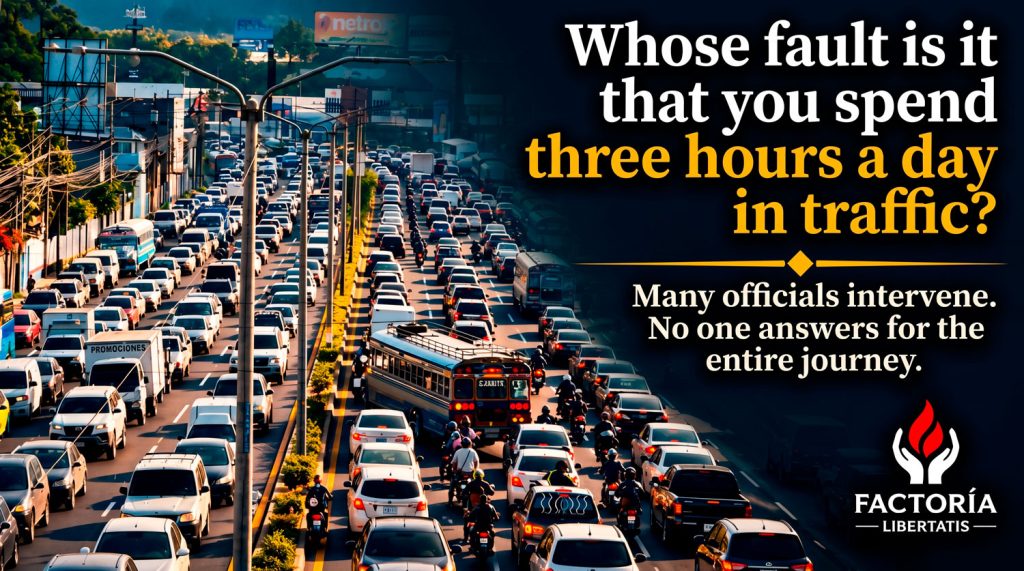
It is ten past six in the morning. You have been sitting for twenty minutes without moving on the Villalobos slope. In front of you, an endless line of red lights climbs toward the capital. You look at your watch. You will be late again. What you don’t know is that, a few kilometers ahead, you will cross an invisible border: you will leave Villa Nueva and enter Guatemala City. You cross it every day, but when traffic steals three hours of your life, whom can you hold accountable?
On October 28, the Federation of Chambers of Commerce of the Central American Isthmus presented a study on urban mobility in Panama. Guatemala posted the worst result of the five capitals studied: a worker who travels more than 10 kilometers to get to his job spends, round trip, 3 hours and 10 minutes a day in traffic. In Panama it is 2 hours and 20 minutes; in San Salvador, 2 hours and 10 minutes. If he works 240 days a year, the Guatemalan will have spent the equivalent of 95 eight-hour workdays in traffic. Nearly a hundred days of work that could have gone to producing, resting, or being with his family. Time lost forever.
The problem is that your street is fixed by a mayor, but your trip cannot be fixed by any of them. You can leave one municipality, cross another, and work in a third. Each mayor can act on the streets under his responsibility, but none can solve the entire route alone. While the city grew and spilled past its municipal limits, decisions stayed locked inside them. You pay the consequences every day.
The law provides for an official in charge of coordinating municipal policies: the departmental governor. Article 47 of the Law of the Executive Branch expressly assigns him the responsibility to “ensure the effective coordination of municipal policies.” He is appointed by the President of the Republic and can be dismissed whenever the President sees fit. In theory, someone is in charge of making the municipalities act in coordination. Why, then, are we still trapped in the same problem?
The contradiction appears when one reads his powers. The governor can represent, preside, oversee, promote, inform, and supervise. But the law does not grant him, through those functions, the power to decide how transportation between municipalities is organized or to carry out the works needed to solve it. The governorships have budgets, but they lack a general mandate and the resources to manage metropolitan mobility. He was tasked with coordinating a city that functions as one, without being given the instruments to govern its common problems.
Why does a city that functions as one keep being governed in parts? To understand it, we must go back several centuries, to when communities had their own authorities, laws, and customs, and power was organized in a very different way. The story of how we went from that diversity to our current territorial division helps explain why administrative borders still weigh so heavily on our daily lives.
The Hispanic political tradition, rooted in the Visigothic era and developed over centuries up to the monarchy of the Habsburgs, recognized different forms of autonomy for communities to govern their own affairs. Their authorities knew the territory, its inhabitants, and their needs. That autonomy had a virtue: it brought decisions closer to those who had to live with their consequences. But it also raised a question that is decisive today: what happens when a problem stops belonging to a single community and affects many at once?
In 1135, Alfonso VII was crowned emperor in the cathedral of León. Under his authority coexisted various kingdoms and lords who kept their own laws, institutions, and customs. Ramón Menéndez Pidal described him as a “king of local kings.” That tradition evolved over centuries until it took a more complex form under the Habsburgs: the composite monarchy. A single sovereign governed different territories, whose charters (fueros) and privileges he had to recognize and, depending on the kingdom, swear to uphold. Political unity did not require that all communities be governed in the same way.
More than three centuries ago, on a day like today, November 16, 1700, Louis XIV presented his sixteen-year-old grandson at Versailles as the new king of Spain. When the Spanish ambassador addressed a few words to him in Castilian, the French monarch had to answer for him: the boy did not yet understand the language of his new subjects. That young man, Philip V, arrived in Spain and swore to respect the fueros of Aragon and the constitutions of Catalonia. But in 1707 he abolished the fueros of Aragon and Valencia, and in 1716 he imposed a new political organization on Catalonia. The king who had sworn to respect the institutions of his kingdoms ended up suppressing some of them, leaving a historical wound that is still part of the conflicts between Catalonia and Madrid.
With the Bourbons came to Spain a French conception of government: to make institutions uniform and concentrate decisions in the Crown. Where laws, prerogatives, and forms of government had once coexisted side by side, the aim became to impose more homogeneous rules. Territorial diversity, which for centuries had been part of the monarchy’s organization, began to be seen as an obstacle to governing it. That transformation would also reach the Kingdom of Guatemala, though by different paths and several decades later.
The Kingdom of Guatemala was also organized around communities with their own authorities. The historian Jordana Dym described it as a “republic of cities”: each had its cabildo (town council) and governed a territory that could extend many leagues around it. But that organization began to change with the reforms of Charles III. Starting in the 1780s, the Crown introduced the intendancy system to reorganize the administration and strengthen its authority. Dym identified a paradox: the reforms designed to increase the monarchy’s control also helped redistribute political power among the American communities.
But the deepest transformation came after independence, and this time we drove it ourselves. Until then, cities, towns, and villages had different categories and powers, reflecting their respective traditions and institutions. In 1825, the Assembly of the State of Guatemala reorganized the territory into departments and established a more uniform municipal framework. That reorganization drew on European administrative models, particularly the French one. Communities kept their names and a good part of their local life, but began to be governed within a territorial structure designed from above by officials.
The French model had a very specific purpose. In 1790, the Revolution reorganized France into departments whose names, taken mainly from rivers, mountains, and other geographic features, replaced the old provincial designations. One of the proposals was to divide the country into 81 almost square units. Among the criteria discussed was that a citizen should be able to travel from his locality to the administrative seat and back in a single day. It was a way of organizing territory around the distances that could be covered on horseback. More than two centuries later, we are still trying to govern cities of millions of inhabitants through administrative divisions inherited from times when automobiles did not exist.
Administrative uniformity also found critics in Guatemala. In the nineteenth century, Mariano de Aycinena, former head of state and a prominent figure of Guatemalan conservatism, warned against “setting up a uniform system” that would upset “the particular regime of the towns, established by themselves.” His argument was simple: communities had developed their own institutions and did not necessarily all have to submit to the same model. The warning remains relevant when officials play at being little gods, imposing decisions and restrictions without understanding the consequences they will have on people’s daily lives.
Let us return to the Villalobos slope. In early November 1839, when Guatemala was reorganizing its territorial administration, the authorities established an independent district made up of Amatitlán, Palín, Villa Nueva, and the Petapas, with its own authorities to handle its affairs. In 1866, to maintain administrative uniformity, they turned it into a department. But in 1935 officials abolished the department of Amatitlán and divided its municipalities between Guatemala and Escuintla. Today, almost two centuries later, you are still stuck in one of those same corridors, while our institutions are still looking for a way to govern it.
In 2012, the mayors themselves recognized the need to work together. Six municipalities in the south of the metropolitan area formed the Mancomunidad Gran Ciudad del Sur: Amatitlán, Mixco, San Miguel Petapa, Santa Catarina Pinula, Villa Canales, and Villa Nueva. Guatemala City joined in 2019. The association has promoted shared projects and services, but it lacks a general authority to organize transportation and traffic among all those municipalities. Almost two centuries after that district of 1839, the communities once again sought a joint response. The problem is that we still have no institution responsible for the complete trip you make every morning.
But is there a solution? The answer is yes. In 2014, Rotterdam, The Hague, and other municipalities in the Netherlands constituted a common metropolitan authority, which began operating in 2015. Today it brings together 21 municipalities and approximately 2.4 million inhabitants. Each municipality keeps its local government, while the metropolitan authority coordinates regional public transportation. Why do we want more bureaucracy, you will ask. Precisely to avoid it, the solution must consist of assigning clear responsibilities and existing resources, without duplicating offices or functions. The route between them will finally have an owner.
Here there is no need to reform the Constitution. Article 224 allows Congress to modify the country’s administrative division, even to establish other systems, provided it respects municipal autonomy. But there is something even more revealing: Article 231 expressly recognizes the Metropolitan Region, made up of Guatemala City and its area of urban influence, and provides that a law shall determine its administrative organization. The Constitution has offered the basis for addressing this problem for forty years. What is missing is turning that possibility into an organization capable of answering for the problems we share across municipalities.
To solve it, the president could, as soon as tomorrow, instruct the departmental governor to bring the metropolitan mayors together. Congress could, as it just did with the Film Law, declare a Metropolitan Mobility Law a matter of national urgency. The mayors would form a council in charge of appointing, through a merit-based competition, a director with proven experience, clear responsibilities, and enforceable results. The proposal would draw on existing institutions, without multiplying bureaucracy. That way, when you lose three hours of your life in traffic, there will be someone to demand a solution from.
The map that governs us was drawn two centuries ago, when no one imagined a city of millions of inhabitants that would cross several municipalities every morning. The city changed, but our institutions did not learn to govern it as one. Meanwhile, you are still stopped on the Villalobos slope, looking at your watch and watching another morning of your life slip away. My question for you is this: are you willing to demand today, from the president, from Congress, and from the mayors, that they act now so that we can begin to solve our mobility problem?
Ramiro Bolaños, PhD. / President of the Centro de Pensamiento y Acción Factoría Libertatis
References
- Arrieta Alberdi, Jon, “Entre monarquía compuesta y estado de las autonomías.”
- Congreso de la República de Guatemala, “Nueva normativa promueve el arte cinematográfico” (November 10, 2026), https://www.congreso.gob.gt/noticias_congreso/17461/2026/4.
- Constitución Política de la República de Guatemala (1985), arts. 224 and 231.
- Coronas González, Santos M. (coord.), Fueros locales del reino de León (910-1230) (Madrid: Agencia Estatal Boletín Oficial del Estado, 2018).
- Coronas González, Santos M., Los juramentos forales y constitucionales de Felipe V en los reinos de España (1700-1702) (Madrid: Agencia Estatal Boletín Oficial del Estado, 2017).
- Dym, Jordana, A Sovereign State of Every Village: City, State and Nation in Independence-era Central America, ca. 1760-1850 (doctoral dissertation, New York University, 2000).
- Elliott, John H., “A Europe of Composite Monarchies,” Past & Present 137 (1992): 48–71.
- Federación de Cámaras de Comercio del Istmo Centroamericano, Impacto del Tráfico y la Movilidad Urbana (Panama City, October 28, 2026).
- Menéndez Pidal, Ramón, El imperio hispánico y los cinco reinos (1933).
- Metropoolregio Rotterdam Den Haag, “Bestuur” and “MRDH-organisatie,” https://mrdh.nl/wie-zijn/bestuur and https://www.mrdh.nl/wie-zijn/mrdh-organisatie.
- Morales Urrutia, Mateo, La división política y administrativa de la República de Guatemala, vol. I (1961).