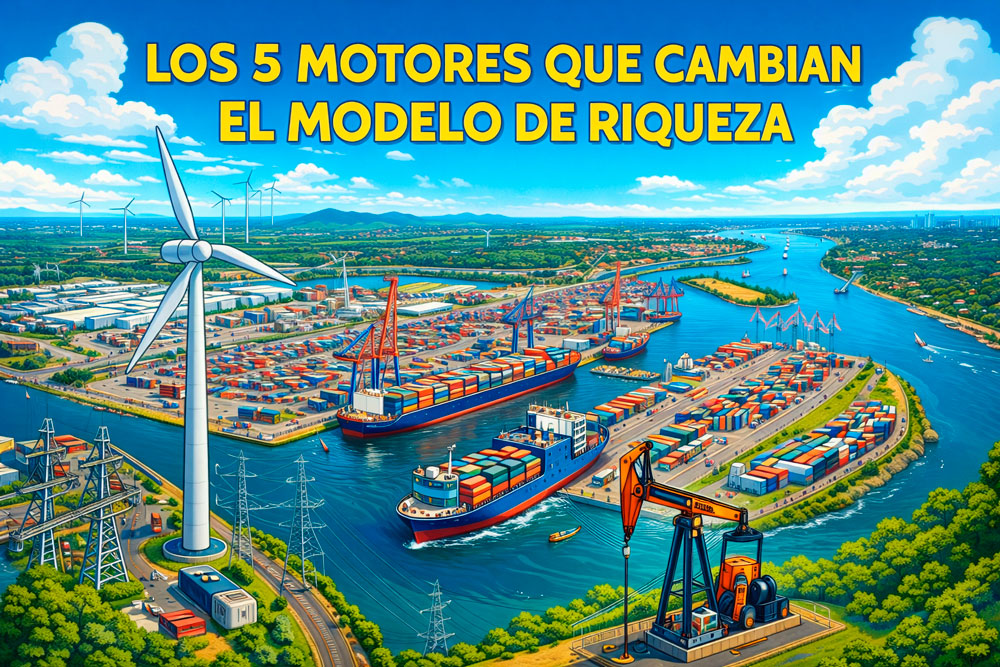
I do not believe in privileges or special conditions for specific sectors, but I do believe in country models that allow nations to compete among the global elite. Guatemala is one of the few countries on the planet that could activate the five engines shared by the world’s most productive economies: high-value industry, strategic logistics, abundant energy, sophisticated services, and premium agro-marine production. We are not talking about size, but about productivity per person, competitiveness, added value, and surplus that remains at home.
Economist Paul Krugman wrote that productivity is not everything, but in the long run it is almost everything. A nation’s standard of living depends on how much value each worker produces. This can be demonstrated in reality. If we measure productivity through exports per capita, Luxembourg exports US$263 thousand per person. Guatemala barely exports US$977. Rank 126 in the world. In all of Central America, we are the country with the lowest productivity: even Belize, with US$4,241, exports more than four times per person than we do.
If we look at the 14 countries with the highest export productivity per person, we will see that there are five extremely powerful engines of wealth generation, in addition to certain conditions necessary for economic growth, such as simple rules with general compliance, a non-corruptible legal system, and guaranteed economic freedom for individuals and businesses.
The first engine is high-value goods exports per capita. Countries that became rich by manufacturing very complex and expensive products per worker: medicines, advanced chemicals, precision machinery, sophisticated electronics, or premium biological products. This group includes Ireland, Switzerland, Malta, and Iceland.
Ireland is today a biopharmaceutical and chemical powerhouse. Switzerland exports innovative pharmaceuticals and highly precise machinery. Malta integrates itself into value chains where what crosses the border is not a commodity but niche industrial goods with embedded technology. Iceland adds to this aluminum produced with very cheap and clean energy: it imports bauxite, transforms it, and exports high-value aluminum, in addition to high-quality processed marine products.
The second engine is high-transit logistics: countries that not only produce and export high-value goods, but also become the place through which other nations’ trade passes. In the Netherlands, Singapore, Hong Kong, and Belgium, a huge portion of what is recorded as exports did not originate there, but rather enters, is stored, transformed, financed, and then exits again. This allows them to achieve even higher exports per capita: the value of the product plus transportation, financing, and transformation services, in the style of Panama. There, trade creates value three times: when it enters, when it is transformed, and when it exits again. Guatemala has the geography; what it lacks is efficiency and infrastructure.
The third engine is minerals and energy: the ability to capture extraordinary rents from scarce and highly demanded natural resources. Norway transformed its North Sea oil and gas reserves into a gigantic flow of exports per capita and into a sovereign wealth fund that capitalizes that income for the future. Iceland combines geothermal and hydro resources with a small population and achieves one of the cheapest and cleanest energy systems in the world per person. With 37 volcanoes and abundant rainfall, Guatemala has the highest energy potential in the region.
The fourth engine is elite services, meaning economies that specialize in selling the world financial services, risk management, tourism, entertainment, or knowledge so sophisticated that they alone sustain extremely high levels of income per person. Luxembourg, Macau, Bermuda, and Hong Kong are clear examples of this pattern. Luxembourg and Hong Kong demonstrate how financial and professional services can become high-value exports. They export decisions, legal structures, and global capital management.
The lesson is that a small country can become very rich by specializing in intangible niche services, as long as it achieves three things: institutional trust, so the world entrusts it with its money or risks; a competitive legal and regulatory environment; and a critical mass of highly qualified talent. Unlike the industrial engine, what is exported here are decisions, information, expertise, and highly specialized time, and the added value per worker can be higher than in the best manufacturing sectors. Guatemala already has tourism that only needs to be strengthened with financial services, reinsurance, and market intelligence.
The fifth engine is high-value agriculture and marine products, where wealth does not come from selling tons of cheap commodities, but from very few kilograms of premium biological products. The clearest examples here are the Faroe Islands and Iceland.
The Faroe Islands live almost literally from the sea: between 90% and 95% of their exports come from high-quality fishing and aquaculture. Iceland follows a similar logic. Incredible as it may seem, the Faroe Islands’ exports per capita exceed US$40 thousand, forty times more than Guatemala’s. Off our coasts lies one of the richest zones of tuna and billfish abundance in the eastern Pacific, globally recognized for the quality of its sport and commercial fishing. Agriculture and fishing stop being synonymous with backwardness when they become branded and traceable niche bio-industries.
Guatemala is, perhaps without realizing it, one of the few geographies in the world where these five engines could coexist simultaneously. It is not a country condemned to mediocrity. It is a country that has not decided to compete seriously. This requires clear rules, predictable justice, efficient infrastructure, and a State that facilitates instead of obstructing. Being such a geographic rarity in the world, let us begin taking the future of our country seriously.
This is not a utopia. It is an observable model. A country where half the economy exports high-value goods and services, where logistics generate margins, energy is abundant and cheap, tourism captures premium spending, and the sea becomes a sophisticated industry.
In that model, Guatemala stops exporting cheap volume and begins exporting intelligence, energy, logistics, and brand value.
Activating these engines requires concrete decisions: doubling the exports-to-GDP ratio by improving the quality of what we sell; investing in ports, airports, customs, and logistics corridors; expanding electrical transmission and exporting renewable energy; sophisticating tourism toward higher spending per visitor; and transforming agriculture and fishing into premium brands with international certification.
Guatemala has territory, climate, energy, location, and talent. What is lacking is not potential. It is decision. The question is not whether we can do it. The question is when we decide to stop settling. Change begins with the model. And models do not change by accident; they change by decision. Let us dare to choose what kind of Guatemala we want to build.
Ramiro Bolaños, PhD. / President of the Think Tank and Action Center Factoría Libertatis.
References:
Krugman, Paul. The Age of Diminished Expectations: U.S. Economic Policy in the 1990s. Cambridge, MA: MIT Press, (1994).
The 14 countries with the highest exports per person in 2024 were: 1. Luxembourg US$263k – 2. Ireland US$163k – 3. Singapore US$162k – 4. Hong Kong US$98k – 5. Switzerland US$75k – 6. Bermuda US$74k – 7. Macau US$66k – 8. Netherlands US$55k – 9. Malta US$52k – 10. Denmark US$50k – 11. Belgium US$44k – 12. Norway US$41k – 13. Faroe Islands US$40k – 14. Iceland US$36k – 55. Panama US$8.5k – 61. Costa Rica US$7.1k – 80. Belize US$4.2k – 92. Dominican Republic US$2.5k – 102. El Salvador US$1.8k – 117. Nicaragua US$1.15k – 118. Honduras US$1.15k – 126. Guatemala US$0.98k
World Bank. 2025. World Development Indicators: Exports of goods and services (current US$), indicator code NE.EXP.GNFS.CD. World Bank, Washington, DC. Available at: World Development Indicators (WDI). https://data.worldbank.org/indicator/NE.EXP.GNFS.CD [Accessed February 28, 2026].
World Bank. 2025. World Development Indicators: Exports of goods and services (current US$), indicator code NE.EXP.GNFS.CD. World Bank, Washington, DC. Available at: World Development Indicators (WDI). https://data.worldbank.org/indicator/NE.EXP.GNFS.CD [Accessed February 28, 2026].