In After Virtue, Alasdair MacIntyre explains that societies are not sustained by institutions, laws, or technical programs, but by shared moral narratives. A people remains united only when it can say who it is, whom it admires, what it considers honorable, and why sacrifice is worthwhile. In heroic societies —those he analyzes in his famous chapter on “heroic peoples”— identity is not a choice; it is a narrative. Virtue is not a feeling; it is a duty. The individual does not exist in isolation; he exists within a story where his actions are judged by his clan and his ancestors. Honor is the moral compass: losing it is worse than dying. And when a people ceases to have heroes, it ceases to have a common narrative. When that happens, virtue withers and the republic collapses from within.
Guatemala was born within that heroic tradition. We do not say this out of romanticism, but because of verifiable facts. Our Maya peoples built for centuries a civilization where virtue was public and narrative. The so-called star wars, documented in inscriptions and studied by Linda Schele, show at least a dozen ritual wars through which cities legitimized their rulers. These were not improvised conflicts; they were military ceremonies linked to the heavens, cosmic cycles that ordered political and moral life. In paintings and stelae, the ruler appears capturing his rival, ritually humiliating him to demonstrate that his lineage was worthy. Identity was clear: the hero is the one who sustains the people’s story. And when one looks at that sequence of victories, captures, and defeats among Tikal, Calakmul, Yaxchilán, or Palenque, it becomes clear that our ancestors lived in an almost permanent state of heroic rivalry. Honor was everything.
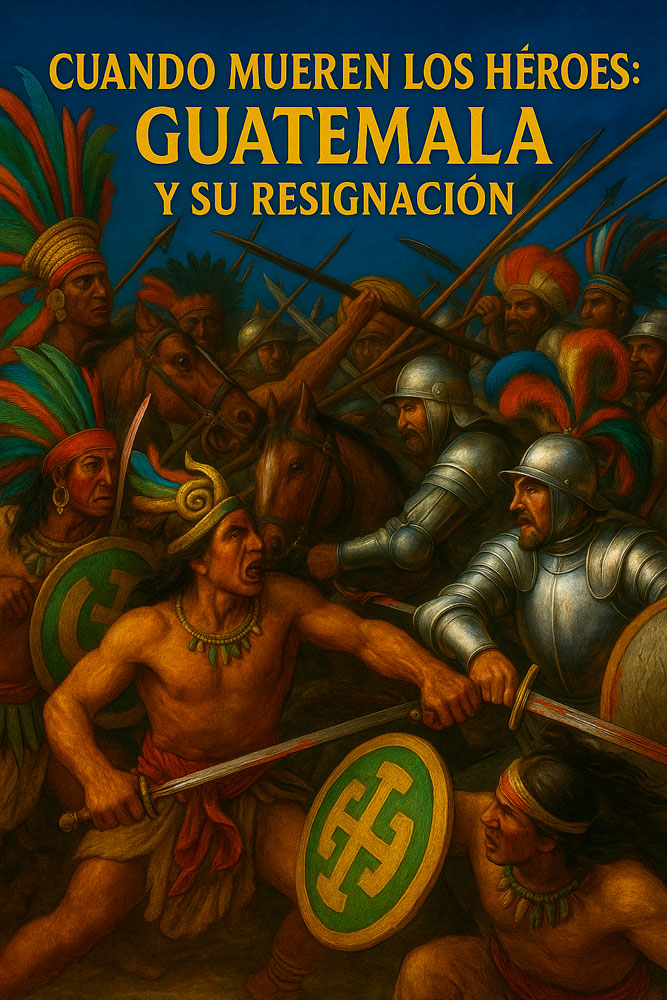
Already in the fifteenth century, the Highlands experienced episodes that showed that same spirit. In 1492, the K’iche’ attacked Iximché with an army of more than sixteen thousand men. The Cakchiquels were less than half that number. They defeated them through strategy, knowledge of the terrain, and discipline. It was not just a battle: it was the affirmation of a people’s destiny. A few years later, when the Spanish arrived, that ethos remained alive. The defense of Zaculeu, led by Kaibil B’alam, is one of the most heroic scenes in our history: hundreds of warriors resisting for months the siege of thousands of indigenous allies and Spanish troops, feeding themselves on boiled leather and roots, never surrendering. The death of Kaibil B’alam is not just a historical fact: it is a symbol. That man embodies what MacIntyre calls “the tragic hero”: one who chooses virtue even if it means his end.
The Conquest in Guatemala lasted one hundred and seventy-three years. No other Mesoamerican territory resisted for so long. The first great battle of Acajutla, described by Pedro de Alvarado in one of his letters to Cortés, shows the power of the Pipils. More than twenty thousand warriors against barely one hundred and fifty Spanish horsemen, two hundred and fifty infantrymen, and around six thousand Tlaxcalans. Alvarado confesses fear. He confesses vulnerability. The wound he receives would leave him lame for life. Those battles were followed by Jorge de Alvarado’s 1526 campaign with the Quauhquecholtecas, the pact with the Cakchiquels, the wars against the Poqomames, Mopanes, and Itzaes, the pacification of the so-called “Land of War,” which the Franciscans would transform into “Vera Paz” not through conquest, but through dialogue and evangelization. And finally, Tayasal, the last independent city on the continent, which fell in 1697. Guatemala’s history is a history of very long, complex, and dignified heroic strength; even in 1820, Atanasio Tzul in Totonicapán once again embodied that same spirit by challenging imperial authorities in defense of his people.
But that greatness became intermittent with the arrival of the modern world. In 1821 we did not fight for our independence. Unlike El Salvador, which did take up arms, Guatemala annexed itself without resistance to the Mexican Empire. And when the region reorganized in 1823, Guatemala lost Chiapas, Soconusco, Santa Ana, and Sonsonate without combat. Belize consolidated itself as a British colony and remained outside Guatemalan territory in 1859 through the Wyke–Aycinena Treaty, without any real military defense. It was a century where there was courage, yes, but also renunciation. And that renunciation fractured the heroic narrative.
Even so, nineteenth-century Guatemala preserves moments of greatness. The State of Los Altos became independent in 1838 and had its own flag, government, and structure. Rafael Carrera reincorporated it by force in 1840 and then definitively in 1849. Carrera defeated Morazán when he invaded Guatemala in 1840 and won the Battle of La Arada on February 2, 1851, facing with Guatemalan forces of 1,500 men a combined army of 4,500 Salvadorans and Hondurans that practically tripled his numbers. La Arada is still studied today at West Point because of the strategic brilliance of its use of terrain: zigzag artillery, elevated positions, swamps as natural barriers, and the famous burning of the sugarcane field that blinded and disoriented enemy troops. And in 1847 came the founding of the Republic of Guatemala by Rafael Carrera himself. During the war against the filibusters (1856–1857), Guatemala sent decisive contingents, from which figures such as Marshal Zavala and other national heroes emerged, helping to defeat William Walker’s slaveholding project. At the end of the nineteenth century, in the Totoposte wars, Guatemala successfully defended itself again. And at the beginning of the twentieth century, Estrada Cabrera mobilized tens of thousands of civilians —sources speak of figures close to seventy thousand— to simultaneously confront a rebellion supported by Mexico and troops from El Salvador, Honduras, and Nicaragua. All this demonstrates a surprising military strength: Guatemala records almost no defeats in open warfare; even during the internal armed conflict, the State was not militarily defeated. Its greatest losses have been political, not military.
The problem has not been a lack of capability. It has been a lack of moral continuity. Guatemala had heroes —Carrera, B’alam, the defense of the nineteenth century— but it never developed a modern heroic ethos like Japan, Finland, Israel, or the Georgians in 2008. And the definitive rupture came in the twentieth century. The internal war destroyed not only lives, but the national narrative. It divided the country between rich and poor, between oppressors and oppressed, between ladinos and indigenous people, between elites and everyone else. That manufactured narrative erased the idea of a mestizo and united people. It replaced the figure of Carrera —founder of the Republic in 1847— with the ideological exaltation of Morazán. It shattered the only possible basis for rebuilding a national project: recognizing ourselves as one people. When a country loses its heroic narrative, it loses its virtue.
And that is what we feel today. Guatemala lives in an era in which almost everything has become acceptable. Government execution is minimal. Congress openly displays votes negotiated for tens of millions of quetzales. The national budget has grown sixty percent in barely three years as if debt were a sport and not a moral responsibility. Corruption accusations multiply while society lowers its gaze. And the most dangerous thing is not what happens above, but what happens below: silence. When a country stops feeling indignation, it enters the antechamber of its moral death. Mexico is the closest contemporary example: a State that little by little has ceded spaces to mafias, corruption, and political capture, not because people do not see it, but because they have stopped reacting. Guatemala is not there yet, but it walks toward that precipice if it continues renouncing its civic courage.
The risk is no longer poverty, inequality, or whether one party governs better or worse. The risk is deeper: that Guatemala ceases to be a country capable of defending what belongs to it. That it renounces, as it did in the nineteenth century, but this time not a territory, but its soul. Because when heroes die —when no one is willing to defend truth, dignity, and civic honor— the republic is left without guardians.
And yet, not everything is lost. History shows that Guatemala has always been stronger than it believes. That when it remembers who it is, it rises. That it possesses a heroic legacy that no trauma has managed to erase completely. That legacy must come back to life: not to glorify war, but to recover virtue. Virtue to feel indignation without violence. Virtue to demand without hatred. Virtue to defend without destroying. Virtue to say, as our ancestors said, that there are things worth fighting for. Guatemala will survive only if it recovers the courage to defend what is still its own.
Ramiro Bolaños, PhD.
References
- Alasdair MacIntyre. After Virtue. (Notre Dame: University of Notre Dame Press, 1981), pp. 110-122.
- Linda Schele & Mary Ellen Miller. The Blood of Kings: Dynasty and Ritual in Maya Art. (Fort Worth: Kimbell Art Museum, 1986), pp. 36-55, 112-129.
- Pedro de Alvarado. “Second Letter to Hernando Cortés” in Letters from Don Pedro de Alvarado to Hernán Cortés. (Guatemala: National Printing Office, 1913), pp. 16-20.
- Maria Eugenia López Mejía. Popular Revolts and Liberal Factions. Central America in the Years of Independence. (San Salvador, Universidad Tecnológica Publishing House, 2021).
- Alejandro Marure. Ephemerides of the Republic of Central America. (Guatemala: Imprenta de la Paz, 1844), pp. 3-5, 12-17, 25-27, 56-61.
- Alejandro Marure. Historical Sketch of the Revolutions of Central America. (Guatemala: Tipografía El Progreso, 1877), Volume I, pp. 145–152, 215–218, 243–249, 258–272.
- Alejandro Marure. Historical Sketch of the Revolutions of Central America. (Guatemala: Tipografía El Progreso, 1878), Volume II, pp. 12–15, 47–52, 92–103, 110–120, 160–170.
- Rafael Carrera, “Speech by President Rafael Carrera on the Founding of the Republic of Guatemala (1847).” (Guatemala: National Printing Office, 1847), pp. 1-4.
- L. Zorina. “The Clayton-Bulwer Treaty of 1850 and Russian Diplomacy” in Central America and the Great Powers. (Moscow: Institute of Latin America of the USSR Academy of Sciences, 1980), pp. 175-194.
- Ricardo de Jesús Moscoso Chigua, Rafael Carrera: His Life, the Battle of La Arada, and Other Feats. (Chiquimula: Imagraf G&N, 2017), pp. 194-203.
Battles Won by Guatemala
Battle of San Miguel Dueñas (1828); Battle of El Aceituno (1829); Battle of Guatemala against Morazán (1840); Defeat of the State of Los Altos (1840 and 1849); Battle of La Arada (February 2, 1851); War against the Filibusters (1856–1857); Totoposte Wars (1890s); Conflicts with Honduras, Nicaragua, and El Salvador (1897–1902); Internal Armed Conflict (1960-1996).
Defeats of Guatemala
The Filisola Invasion (1823); Morazán’s Entry in 1829; Internal Conflicts (revolts 1826–1830).