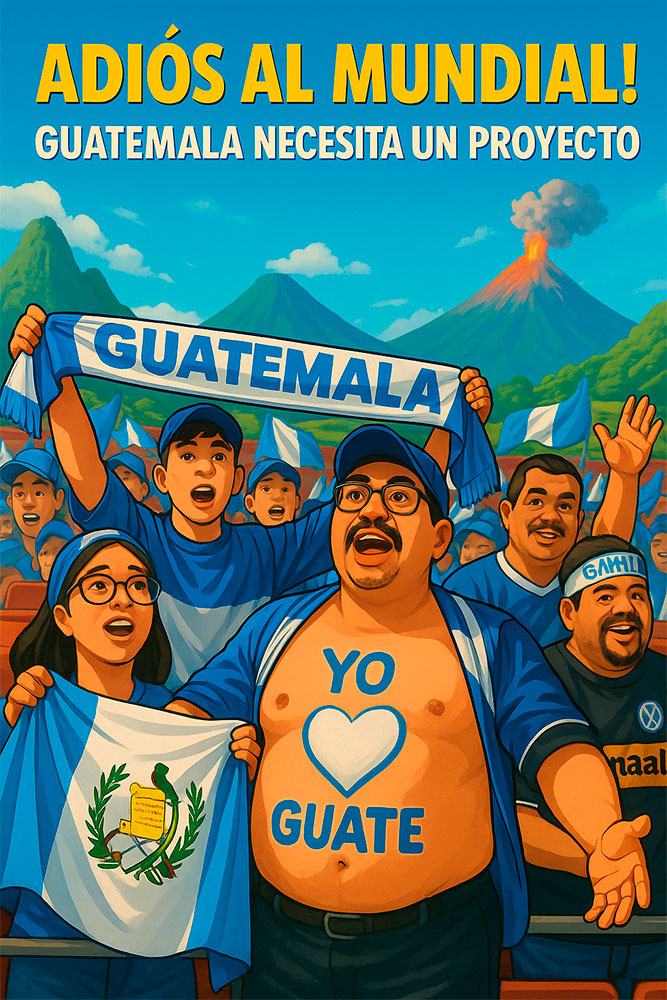
The entire country held its breath for ninety minutes. For some, that match no longer meant anything. “Why watch it? They’re going to lose anyway,” they said with the resignation of those accustomed to defeat. For others, the day was filled with hope; they had followed every step of the qualifiers and believed in the possibility of a miracle. Two opposite emotions, one identical ending: Guatemala was once again left out of the World Cup.
Fourteen complete qualifying campaigns. Fourteen repeated illusions. Fourteen identical endings. It is not bad luck. It is not punishment. It is a profound reflection of the country we are. What happens with the national team happens with Guatemala: we advance a little, become hopeful, stumble, fall back, and start over again without breaking the pattern that has repeated itself for decades.
This is not a column about football. It is a moral and cultural X-ray of a country that, like its national team, cannot build the transformative project it needs.
The same thing happens in sports: while some shine individually, the structure of team sports repeatedly sinks. This generation ended up repeating an old national vice: complacency. We believed that a good performance in the Gold Cup made us superior. We assumed El Salvador would be an easy step, when the results of the last 25 years show no real superiority. And suddenly, while winning, we allowed Suriname to equalize in the 90+4 minute, when the match was already dying. Against Panama, we achieved the miracle of tying the game with two consecutive goals —in the 69th and 72nd minutes— only to lose focus six minutes later and allow the decisive blow in the 78th minute. The image of the national team’s equipment manager crying went around the world. It is the same emotional curve as the country: immediate enthusiasm, brief discipline, inevitable collapse.
Behind every elimination there is something more serious than a scoreline: the absence of a transformative project. In Guatemala, every cycle starts from zero. New coach, new promises, new hope… but without continuity, without integrated methodologies, without solid academies, without real infrastructure, without a national development model. The country works the same way. Every government erases the previous one, every institution starts over, every administration improvises. No collective project prospers without continuity.
The most alarming thing is that we have normalized low standards. Most people are not held accountable, few evaluate processes, and very few measure results rigorously. In a local comedy, they joked that if NASA had been created in Guatemala it would be called WASA, because here everything is treated like a joke. The humor works, but it reveals something deep: we have turned improvisation into identity and low standards into culture. “Just let it go,” they say. That mentality has made us lose matches, opportunities, investments, and decades of development.
In the last 25 years, nine countries have managed to do what Guatemala has never achieved: break their cycle, transform their national team, and compete among the elite. Belgium, Morocco, Croatia, Japan, Iceland, Senegal, Canada, Switzerland, and Qatar made extraordinary leaps in FIFA rankings. Some went from modest national teams to World Cup semifinalists. Others climbed from below the 100th position into the top twenty.
What did they do? They professionalized youth development, exported talent to elite leagues, hired internationally recognized coaches with real continuity, invested consistently for ten to fifteen years without interruption, and corrected their institutional culture. The countries that broke their curse did so when they decided to correct their culture, not only their tactics.
And here appears an uncomfortable truth: a coach earning US$300 thousand a year changes nothing. Our federation manages around US$5 million a year, enough to operate, but insufficient to transform. To understand the magnitude of the challenge, it is enough to observe what the countries that broke their curse did: Belgium invested more than a decade in academies and performance centers; Morocco allocated hundreds of millions to infrastructure and professionalization; Japan built a training system that took fifteen years to consolidate; Canada and Senegal raised their annual investment above US$25 million sustained over time. None of this happened overnight. It required significant amounts of money, but above all continuity, discipline, and a national conviction that collective success depends on extraordinary effort. What truly transforms is vision, investment, continuity, and discipline.
At an individual level, Guatemala produces extraordinary talent. Brilliant young people, exceptional athletes, entrepreneurs capable of competing in any market in the world. We have already won three Olympic medals in individual events, and Pescadito held the world record for the most goals in World Cup qualifiers for nine years, proof that when success depends on personal effort, Guatemala can compete at the highest level. But the collective leap requires something more: character, discipline, and planning.
In Uruguay, character is called garra. Rubén Amorín, the most successful Uruguayan coach in our country, stated that character is born from the moral commitment to compete with everything, beyond the size of a country. That inner strength is what allows a small team to defeat giants. And the brightest stage in our football history came precisely from Amorín and the Uruguayan garra he instilled in our national team.
That is why Guatemala has a period in its history that proves we are not condemned to mediocrity. There was a golden era that almost no one remembers today: we were NORCECA champions, we lost only 1-0 against the Olympic champion of that time, and we even defeated Czechoslovakia, a world football power. That achievement is worth more than the famous draw against Brazil because it was not an accident; it was the result of character, discipline, and a generation that believed Guatemala could compete with anyone. That history proves that garra is also part of our mental framework. We simply need to recover it.
And in discipline and planning, this is where Japan enters. A nation that now dominates world baseball thanks to discipline, precision, patience, and a culture of effort. Japan demonstrates that excellence is not accidental; it is training, method, and consistency. It produces players like Ohtani and Yamamoto, leaders of the Los Angeles Dodgers, because its system perfects talent instead of exhausting it through improvisation.
In the history of ice hockey there is another decisive example. In 1980, the United States defeated the Soviet empire, which led in almost everything. That coincided with the leadership of Ronald Reagan, who in eight years managed to overcome the most powerful adversary of his time because he changed the character of his nation. That victory was not only athletic; it was the reflection of a country that decided to stop kneeling and started competing as if its destiny depended on it. That is the kind of transformation Guatemala needs today.
We did not lose a match: we lost another opportunity to break the cycle. But this defeat can also become the turning point we have postponed for decades. Guatemalan football does not need adjustments; it needs a true transformation. The famous constitutional 3% allocated to sports would allow the assignment of US$100 million to a serious national project of training, infrastructure, regional academies, and total professionalization of the system. It is not a dream. It is a budgetary decision and an act of vision.
The same applies to Guatemala. A country that decides to double its GDP per capita, raise its exports to 50% of GDP, and organize itself around a national strategy can achieve it. Bulgaria did it in just twenty years: it transformed itself by multiplying productivity, attracting investment, and connecting its economy to the world. Changing destiny is possible. In football and in the country. It is a matter of truly committing ourselves and building a national project that does not depend on political cycles or improvisation. When a country decides to grow, history changes. When Guatemala decides to do it, it will too.