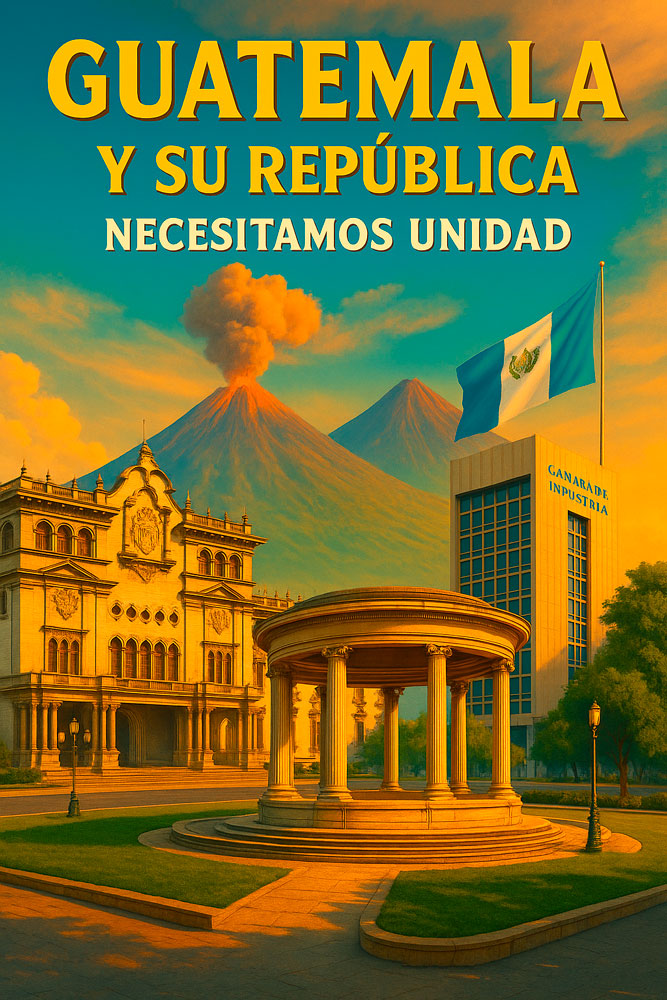
In recent months, we have heard a dangerous idea repeated in Congress and in certain political circles: building a Guatemala without CACIF. The proposal is not minor. It implies eliminating the representation of the organized productive sector from State boards and, with it, breaking one of the essential balances of any functional republic. A country that replaces dialogue with expulsion and representation with imposition does not become stronger; it fragments. And a fragmented republic almost always ends up poorer, weaker, and more subjected to the interests of the political power of the moment.
Since Aristotle, Polybius, and Cicero, the republic has been understood as a delicate balance between three forces: government (monarchy in its abstract form), the productive elite (aristocracy), and the people (democracy).1 Each contributes stability from its own place, but each also possesses a defect that, without counterweights, destroys the system. Monarchy tends toward dictatorship, as occurred in absolutist France or Tsarist Russia; aristocracy degenerates into oligarchy when it ceases to renew itself, as happened in Argentina at the end of the nineteenth century; and democracy, without restraints, can fall into anarchy or populism, as demonstrated by classical Greece or, more recently, Venezuela and Nicaragua.2 The republic survives only when these forces balance one another; it dies when one attempts to suppress the others.
Eliminating CACIF from institutional representation is therefore a direct attack on one of the pillars sustaining that balance. And what is most serious is that it is based on false premises. CACIF is not a closed club of large corporations. It is a federation of chambers with internal elections, rotating presidencies every year, and representation of entire sectors, not isolated individuals. Documentary evidence from the last fifteen boards proves it: chambers such as FEPYME and the Chamber of Commerce and Services have participated, whose leadership is composed almost exclusively of small and medium-sized businesses. The Chamber of Commerce, which at times has formed part of CACIF and today maintains temporary independence, is itself a reminder that the business sector can act united even from autonomy.
Business diversity is a visible fact. In recent years, several of the country’s largest chambers have been chaired by medium-sized entrepreneurs who compete with national corporations and built their companies from scratch. This form of organization is not a Guatemalan anomaly; it is the norm in countries that have managed to develop and continue doing so. South Korea has the Federation of Korean Industries, Japan has Keidanren, Germany has the BDI, Italy has Confindustria, and in countries such as Ireland, the Netherlands, Sweden, Denmark, and Finland, business confederations play a central role in economic dialogue and the formulation of long-term policies. In all those cases, national prosperity emerged —and continues to endure— thanks to the existence of strong, representative business interlocutors capable of thinking beyond electoral cycles. No successful country has replaced its chambers with political structures; the countries that have done so entered decline. Guatemala should not become the exception.
In economic terms, CACIF’s representativeness is also unmatched. The chambers that compose it group between five thousand and seven thousand companies, but those companies generate between one half and two thirds of national GDP, pay more than two thirds of business taxes not derived from domestic VAT, produce three quarters of the country’s exports, and concentrate most formal employment.3 No other business organization, neither the CNE nor any other political or social actor, comes remotely close to this economic and technical weight. And their spaces on boards are not privileges: they are established by laws requiring the State to listen to representative productive sectors, not improvised structures or individuals chosen by political power.
It cannot be denied that in recent years several international actors —among them cooperation agencies from Western governments— have provided financial and political support to the CNE under the premise that this structure could “balance” the influence of the organized productive sector. The intention may have been legitimate, but the result is problematic: an attempt is being made to replace real and elected business representation with a political structure lacking economic legitimacy, internal elections, and sectoral backing. International cooperation is welcome when it strengthens institutions, not when it replaces them. In the business sphere, replacing an elected federation with a political structure weakens, rather than strengthens, the quality of institutional dialogue.
This type of replacement has clear precedents. It happened in Russia, it happened in Venezuela, and it happened in Zimbabwe. In all those cases, the destruction of independent business representation preceded economic collapse. When that counterweight is eliminated, investment falls, employment is destroyed, inflation rises, and opportunities for State arbitrariness multiply. Elites almost always have the possibility of moving away, relocating their investments, or waiting out the storm. Those left behind to suffer the consequences are workers, small businesses, young people without opportunities, and families dependent on formal jobs. The poor always pay the highest price when a republic is destroyed.
That is why it is important to clarify another point: the enemy is not formal entrepreneurs. The most serious privileges in Guatemala come from companies operating within corruption networks tied to public works, not from the chambers represented in CACIF. It is enough to remember that none of the major companies affiliated with the Construction Chamber appear among the State’s principal contractors. Their real work lies in the more than 250 buildings currently under construction in Guatemala City and the 60 more that will begin next year. The problem is not with those who compete, innovate, and generate employment, but with those who cling to the State to live off opaque contracts.
Those who still doubt the value of solid business interlocution should remember what happened just a few months ago. When Guatemala had to negotiate tariff and export issues with President Donald Trump —probably the toughest negotiator in the world— the government and the business sector walked together. The result was extraordinary: only four countries obtained preferential access: Argentina, El Salvador, Ecuador, and Guatemala. Not even England, with its historic relationship with the United States, achieved that result. This victory was not the product of improvisation; it was the product of unity.
Some will believe I write these lines because I am “aligned” with CACIF. But reality is simpler. I am an entrepreneur. Our company exports artificial intelligence services, and that is why we are affiliated with AGEXPORT, which forms part of CACIF. We did it because we understood something fundamental: it is easier to grow, learn, compete, and sell when one is part of a structure that represents, supports, and opens doors. Since medieval Europe, guilds have been the foundation of small and medium-sized business development. In Guatemala, where 99% of companies are small or medium-sized, strengthening that ecosystem is not about defending privileges: it is about expanding opportunities. And in a country with so much informality, the challenge is not to divide the business sector, but to help entrepreneurs formalize, become more sophisticated, and transform themselves not only into entrepreneurs, but into exporting entrepreneurs.
That is why the underlying debate is not CACIF yes or CACIF no. The debate is whether we want a functional republic with counterweights or a republic captured by a single vision. What Guatemala needs today is unity, not purges; long-term vision, not improvisation; and more participation, not less. Citizens cannot have political space only three months every four years. A democracy is strengthened only when it is exercised. A muscle grows only when it is worked. Our republic does too.
The final question is simple: Do we want a country capable of reaching agreements in order to prosper, or a country condemned to divide itself in order to fail?
1 Democracy comes from the Greek δῆμος κράτος (demos kratos), which literally means the power of the people. Aristocracy comes from ἄριστος κράτος (aristos kratos), meaning the power of the best. Monarchy comes from μόνος ἀρχή (monos arché), meaning a single command or the rule of one. These definitions appear in the classical works discussing forms of government: Aristotle, Politics, books III and IV (especially III.6–7); Polybius, Histories, book VI (the theory of mixed government); Cicero, De re publica (The Republic), books I and II.
2 “Monarchy degenerates into tyranny when the ruler governs for his own interest and not for the common good.” Aristotle, Politics, III.7.1279b. Also found in: Cicero, De re publica, I.26, Polybius, Histories, VI.4. “Aristocracy degenerates into oligarchy when the government of the best becomes the government of a few, oriented toward private benefit.” Aristotle, Politics, III.7.1279b; “Aristocracy, if corrupted, becomes an oligarchy where a few seek power for themselves.” Polybius, Histories, VI.4. / ἀναρχία (anarchía) → absence of government, chaos. ὀχλοκρατία (ochlocracy) → rule of the crowd without law. “Democracy, when corrupted, degenerates into ochlocracy, the rule of the mob.” Polybius, Histories, VI.4; “When liberty lacks restraint, the republic dissolves into disorder.” Cicero, De re publica, I.43. “Extreme democracy turns into anarchy, because each person believes they have the right to do whatever they desire.” Aristotle, Politics, IV.4.1292ª.
3 Estimates based on data from the SAT (Large Taxpayer reports), the Bank of Guatemala (sector participation in GDP), AGEXPORT (export statistics), the Ministry of Economy (export profile), and sector chamber records indicate that companies affiliated with the chambers that make up CACIF generate between 50% and 65% of GDP, pay more than two thirds of business taxes not linked to domestic VAT, produce close to 75% of national exports, and concentrate most formal employment.
In a country with so much informality, the challenge is not to divide the business sector, but to help entrepreneurs formalize, become more sophisticated, and transform themselves not only into entrepreneurs, but into exporting entrepreneurs.
That is why the underlying debate is not CACIF yes or CACIF no. The debate is whether we want a functional republic with counterweights or a republic captured by a single vision. What Guatemala needs today is unity, not purges; long-term vision, not improvisation; and more participation, not less. Citizens cannot have political space only three months every four years. A democracy is strengthened only when it is exercised. A muscle grows only when it is worked. Our republic does too.
The final question is simple: Do we want a country capable of reaching agreements in order to prosper, or a country condemned to divide itself in order to fail?