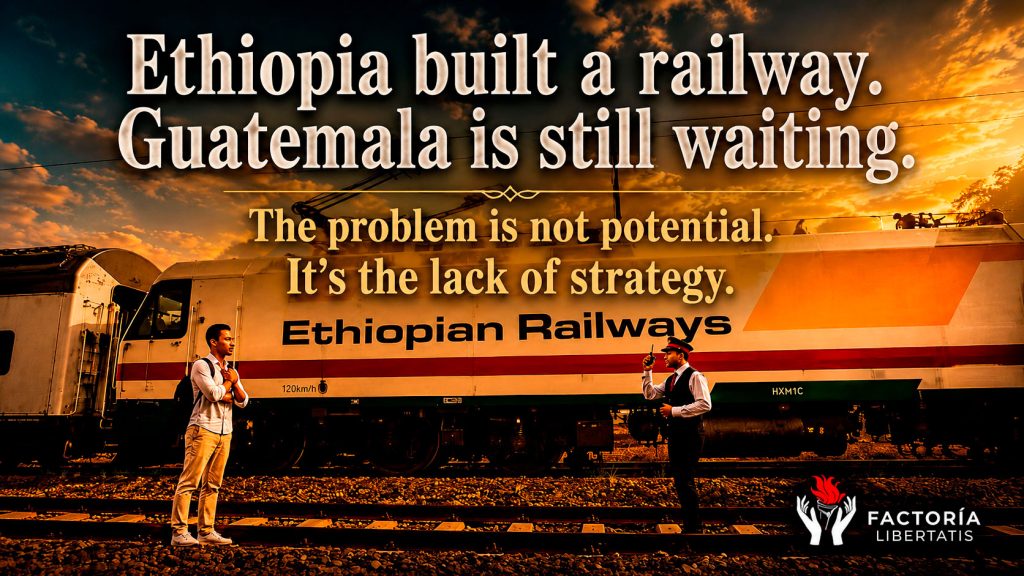
In 2011, Ethiopian Prime Minister Meles Zenawi called Beijing with a simple proposal: give me four billion dollars, I will build a 756-kilometer railway, and I will repay it with the exports that railway makes possible. In 2016, five years later, the railway was inaugurated and began operations in 2018. Ethiopia—landlocked, recently emerging from civil conflict, and burdened by structural corruption—became the manufacturing hub of East Africa. Swedish companies such as H&M and IKEA, as well as PVH (Van Heusen), established operations in its industrial parks. In 2024, the country attracted more than four billion dollars in foreign direct investment.
In 2002, King Mohammed VI of Morocco announced that his country would build the largest port in the Mediterranean in a place called Tanger Med. There was nothing there but cliffs and vision. The first ships arrived in 2007. By 2026, twenty-four years after the announcement, Tanger Med is expected to handle nine million containers annually and has become the largest port in Africa and the Mediterranean. Renault built a plant capable of producing 400,000 vehicles per year. Stellantis—which includes brands such as Fiat, Peugeot, and Dodge—built another. Morocco’s manufacturing exports grew by 300 percent. The King maintained the same strategy through four different governments.
In 1996, Costa Rican President José María Figueres learned that Intel was looking for a location in Latin America. He boarded a plane, traveled personally to Santa Clara, California, and together with his team and investment promotion agencies presented Intel executives with the strengths of Costa Rican engineering talent, reliable electricity, and a free-zone regime offering extensive tax incentives. Intel chose Costa Rica. Today, the country’s focus on semiconductors and, above all, medical devices accounts for more than 40 percent of its exports. Everything began when a president turned a visit to Intel into the foundation of a long-term national strategy.
Guatemala received US$1.848 billion in foreign direct investment in 2024. Less than Ethiopia. Less than Uganda. Less than the Democratic Republic of the Congo.
Whenever that figure is mentioned, the usual explanations emerge: corruption, insecurity, a small market, weak institutions. These are real obstacles, and no one denies it. Yet World Bank data undermine those arguments. The Democratic Republic of the Congo—which faces active civil conflict and ranks among the most corrupt countries on Earth—received US$2.915 billion. Uganda, whose corruption levels exceed Guatemala’s according to Transparency International, attracted US$3.257 billion. Mozambique, where thirty-four million people live in extreme poverty, received US$3.508 billion. If corruption, insecurity, and market size were the true causes, the Congo would not be attracting 50 percent more investment than Guatemala.
The real question is not what prevents us from attracting investment. It is what they have that we do not.
The answer is a clear value proposition.
The Congo possesses the cobalt the world needs for electric vehicle batteries. Mozambique has natural gas discovered in 2010 by Total and the Italian multinational energy company ENI. Uganda has oil in Lake Albert. Ethiopia built industrial parks with subsidized electricity and duty-free access to the U.S. market. Namibia is positioning itself as Africa’s first major exporter of green hydrogen to Europe.
Each of these countries, no matter how poor or unstable, offers something concrete.
Guatemala offers good weather and hardworking people—but without packaging.
Guatemalans are among the friendliest, most welcoming, and hardest-working people in the world. Yet we have failed to transform that human gold into an image of sophistication, reliability, and global business capability.
Part of what is missing is genuine and sustained legal certainty.
Investors do not fear high taxes. They can calculate them and decide whether the return justifies the cost. High taxes merely make us less competitive.
What investors cannot calculate is signing a contract today only to see it suspended tomorrow by a court ruling, or watching a ministry change tariff methodologies halfway through the game.
Guatemala has already lost three international arbitration cases before ICSID—including the EEGSA and Railroad Development Corporation disputes—which circulate among multinational investment committees as warning signals.
The Escobal mine, one of the world’s largest silver reserves, has remained largely inactive for seven years. The Marlin mine was closed ahead of schedule.
Every political-risk analyst in London, New York, and Tokyo knows these stories.
Bolivia possesses enough lithium to supply much of the world, yet struggles to develop it because investors do not trust the rules. Ecuador lost a decade of oil-sector investment for similar reasons.
Legal uncertainty carries a price tag—and Guatemala charges dearly for it, often without realizing it.
Mining illustrates an even deeper issue.
The Dominican Republic exports hundreds of millions of dollars in gold annually thanks to the Pueblo Viejo mine. Panama attracted more than US$10 billion through Cobre Panamá, the largest private investment in its history.
Both countries understood that natural resources generate prosperity only when there is a clear formula balancing investors, communities, and the state.
Panama ultimately experienced a political crisis that resulted in the closure of the mine. Yet even that case offers an important lesson for Guatemala: legal uncertainty carries enormous costs.
Capital can tolerate high taxes, social conflict, and even difficult political cycles.
What it cannot tolerate is not knowing whether tomorrow’s rules will be the same as today’s.
But perhaps the most important—and least discussed—competitive disadvantage is corporate taxation.
Guatemala imposes a 25 percent corporate income tax plus a 5 percent tax on dividends, resulting in an effective burden close to 29 percent.
Costa Rica, Panama, and the Dominican Republic partially address this challenge through free zones: enclaves where foreign investors pay no taxes while the rest of the economy remains subject to higher rates.
This approach generates growth, but only of a particular and limited kind. The free zones of the Dominican Republic, Panama, and Costa Rica have helped drive per-capita GDP growth at rates of approximately three to four percent annually.
The reason is simple.
Capital compares not only resources but also rules.
Countries that accelerated growth beyond those levels did not rely solely on free zones.
Bulgaria and Kosovo adopted corporate tax rates of 10 percent.
Ireland built one of the world’s most successful investment attraction strategies around a 12.5 percent corporate tax rate.
Estonia eliminated taxes on reinvested profits, taxing only distributed earnings.
Rather than creating exceptions, they made their entire economies competitive.
When incentives apply broadly, capital does not concentrate in isolated enclaves—it transforms an entire nation.
If Guatemala chose to develop a coherent strategy, the anchors are already visible.
Value-added agribusiness: Guatemala is a global leader in cardamom, coffee, sugar, and bananas, yet continues exporting commodities while international markets increasingly pay premiums for traceable, verified products.
Precision manufacturing in competitive free zones: select two or three sectors—medical devices, agricultural inputs, basic electronics—and build incentive frameworks that match or surpass those offered by the Dominican Republic, with stable rules guaranteed for at least fifteen years.
A bi-oceanic logistics hub: Guatemala is the only Central American country with coastlines on both oceans less than 300 kilometers apart, yet no one has fully leveraged this advantage.
Responsible mining with state participation, following the Pueblo Viejo model.
Export-oriented fisheries and aquaculture along underdeveloped coastlines.
High-value tourism rather than high-volume tourism, focusing on cultural, volcanic, and biodiversity experiences that no neighboring country can replicate.
And perhaps the most underestimated anchor of all: energy.
It is difficult to understand why Guatemala continues importing part of the electricity it consumes.
In a world where energy has become one of the decisive factors for attracting investment, producing competitively, and sustaining growth, that contradiction should force us to reflect.
Twenty-first-century industries seek abundant, reliable, and affordable electricity with the same intensity that previous generations sought ports, railways, and raw materials.
Iceland transformed its geography and volcanoes into an economic advantage.
Guatemala has yet to decide whether energy will become a national strategy.
And when a country transforms an advantage into a strategy, it stops chasing investment and starts attracting it.
Foreign investment does not arrive evenly. It comes in waves lasting five to eight years that transform entire economies before stabilizing until the next cycle.
Vietnam experienced its transformative wave in the late 1990s and another in the early 2010s.
Morocco between 2007 and 2015.
Ireland between 1990 and 1998.
These windows do not open twice for the same destination within a single generation.
Guatemala has already missed at least two: the post-CAFTA period between 2006 and 2010, and the post-pandemic rebound between 2021 and 2023.
The next wave will come.
Global capital is constantly searching for its next destination: a stable country with affordable energy, access to two oceans, and a clear value proposition.
That description fits Guatemala perfectly.
Guatemala faces a presidential election in 2027.
Here lies an opportunity no serious candidate should waste.
Whoever arrives with a genuine national strategy—not vague promises of growth, but a concrete proposal explaining what Guatemala represents for global investors, which anchors will be developed, which rules will be guaranteed, and for how long—will not merely differentiate himself from the competition.
He could inaugurate the investment cycle the country has been waiting for for decades.
Zenawi had a railway.
Mohammed VI had a port.
Figueres had an airplane and a proposal.
The question for 2027 is: who has Guatemala’s equivalent?
What is missing is not geography, talent, or potential.
What is missing is what those three leaders possessed: a clear, long-term commitment that extends beyond a single administration and is supported by rules that do not change with every election.
Until that happens, we will continue watching countries such as Ethiopia, Uganda, and the Congo transform their resources into strategy, their strategy into investment, and their investment into prosperity, while Guatemala continues passing potential on to the next generation instead of converting it into wealth and opportunity.
Ramiro Bolaños, PhD
President, Factoría Libertatis Center for Thought and Action
Referencias
- Banco Mundial. Foreign Direct Investment, net inflows (BoP, current US$). Washington, D.C.: World Bank Data, 2024. https://data.worldbank.org/indicator/BX.KLT.DINV.CD.WD
- Transparency International. Corruption Perceptions Index 2024. Berlín: Transparency International, 2025.
- Centro Internacional de Arreglo de Diferencias Relativas a Inversiones (CIADI). Casos ARB/06/03 (EEGSA/Iberdrola) y ARB/07/23 (Railroad Development Corporation vs. Guatemala). Washington, D.C.: CIADI/Banco Mundial.
- Barrick Gold Corporation. Pueblo Viejo Mine: Overview and Sustainability Report 2023. Toronto: Barrick Gold, 2024.
- Agence Française de Développement (AFD). Tanger Med: A Case Study in Port-Led Development. París: AFD, 2021.
- Ethiopian Railway Corporation. Addis Ababa–Djibouti Railway: Project Completion Report. Addis Abeba: ERC, 2017.
- CINDE / Coalición Costarricense de Iniciativas de Desarrollo. How Costa Rica Attracted Intel: A Landmark in FDI Strategy. San José: CINDE, 2015.
- Banco Mundial. Business Ready (B-Ready) Report 2024. Washington, D.C.: World Bank, 2024.
- Fondo Monetario Internacional. World Economic Outlook Database, abril 2025. Washington, D.C.: FMI, 2025.