Alisa Zinovievna Rosenbaum was twelve years old when the Bolshevik Revolution arrived in Petrograd. She watched as the State confiscated her family home and her father’s business, a pharmacist who had built his life through his own work. There was no compensation, no due process, no possibility of appeal. The Soviet Constitution of 1918 had stated it with surgical precision in Article 3: “private ownership of land is abolished; and all rural properties are declared public property.” Article 79 authorized the State to satisfy its needs “without stopping before the violation of private property rights.”
Years later, in the United States and transformed into Ayn Rand, novelist and philosopher, she would describe Marxism as the system of those who sought to sacrifice “the able, the intelligent, the successful” in the name of a utopia that never materialized. What happened to her family was not an accident of the revolution nor an excess of its executors. It was written from the beginning, in Article 3, signed and published.
There is a question that gnaws at my soul: how is it possible? After one hundred years of accumulated evidence, after Stalin’s gulags, the Ukrainian Holodomor, the Khmer Rouge in Cambodia, Cuba, Venezuela, North Korea, after the fall of the Berlin Wall in 1990 that seemed to settle the debate once and for all, how is communism becoming fashionable again? Not as melancholy nostalgia, but as a serious academic and political proposal.
The Polish philosopher Leszek Kołakowski warned before his death in 2005: “It may come back to life.” He was right. And here I am, writing this column, because I believe indignation can also be an argument.
I am anti-communist because I have read the documents.
The Soviet Constitution of 1918 leaves no room for romantic interpretations. Article 9 establishes as an explicit constitutional objective “the establishment of the dictatorship of the proletariat.” Lenin was equally precise in The State and Revolution (1917): the objective is to replace one “special force of repression”—that of the bourgeoisie over the proletariat—with another special force of repression in the opposite direction. He called it dictatorship. Not government of the people, not popular sovereignty, not workers’ democracy. Dictatorship.
Karl Marx had anticipated it in The Communist Manifesto (1848) with a clarity that many modern admirers prefer to ignore: “The communists can sum up their theory in this single expression: the abolition of private property.”
And Che Guevara, idol of T-shirts and university posters, completed the picture in his Message to the Tricontinental (1967):
“The hatred as an element of struggle; the uncompromising hatred of the enemy, which pushes a human being beyond his natural limitations and turns him into an effective, violent, selective, and cold killing machine.”
This is not a caricature of communism. It is communism describing its own method in its own words.
Karl Popper demonstrated that Marxism is not science but faith: its predictions can never be falsified because they are always reinterpreted to survive the evidence. Bertrand Russell, who considered himself both socialist and pacifist, was even more direct:
“I have always disagreed with Marx… What seems particularly disastrous to me is his abandonment of democracy.”
And Aristotle, twenty centuries before Marx, warned of something that dialectical materialism could never refute:
“What is common to the greatest number receives the least care. Everyone thinks chiefly of his own interest, and scarcely at all of the common interest.”
Common property does not produce equality. It produces neglect.
Today, however, communism does not arrive wearing military uniforms or carrying incendiary manifestos. It arrives in the language of social justice, progressivism, and rights.
In Spain, the progressive left-wing party Más Madrid recently declared in the regional assembly that:
“No one should have the right to own 10 homes, not 10 nor 3. Whoever has 10 properties should be taxed heavily and expropriated.”
Notice the word: right. They are not speaking about fiscal policy or market regulation. They are speaking about what you deserve to own—that is, what the State may take from you. It is Article 3 of the Soviet Constitution of 1918 translated into the language of the twenty-first century.
In the United States, the phenomenon has a name, a surname, and a genealogy. Mahmood Mamdani, a Ugandan-American academic at Columbia University, has spent decades constructing the intellectual architecture of a postcolonial Marxism that describes the liberal nation-state as the root of all structural violence. His influence on a generation of university students is enormous.
His son, Zohran Mamdani, has transformed those ideas into a political platform: New York mayoral candidate, open socialist, advocate of rent controls, massive state expansion, and a program that sounds like justice but smells like concentration of power.
The father’s academic communism gives birth to the son’s political communism.
It does not emerge from nowhere.
It has roots. It has professors. It has votes.
In Colombia, Gustavo Petro speaks of “democratic capitalism” while systematically weakening the institutions that should restrain him.
In Mexico, the Morena party has patiently constructed, through opaque clientelist programs and handouts that purchase loyalties, an architecture of power that disturbingly resembles the seventy years of PRI dominance: a party that does not govern for the people but buys the people in order to govern indefinitely, weakening in the process autonomous institutions—the National Electoral Institute and the Supreme Court—that should serve as counterweights.
The pattern is always the same: someone who knows, someone who decides, someone who concentrates power, someone who distributes it to himself.
To understand why this always ends in tyranny, one must return to Polybius and Cicero, who diagnosed the problem with a precision that two thousand years of history have failed to refute.
Every system of government has a virtuous form and a defect that corrupts it.
Monarchy—the rule of one—degenerates into tyranny when it loses its restraint.
Aristocracy—the rule of the best—degenerates into oligarchy when the best become merely the richest and govern for themselves.
Democracy—the rule of the people—degenerates into anarchy when collective passions dissolve order and law.
The remedy they proposed was the mixed constitution of the Republic: a system in which the power of the ruler, the power of the elite, and the power of the people balance and limit one another.
Not out of philosophical naïveté, but because the experience of Rome had taught them that no unchecked power can resist the temptation to abuse itself.
The England that preceded modern democracy embodied this principle through its parliamentary monarchy: a king, a House of Commons, and a House of Lords. Three distinct forces compelled to negotiate. A system in which no one could do everything.
Communism destroys this balance at its root.
By eliminating private property, it eliminates the economic foundation upon which an elite independent of the State can exist.
By concentrating all power in the party, it eliminates genuine representation of the people.
By suppressing institutional checks and balances, it leaves the ruler without restraint.
The result was predicted by Polybius two thousand years ago: when the people are left alone, without defense, without property, without institutions capable of protecting them from themselves and from their rulers, their natural defect—anarchy—pushes them to surrender all power to a strongman who promises order and justice.
Thus are born Chávez, Maduro, Ortega, Castro.
And in its modern, technological, and democratically approved version, Bukele.
They are not anomalies of the system.
They are its logical destination when checks and balances disappear.
The democratic disenchantment that today fuels the return of communism is born precisely from this: democracies that ask who governs, but not how power is exercised; elections that legitimize the origin of rulers, but do not limit their actions; institutions that exist on paper but have been emptied of real authority.
Cicero expressed it with a precision that has never aged:
“We are slaves to the laws so that we may be free.”
Freedom does not come from a leader who liberates us.
It comes from institutions that protect us from leaders.
And the Republic, in its deepest sense, is not merely a system for choosing rulers. It is a system for constructing truth together, because it begins from the most honest and difficult premise of all: that no one knows enough to plan the future of millions of people; that knowledge is dispersed among millions of individual decisions; and that the only way to make use of it is to guarantee the freedom of every individual to act upon it.
A mediocre leader in a system with strong checks and balances does little harm.
A brilliant leader without checks and balances is a catastrophe.
The history of communism does not contradict this.
It confirms it without exception.
That is why I am anti-communist.
Not out of nostalgia for any old order, nor in defense of any privilege.
But because I have read Marx, Lenin, and Che.
Because I have read the Soviet Constitution of 1918.
Because I have read Polybius and Cicero.
And because I believe that truth belongs to no one: it is built by all of us, in freedom, with property, with law, and with the checks and balances that prevent anyone from appropriating it.
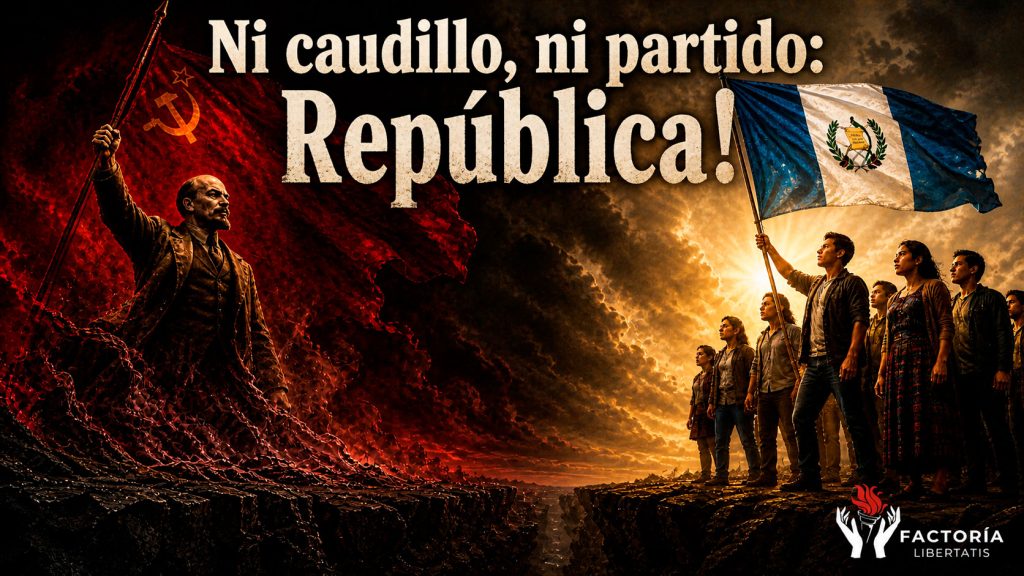
Neither caudillo nor party.
Republic.
Ramiro Bolaños, PhD.
President of the Center for Thought and Action: Factoría Libertatis
References
Primary Historical Sources
Constitution of the Russian Socialist Federative Soviet Republic (1918). Adopted at the Fifth All-Russian Congress of Soviets on July 10, 1918. Articles 3a, 9, and 79. Published in Izvestia of the All-Russian Central Executive Committee, No. 151, July 19, 1918. Spanish edition reproduced in Quintiliano Saldaña (ed.), appendix, pp. 96–116.
Lenin, Vladimir Ilyich. The State and Revolution (1917). Chapter I: “Class Society and the State.” Page 40: discussion of the “special force of repression” and the dictatorship of the proletariat.
Marx, Karl, and Friedrich Engels. The Communist Manifesto (1848). Section II: “Proletarians and Communists.” Quote: “The communists can sum up their theory in this single expression: the abolition of private property.” Reference edition: Marx, Karl. The Communist Manifesto. El Aleph, 2000.
Guevara, Ernesto “Che.” Message to the Tricontinental (1967). Originally published in Tricontinental magazine, Havana, 1967. Citation regarding hatred as a factor in struggle.
Philosophical and Scientific Sources
Aristotle. Politics, Book II, Chapter 3, 1261b (c. 350 BC). On the neglect of common property.
Cicero, Marcus Tullius. Pro Cluentio (c. 66 BC). Quote: “We are slaves to the laws so that we may be free.”
Kołakowski, Leszek. My Correct Views on Everything. St. Augustine’s Press, 2005, p. vii. Warning about the possible return of communism.
Polybius. Histories, Book VI (c. 150 BC). Theory of anacyclosis: the cycle of degeneration of forms of government and the defense of the mixed constitution.
Popper, Karl. Conjectures and Refutations: The Growth of Scientific Knowledge. 2002, p. 49. On the unfalsifiability of Marxism.
Rand, Ayn. For the New Intellectual. New York: Signet–Penguin Books, 1961. On Marx as an “impractical idealist” and the sacrifice of the capable.
Russell, Bertrand. Why I Am Not a Communist (1956), p. 211. On Marxism’s abandonment of democracy.
Contemporary Sources
García, Mónica, and Manuela Bergerot (Más Madrid). Statement during a debate on housing rights, Madrid Regional Assembly, April 23, 2026. Quote: “No one should have 10 houses, not 10 nor three. There is no right to own 10 houses. There is a right to have one, not 10. And those who have them should be taxed heavily and expropriated.” Source: El Mundo, 2026. [Accessed April 24, 2026].
Mamdani, Mahmood. Neither Settler nor Native: The Making and Unmaking of Permanent Minorities. Harvard University Press, 2020. Reference regarding the liberal nation-state as a root of structural violence.
Mamdani, Zohran. New York City mayoral campaign, 2025. Socialist platform advocating rent controls, expansion of the state, and universal public services.
Petro, Gustavo. Interview in El País, September 9, 2021. Statement regarding “democratic capitalism” as a rhetorical framework for state-centered concentration agendas.
Biographical Source
Biographical information on Ayn Rand (Alisa Zinovievna Rosenbaum, 1905–1982): born in Saint Petersburg (Petrograd), studied History and Social Pedagogy at Petrograd State University, emigrated to the United States in 1926. Reference in: Bolaños, Ramiro. From Hegel’s Rationalist Drift to the Inconsistencies in Marx’s Life. Essay, September 12, 2021, p. 15.