Today’s global logistics crisis did not begin with the war involving the United States, Israel, and Iran. It is the result of accumulated pressures over nearly two decades. As early as 2008, the system was already facing accelerated demand from emerging economies such as China and India, geopolitical tensions in key producers like Iran and Nigeria, and a financial environment marked by low interest rates and a weakened dollar. Global capital amplified the phenomenon through futures markets and speculative flows, driving the price of Brent crude to 147 dollars per barrel. It was the signal of a system under strain beyond its structural capacity.
That underlying fragility was later confirmed. Between 2011 and 2013, prices remained high due to Asian demand, instability in countries such as Libya and Iraq, and a restrained OPEC. However, beginning in 2014, the emergence of light crude oil production in the United States, combined with slowing global demand and OPEC’s decision not to cut production, triggered an abrupt adjustment. Within months, Brent prices fell from over 100 dollars to less than 60. The system stopped appearing stable and began to reveal its true nature: dependent on increasingly fragile balances.
But the real test came with the pandemic. Between 2020 and 2022, the world experienced an unprecedented disruption in supply chains. Anticipating a contraction in trade, shipping companies withdrew up to 20% of their capacity. However, demand rebounded at an unexpected speed in the second half of 2021, causing port collapses, intermodal failures, and route saturation. Container shortages and congestion drove freight costs to historic levels. The pandemic exposed the vulnerability of an excessively concentrated system, lacking real redundancies and incapable of absorbing shocks without overflowing.
That fragility became evident on a global scale. Intermittent closures due to COVID outbreaks at strategic Chinese ports added uncertainty. In March of that year, the container ship Ever Given ran aground in the Suez Canal and blocked one of the main arteries of global trade for nearly a week. More than 300 ships were halted, while others rerouted, adding thousands of kilometers and weeks of delay. Freight rates surged once again, and supply chains entered a new phase of disruption. A single ship, at a single point, had managed to distort the global logistics flow. Vulnerability ceased to be a hypothesis. It became evidence.
That vulnerability continued to consolidate. Beginning in 2023, attacks by the Houthis in Yemen against vessels introduced a persistent and cumulative risk. By the end of 2024, the number of attacked vessels had surpassed 190. More than one thousand container ships began avoiding the Suez Canal, opting instead to sail around the Cape of Good Hope. This diversion added nearly 6,000 nautical miles and between three and four additional weeks of transit on key routes. Immediately, traffic through Suez fell to less than one-third of its normal levels, and freight costs once again escalated. The Red Sea became a critical point of friction. The system stopped operating under a logic of optimization and shifted toward one of permanent risk.
In 2024, geopolitical tension escalated to a systemic scale. The indirect confrontation between Israel and Iran placed the Strait of Hormuz at the center of risk, through which between 20% and 35% of the world’s seaborne oil and nearly 20% of global liquefied natural gas transit. This year, attacks against strategic facilities in Iran caused the suspension of routes through the area and forced vessels to reroute around southern Africa. The simultaneous tensions in the Red Sea and the Persian Gulf have increased logistics costs and transformed the understanding of the global system: it is no longer a matter of isolated disruptions, but rather the simultaneous exposure of its main arteries.
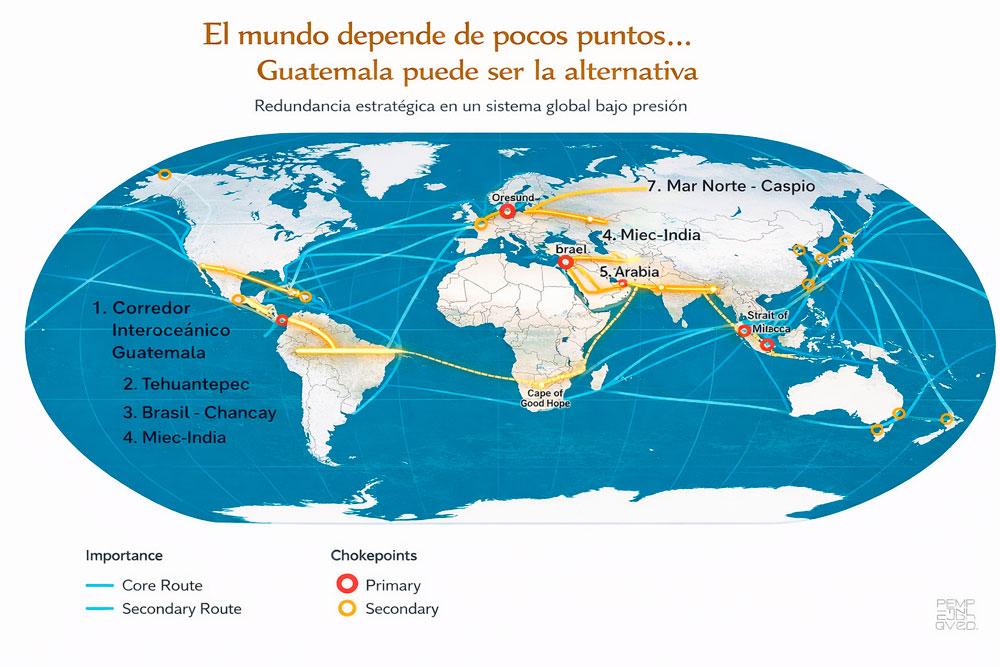
The global logistics system today faces a kind of arteriosclerosis caused by the concentration of flow through a reduced number of critical points. Six major chokepoints sustain global trade: the Strait of Malacca, with nearly 25 million TEUs annually; the Suez Canal, with around 20 million; the Strait of Gibraltar, with about 15 million; the Panama Canal, with approximately 14 million; the Strait of Hormuz, with a critical share of energy transport; and the Bab el-Mandeb passage, exposed to armed conflict and direct attacks. Each faces different pressures: geopolitical tensions in Malacca, instability and blockages in Suez, water stress in Panama, and conflicts in Hormuz and Yemen. The issue is no longer the efficiency of these routes, but their simultaneous exposure. Global trade depends on only a few points… and all of them are under pressure at the same time.
Faced with this reality, the world has opted for a strategic reconfiguration of its routes. A global race to build redundancy has begun. India, together with Europe, is promoting the IMEC corridor, which will connect the subcontinent with the Mediterranean. Israel is developing the Eilat-Ashkelon pipeline as an energy dry canal that will avoid passage through Suez. In the Americas, Brazil and Peru are advancing a railway corridor toward the Port of Chancay, with the potential capacity to move nearly 4 million TEUs. Mexico, meanwhile, is already operating the Isthmus of Tehuantepec Corridor, with projections to reach 1.4 million TEUs by 2033. Clearly, the global system is leaving behind the logic of concentration and beginning to build itself on strategic redundancy. While the world redesigns its routes, Guatemala faces a decision that is not technical, but historical.
Amid this global reconfiguration, Guatemala has an opportunity to become part of the solution to a systemic problem. A group of private sector entrepreneurs has spent 26 years building what today could become a key piece of global trade. Twenty-six years. Six times longer than any political cycle in Guatemala. These entrepreneurs have managed to coordinate more than 350 landowning families, securing land, rights of way, and territorial planning along our country’s eastern border. The project envisions a potential capacity of up to 7 million TEUs annually, connecting two private deep-water ports capable of receiving vessels of up to 22,000 TEUs. Its relevance lies in infrastructure conceived under a model of private ownership and municipal autonomy, aligned with the new demands of global trade. It is about inserting itself into the architecture of redundancy that the world is beginning to build.
The Guatemala Interoceanic Corridor is a potential piece within a global redesign of trade. A dry canal capable of operating when Panama faces water restrictions, when Suez is blocked, or when the Red Sea becomes impassable. What is at stake is the operational continuity of the global system. World trade is transitioning from just-in-time efficiency toward strategic resilience. Alternative corridors are becoming critical infrastructure. Guatemala does not compete in volume. It competes in relevance within a system that can no longer depend on a single route.
Strategic opportunities do not materialize through inertia. They require deliberate decisions and institutional coordination. If Guatemala wants to occupy this space, it must build more than infrastructure: it must build trust. This requires legal certainty that transcends political cycles through a Framework Law for the Corridor, specialized security capabilities to protect critical infrastructure, and an expansion of the scope of the Priority Infrastructure Law, currently limited to barely 10%, despite being one of the few instruments specifically designed to remove large-scale projects from the logic of capture and corruption. Furthermore, it requires incorporating a higher standard of transparency to attract global capital, with technologies such as blockchain or tokenization schemes that ensure traceability, governance, and trust. Guatemala no longer has room for improvisation. We are not starting late, but if we hesitate, we will be left behind.
The final question is strategic. Will we continue watching as other countries redraw the map of global trade, or will we assume the role our geography has granted us? Guatemala is not condemned to being an irrelevant transit point or anyone’s backyard. It can become the bridge the world needs in an era marked by uncertainty and reconfiguration. That possibility depends on our ability to act with clarity, determination, and a sense of purpose. Because in the new global logistics order, the countries that first understand the value of redundancy will not only secure their place in the system… they will define where the wealth of the future flows. In the 21st century, lacking alternative routes is not inefficiency… it is strategic vulnerability. Guatemala can be that solution. But only if it decides to stop watching… and start building.
Ramiro Bolaños, PhD. / President of the Center for Action and Thought Factoría Libertatis
References:
U.S. Energy Information Administration (2025). Petroleum and Other Liquids. US Crude Oil First Purchase Price. https://www.eia.gov/dnav/pet/hist/LeafHandler.ashx?n=pet&s=f000000__3&f=m [Accessed March 31, 2026].
UNCTAD. (2021). Container shipping in times of COVID-19: Why freight rates have surged and implications for policy makers. UNCTAD Policy Brief No. 84. https://unctad.org/publication/container-shipping-times-covid-19-why-freight-rates-have-surged-and-implications-policy [Accessed March 31, 2026].
Song, D.-P. & Lee, C.-Y. (2024). “Tackling global shipping disruptions: Lessons learnt from COVID-19”. Journal of Shipping and Trade. https://journals.sagepub.com/doi/10.1177/2694104X251332108 [Accessed March 31, 2026].
McKinsey & Company. (2022). Navigating the current disruption in containerized logistics. McKinsey & Company, March 2022. https://www.mckinsey.com/industries/logistics/our-insights/navigating-the-current-disruption-in-containerized-logistics [Accessed March 31, 2026].
UNCTAD. (2024). Review of Maritime Transport 2024: Navigating maritime chokepoints. UNCTAD. Available at: https://unctad.org/publication/review-maritime-transport-2024 [Accessed March 31, 2026].
Merk, O. (2025). “Connectivity pattern of the world’s major maritime bottlenecks”. PortEconomics, Management and Policy. https://porteconomicsmanagement.org/pemp/contents/part1/interoceanic-passages/connectivity-pattern-worlds-major-maritime-bottlenecks/ [Accessed March 31, 2026].
Office for National Statistics. (2024). Ship traffic through global critical maritime passages: January 2023 to April 2024. ONS. https://www.ons.gov.uk/releases/shiptrafficthroughglobalcriticalmaritimepassagesjanuary2023toapril2024 [Accessed March 31, 2026].
Boston Consulting Group. (2024). These four chokepoints are threatening global trade. BCG, February 7, 2024. https://www.bcg.com/publications/2024/these-four-chokepoints-are-threatening-global-trade [Accessed March 31, 2026].
Desteia. (2026). Maritime chokepoints: Global trade and disruptions. Desteia Blog, March 16, 2026. https://desteia.com/blog/maritime-choke-points [Accessed March 31, 2026].
Wiseman, Y. (2015). Red Sea and Mediterranean Sea land bridge via Eilat. https://u.cs.biu.ac.il/~wisemay/writr2015.pdf [Accessed March 31, 2026].
Interoceanic Corridor of Guatemala. (n.d.). Interoceanic Corridor of Guatemala – Multimodal logistics platform. https://consorciointeroceanico.com [Accessed March 31, 2026].
Global Finance Magazine. (2026). “Guatemala: Connecting the oceans.” Global Finance Magazine, March 22, 2026. https://gfmag.com/economics-policy-regulation/guatemala-connecting-the-oceans/ [Accessed March 31, 2026].
Seatrade Maritime News. (2024). “Guatemala and Honduras hatch “dry” canal plans”. Seatrade Maritime, July 31, 2024. https://www.seatrade-maritime.com/containers/guatemala-and-honduras-hatch-dry-canal-plans [Accessed March 31, 2026].
PortEconomics. (2019). “Dry canal projects in Central America.” PortEconomics, Management and Policy. https://porteconomicsmanagement.org/pemp/contents/part1/interoceanic-passages/dry-canal-projects-central-america/ [Accessed March 31, 2026].
PortEconomics. (2019). “Main maritime shipping routes and chokepoints.” PortEconomics, Management and Policy. https://porteconomicsmanagement.org/pemp/contents/part1/interoceanic-passages/main-maritime-shipping-routes/ [Accessed March 31, 2026].
Mexico Daily Post. (2024). “The Isthmus of Tehuantepec’s Interoceanic Corridor could compete with the Panama Canal”. Mexico Daily Post, January 26, 2024. https://mexicodailypost.news/2024/01/26/the-isthmus-of-tehuantepecs-interoceanic-corridor-could-compete-with-the-panama-canal/ [Accessed March 31, 2026].
Site Selection. (n.d.). Mexico: “The dry canal is an operational reality”. Site Selection Magazine. https://siteselection.com/the-dry-canal-is-an-operational-reality/ [Accessed March 31, 2026].
Ecuacargas. (n.d.). A transcontinental vision: The China–Peru–Brazil railway project – Status, challenges and impact. Available at: https://ecuacargas.com/en/blogs/china-peru-brazil-railway-project-status-challenges-impact [Accessed March 31, 2026].
Atlantic Council. (2025). “Moses parts the Red Sea: Israel’s strategic challenges as new routes emerge”. Atlantic Council – MENASource, November 12, 2025. https://www.atlanticcouncil.org/blogs/menasource/moses-parts-the-red-sea-israels-strategic-challenges-as-new-routes-emerge/ [Accessed March 31, 2026].
S&P Global Platts. (2020). “Israeli pipeline company EAPC to transport UAE oil via Red Sea-Mediterranean route”. S&P Global Platts, October 19, 2020. https://www.spglobal.com/energy/en/news-research/latest-news/crude-oil/102020-israeli-pipeline-company-to-transport-uae-oil-via [Accessed March 31, 2026].
U.S. Energy Information Administration. (2022). “Crude oil prices rise above $100 per barrel after Russia’s invasion of Ukraine”. Today in Energy, February 24, 2022. https://www.eia.gov/todayinenergy/detail.php?id=55020 [Accessed March 31, 2026].
U.S. Energy Information Administration. (2014). Year in review: Crude oil prices 2014. EIA. https://www.eia.gov/finance/review/annual/ [Accessed March 31, 2026].