Imagine watching a promotional video featuring aerial views gliding over a turquoise bay and a resort hidden among palm trees. Gentle waves blend into the golden sand of the beach. We enter private villas with their own pools, spacious terraces, and details that combine Mediterranean elegance with Caribbean warmth. The camera moves through the beach club, where a couple walks toward a seaside restaurant. The spa is accompanied by soft music that reinforces the idea of an intimate and sophisticated retreat.
This video belongs to the luxury resort Eden Roc Cap Cana in the Dominican Republic. A single night in an oceanfront bungalow can exceed US$3,400. But the important point is not the price. It is the system that makes it possible. It is the result of years of sustained investment, world-class infrastructure, and an environment deliberately designed to attract capital.
The Dominican Republic is a model in this regard. The country boasts at least nineteen prime luxury hotels, with rates ranging from US$300 to more than US$1,000 per night. Behind this inventory are not merely attractive beaches, but decades of targeted foreign investment, tourism real estate development, and a clear international positioning strategy. Every room built represents capital that chose to stay.
Costa Rica has taken this logic even further. On the Papagayo Peninsula, the Ritz-Carlton Nekajui reaches rates of up to US$16,000 per night, while the Four Seasons exceeds US$14,000 for its most exclusive suites. The country has developed a portfolio of forty-five luxury hotels. Panama, meanwhile, has consolidated an inventory of twenty-eight luxury properties integrated with logistics and connectivity infrastructure. Belize, despite its much smaller scale, has sixty-seven prime luxury hotels, including properties that charge more than US$4,800 per night.
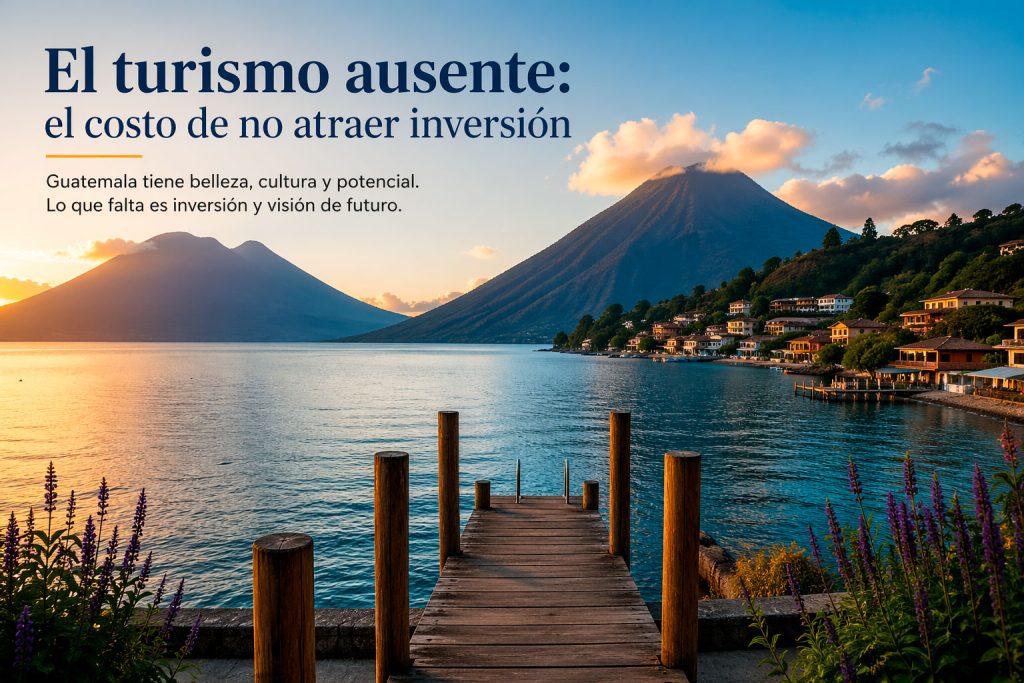
One might assume that Guatemala would be part of this list. It is not. In terms of high-value tourism, Guatemala is not even part of the regional conversation. While other countries have developed extensive inventories of luxury hotels, Guatemala has only five properties charging more than US$300 per night. We have two coastlines, volcanoes, what many consider the most beautiful lake in the world, and extraordinary cultural and historical wealth. Yet these natural advantages have not translated into a high-value tourism offering. Potential that is never converted into investment effectively does not exist.
The absence of high-value tourism in Guatemala is a direct consequence of the country’s investment structure. While economies such as the Dominican Republic and Costa Rica have sustained foreign direct investment inflows exceeding US$5 billion annually, Guatemala has followed a different path. Of the US$1.881 billion in FDI received in 2025, 45 percent was concentrated in financial activities and insurance. Commerce accounted for another US$358 million, followed by manufacturing and services.
Between 2021 and 2025, cumulative foreign direct investment in Guatemala’s tourism sector amounted to only US$6.5 million. In other words, roughly US$1.3 million per year. In 2024, only the island nation of Tuvalu received less tourism-related investment worldwide. In practical terms, Guatemala is absent from global tourism investment flows. By contrast, tourism has represented more than 25 percent of foreign direct investment inflows in the Dominican Republic in recent years. Spain alone directed more than US$1 billion into that sector in 2025 through hotel capital and management investments.
There is a useful rule of thumb in the tourism industry: an efficient tourism country typically receives at least one visitor per resident each year. Belize exceeds that benchmark. The Dominican Republic comes close. Even regional economies such as Costa Rica and Panama reach approximately 0.6 visitors per resident, suggesting room for improvement to match tourism powers such as Spain and Bulgaria. Guatemala, by contrast, stands at around 0.15. That means our goal should be to attract seven times more tourists, but doing so requires serious capital investment.
High-value tourism does not follow scenery. It follows infrastructure. Transforming a potential destination into a real one requires turning natural and cultural assets into an accessible, safe, and high-quality experience. That means investment in airports, highways, and hotels that meet international standards. Guatemala offers clear examples of untapped potential. In the Cuchumatanes Mountains, the Tshkin Xaq ecotourism viewpoint—known as the “Gateway to Heaven”—stands at more than 3,300 meters above sea level and offers visitors the experience of walking among the clouds. Who would not want to visit a gateway to heaven? Yet without proper access, services, and infrastructure connecting it to a broader tourism offering, it remains largely unknown.
The Dominican Republic made a strategic decision decades ago by creating tourism zones with special tax regimes. Corporate income tax exemptions, the elimination of tariffs on tourism projects, and long-term legal stability attracted sustained capital inflows. This was complemented by international promotion and the development of integrated projects combining hotels, real estate, and cruise ports. Panama chose to become a logistics and corporate hub, supported by free trade zones, a special regime for multinational headquarters, and world-class connectivity infrastructure. The canal expansion, ports, and airport hub created an environment in which capital can operate efficiently.
Costa Rica has built one of the most consistent investment attraction models in the region. Its free trade zone regime offers stability, low effective tax burdens for exporters, and clear rules. It also developed a specialized agency—CINDE—with the technical capacity to attract and retain investment.
In Eastern Europe, countries such as Estonia and Georgia simplified their tax systems to the point of taxing only distributed dividends while leaving reinvested earnings untaxed. Bulgaria reduced its corporate income tax rate to 10 percent and integrated into the European Union.
If the problem is the lack of investment in sectors capable of transforming the economy, then the answer must be a change of model. Guatemala needs to redesign its tax framework to compete for capital. Tax structures should concentrate the effective burden on the final distribution of profits. This should be accompanied by anchor investments in strategic sectors where Guatemala possesses genuine advantages, such as tourism, energy, and export-oriented manufacturing.
Infrastructure must cease to be a liability and become a strategy. Roads to tourism destinations, meaningful expansion of La Aurora International Airport, new regional airports, and logistics clusters should be viewed as prerequisites for capital to operate. Without them, any investment attraction policy remains incomplete. Equally important is legal certainty. Streamlined licensing processes, specialized commercial courts, and reduced regulatory uncertainty are essential. Capital seeks not only profitability, but also predictability and contract enforcement.
Finally, Guatemala needs institutions capable of competing for investment. Today’s fragmented investment attraction efforts should be consolidated into a specialized agency with public-private governance and real execution capacity. At present, foreign direct investment in Guatemala is concentrated in sectors such as banking, commerce, and selected manufacturing industries. Tourism and clean energy receive only a tiny fraction of available capital. The problem is not a lack of resources. It is a lack of direction.
Guatemala faces a clear choice. It can continue relying on income generated abroad through the efforts of its migrants, or it can begin creating an environment where productive capital wants to arrive, invest, and remain. The tourism that never arrives is not an image problem. It is the result of an economy that has yet to create the conditions necessary to attract it. Until that changes, the country will continue watching opportunities pass by—opportunities that its neighbors have already learned how to build.
Ramiro Bolaños, PhD
President, Center for Thought and Action: Factoría Libertatis
References:
Hotels and Tourism Pricing
Hotels.com. Hotel rates and luxury accommodation prices in Latin America. Data consulted on April 15, 2026, for average nightly rates during the period May 4–10, 2026.
Foreign Direct Investment — Costa Rica
PROCOMER. (2026). Costa Rica surpasses US$5 billion in foreign direct investment inflows for the second consecutive year. Available at: https://procomer.com/costa-rica-supera-segundo-ano-consecutivo-5-000-millones-en-ied/ [Accessed April 15, 2026].
Foreign Direct Investment — Dominican Republic
Infobae. (2026). Spain led foreign investment in the Dominican Republic during 2025. Available at: https://www.infobae.com/america/agencias/2026/04/15/espana-lidero-en-2025-la-inversion-extranjera-en-la-republica-dominicana/ [Accessed April 15, 2026].
Foreign Direct Investment — Nicaragua
Central Bank of Nicaragua. (2026). Evolution of Foreign Direct Investment in Nicaragua. Available at: https://www.bcn.gob.ni/sites/default/files/2026-03/ [Accessed April 15, 2026].
Foreign Direct Investment — Dominican Republic Performance
PRODOMINICANA. (2023). Foreign Direct Investment: Performance in the Dominican Republic and International Context 2022. Available at: https://adminstituto.prodominicana.gob.do [Accessed April 15, 2026].
Foreign Direct Investment — Guatemala
Bank of Guatemala. (2026). Foreign Direct Investment by Industrial Classification and Country of Origin. Available at: https://banguat.gob.gt/page/ied-ano-2025 [Accessed April 15, 2026].
Global Foreign Direct Investment Data
World Bank. (2024). Foreign Direct Investment, Net Inflows (US$). Available at: https://data.worldbank.org/indicator/BX.KLT.DINV.CD.WD [Accessed April 15, 2026].