In 1965, Wei Ming was five years old and learning to read English with pencil and paper in a classroom without air conditioning in Singapore. By age seven, he was already studying industrial arts. His father was a fisherman. No one in his family had completed high school. But that year, Lee Kuan Yew made a decision that would forever change the life of that boy, although he did not yet know it: he placed education at the center of state policy, with freedom of choice, high standards, accountability, and discipline.
At thirty, Wei Ming was a technician in an electronics manufacturing plant. He spoke English and Mandarin. He had a son.
That son was named Jun Wei. At age five, in 1990, there were already computers in his school. At seven, he learned heuristics to solve non-routine problems. The system remained demanding, competitive, and open: families chose between public and state-funded private schools, and schools competed to attract the best students and teachers. At thirty, Jun Wei was a process engineer on an offshore oil platform in the South China Sea. He had a son.
That grandson is named Kai. He turned five in 2025. He learns with artificial intelligence, accesses content in three languages, and has learned the concept of “agency,” that is, planning an activity and explaining what he learned. At seven, he will work on creative writing and basic coding with programs such as Scratch Jr and Bee-Bot. All of this is possible because in 1965 someone decided that the only raw material that truly mattered was the talent of the people, and designed a system that prepares children and young people to integrate into the economy of the future without wasting a single year or a single quetzal.
The most striking contrast to this logic is not found in Asia. It is found in the United States. New York spends more than US$36,000 per student per year, the highest budget of any state in the country. Florida spends less than half that amount and today leads the nation in reading performance among minority and low-income students. The reason: Florida ranks first in educational freedom. It introduced opportunity scholarships, expanded charter schools—public schools managed by private organizations—and established that no child can advance beyond third grade without knowing how to read. Competition forced public schools to improve or lose students. The money followed the student. And the student won.
New York, by contrast, has the most expensive union monopoly in the world. Its results have remained stagnant for decades despite having the highest educational budget in the nation.
Sweden offers the most honest lesson in the debate: neither extreme works on its own. In the 1990s, it introduced vouchers with freedom of choice but without rigorous evaluation standards. The result was a dramatic decline in PISA scores between 2003 and 2012. An educational market without rules does not produce quality; it produces grade inflation and segregation. But Sweden did not abandon the principle. It corrected it. Beginning in 2013, it strengthened school inspections, nationalized exit examinations, and professionalized teacher training without eliminating freedom of choice. By 2018, results had rebounded above the European average. The lesson is that educational freedom with accountability works.
Northern Italy demonstrates this in contrast to the south. In Lombardy and Veneto, the educational system is deeply integrated with the regional industrial fabric. Public and private schools compete, are held accountable, and prepare students for the real economy. The result is one of the highest youth employability rates in Europe, the consequence of a design in which public money purchases results.
Chile did it even more precisely. After decades with a universal voucher without improvements in quality, it introduced the Preferential School Subsidy in 2008: the voucher is worth more if the student is poor. The money follows the most vulnerable student. Schools that receive those resources are subject to quality and improvement requirements. The result has been an increase in real learning opportunities and social mobility.
Bangladesh accomplished it with the bare minimum. In 1994, with a GDP per capita lower than Guatemala’s today, it implemented a stipend program to help poor rural girls reach secondary school. A direct transfer conditioned on attendance and minimum academic performance. In a decade, it closed the gender gap in school enrollment. It did not build thousands of new schools or repaint them. It financed the decision of families to send their daughters to school. And it changed the future of the country.
The pattern is always the same. It is not how much is spent. It is whether the money reaches the student with a name, a surname, and a measurable outcome. In Guatemala, that money does not reach the student. Education is a bottomless barrel.
The National Survey of Living Conditions (ENCOVI) documents this without ambiguity: there are virtually no cases of extreme poverty among Guatemalans who have completed diversified education. Completing high school is, in our labor market, the gateway out of extreme poverty. And yet, almost half of Guatemalan youth never finish it. The system has been designed without considering the life-changing opportunity available to the student.
For the graduating class of 2025, only 16% achieved proficiency in mathematics and 35% in reading. We have more than 300,000 teachers and more than 52,000 educational centers. The education budget is the largest in the public sector. And that is precisely the core of the problem: doubling educational spending to reach the 6% of GDP recommended by ECLAC and UNESCO would require adding Q26 billion to the budget. Today the fiscal deficit is 2.5%. Such an expansion would raise it to 11%. No country in the region can sustain that without a crisis. “More of the same public spending” is fiscally impossible.
The case of USAC illustrates this with a precision that should scandalize any taxpayer. A study by Francisco Marroquín University calculated that the cost per student at USAC exceeds Q16,200 per year, financed through taxes paid by all of us. At a private university of comparable quality, the cost per student is Q10,600. The public university costs 53% more than the equivalent private institution. And it can shut down for months due to strikes and absenteeism without consequences for anyone: the Constitution guarantees 5% of the national budget, but does not require that a single student learn anything in return.
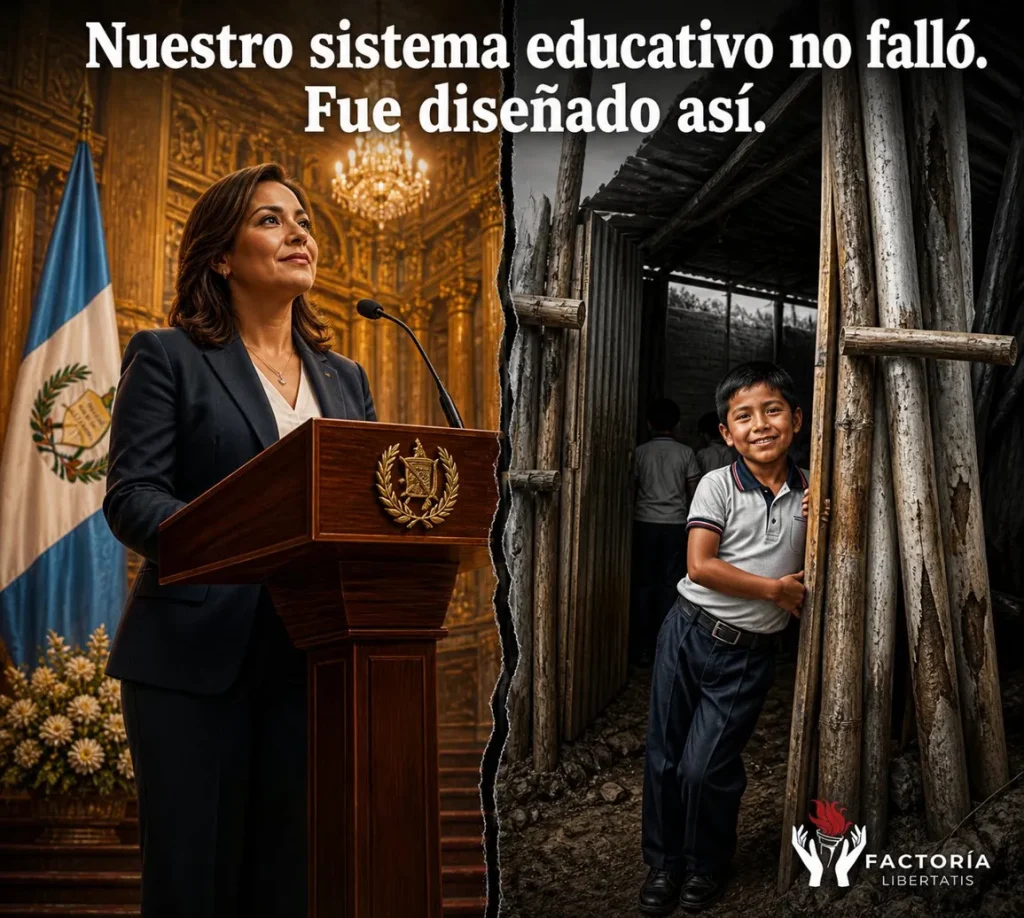
What applies to USAC applies to the entire system: for decades, the Guatemalan state has paid more so that ordinary Guatemalans receive less. But there is something worse: this money finances political structures with hidden interests that depend precisely on the system not functioning.
The alternative is not to spend Q26 billion more hiring untrained teachers and building classrooms that nobody will supervise. The alternative is to finance the decision of poor young people to attend and complete high school. To pay for that result. To allow private, community, and religious schools to compete for those students with their own capital and risk. And, while we are being honest with ourselves, the official goal is 180 school days. In China, it is 240. But the gap is even larger because the effective school year in Guatemalan public schools is closer to 150 actual days. How do we expect to compete with ninety fewer days of instruction per year?
That is how Singapore, Vietnam, Bangladesh, Tanzania, Florida, and Chile did it. None of those countries or states waited until they had Finland’s budget to begin. They started with what they had and placed it where it mattered: on the student.
Guatemala now faces the same decision. Continue financing structures that capture the budget without producing learning, or begin financing the student who needs someone to believe in him so he can reach his full potential.
Kai, Wei Ming’s grandson, is five years old and learning to build his future and that of his country. Diego, the grandson of a Guatemalan farm worker, is five years old and, with luck, will learn to read before the system abandons him.
That is not destiny.
It is a decision.
Ramiro Bolaños, PhD.
President of the Center for Thought and Action Factoría Libertatis
Referencias:
Singapore
Lee Kuan Yew. From Third World to First: The Singapore Story 1965–2000. (New York: HarperCollins, 2000).
Ministry of Education, Singapore. Singapore Students Excel in PISA 2022. (Singapore: MOE, 2023). https://www.moe.gov.sg/news/press-releases/ [accessed April 23, 2026].
OECD. PISA 2022 Results (Volume I): The State of Learning and Equity in Education. (Paris: OECD Publishing, 2023). https://doi.org/10.1787/53f23881-en [accessed April 29, 2026].
OECD. Strong Performers and Successful Reformers in Education: Lessons from PISA for the United States, chapter on Singapore. (Paris: OECD Publishing, 2010).
Florida and New York
Florida Department of Education. The Florida Formula: A Case Study in Education Reform. https://www.fldoe.org/policy/edu-reform/ [accessed April 29, 2026].
Florida Department of Education. Florida’s High School Graduation Rate, 2021–22. https://www.fldoe.org/accountability/data-sys/edu-info-accountability-services/pk-12-public-school-data-pubs-reports/index.stml [accessed April 29, 2026].
National Center for Education Statistics (NCES). Per-Pupil Expenditures for Public Elementary and Secondary Education: FY 2020. (Washington, D.C.: U.S. Department of Education, 2022). https://nces.ed.gov/pubs2022/2022301.pdf [accessed April 29, 2026].
Sweden
Skolverket (National Agency for Education). Sweden’s Results in PISA 2018. (Stockholm: Skolverket, 2019). https://www.skolverket.se/publikationsserier/beskrivande-statistik/2019/pisa-2018 [accessed April 29, 2026].
OECD. PISA 2022 Results: Combined Factsheets for Global Comparison. (Paris: OECD Publishing, 2023). https://www.oecd.org/pisa/ [accessed April 29, 2026].
Italy (North)
OECD. PISA 2022 Results (Volume II): Learning During – and From – Disruption. (Paris: OECD Publishing, 2023). https://doi.org/10.1787/a97db61c-en [accessed April 29, 2026].
Chile — Preferential School Subsidy
World Bank. World Development Report 2018: Learning to Realize Education’s Promise. (Washington, D.C.: World Bank, 2018). https://www.worldbank.org/en/publication/wdr2018 [accessed April 29, 2026].
OECD. PISA 2022 Results (Volume I): The State of Learning and Equity in Education, analysis of Chile. (Paris: OECD Publishing, 2023). https://doi.org/10.1787/53f23881-en [accessed April 29, 2026].
Bangladesh — Female Secondary School Stipend Program
World Bank. Demand-Side Financing in Education. (Washington, D.C.: World Bank, 1996).
UNESCO. Global Education Monitoring Report: The Cost of Inefficiency in Latin America. (Paris: UNESCO, 2022). https://unesdoc.unesco.org/ [accessed April 29, 2026].
Guatemala — Living Conditions and Education
National Institute of Statistics (INE). National Survey of Living Conditions (ENCOVI) 2023. (Guatemala: INE, 2024). https://www.ine.gob.gt/encovi/ [accessed April 29, 2026].
DIGEDUCA, Ministry of Education of Guatemala. General Results of the 2025 Educational Assessment. https://edu.mineduc.gob.gt/digeduca/documents/resultados/Resultados_generales.pdf [accessed May 5, 2026].
Ministry of Education of Guatemala. Statistical Yearbook of Education 2024. https://estadistica.mineduc.gob.gt/anuario [accessed April 23, 2026].
UNESCO. Global Education Monitoring Report: Guatemala SDG4 Country Profile. https://education-estimates.org/country-profiles/GTM [accessed April 29, 2026].
Education Budget and Public Finances
ECLAC. Social Panorama of Latin America 2024. (Santiago: Economic Commission for Latin America and the Caribbean, 2024).
Ministry of Public Finance of Guatemala. General Budget of State Revenues and Expenditures 2025. https://www.minfin.gob.gt/ [accessed May 5, 2026].
Bank of Guatemala. Gross Domestic Product: Historical Series and 2025 Estimates. https://banguat.gob.gt/ [accessed May 5, 2026].
UNESCO. Global Education Monitoring Report 2023. (Paris: UNESCO, 2023).
School Days
China, Ministry of Education. National School Calendar and Education Standards: Beijing and Shanghai Regions. (Beijing: Ministry of Education of the People’s Republic of China, 2023). http://en.moe.gov.cn/ [accessed May 1, 2026].
Business Leaders for Education. School Days Monitoring Report: 2023 School Year. (Guatemala City: Business Leaders for Education, 2024). https://www.empresariosporlaeducacion.org/monitoreo-dias-clase [accessed May 1, 2026].
Guatemala, Ministry of Education. Ministerial Agreement Number 3911-2023: School Calendar for the 2024 Academic Year. (Guatemala City: MINEDUC, 2023). https://www.mineduc.gob.gt/portal/index.asp [accessed May 1, 2026].
National Center on Education and the Economy (NCEE). China: Instructional Time and School Calendar. (Washington, D.C.: NCEE, 2022). https://ncee.org/center-on-international-education-benchmarking/top-performing-countries/china-overview/ [accessed May 1, 2026].
USAC and Demand-Side Financing in Guatemala
Dirkmaat, Olav. “How Much Does USAC Cost?” UFM Trends, Francisco Marroquín University. https://trends.ufm.edu/trend/cuanto-cuesta-la-usac/ [accessed April 29, 2026].