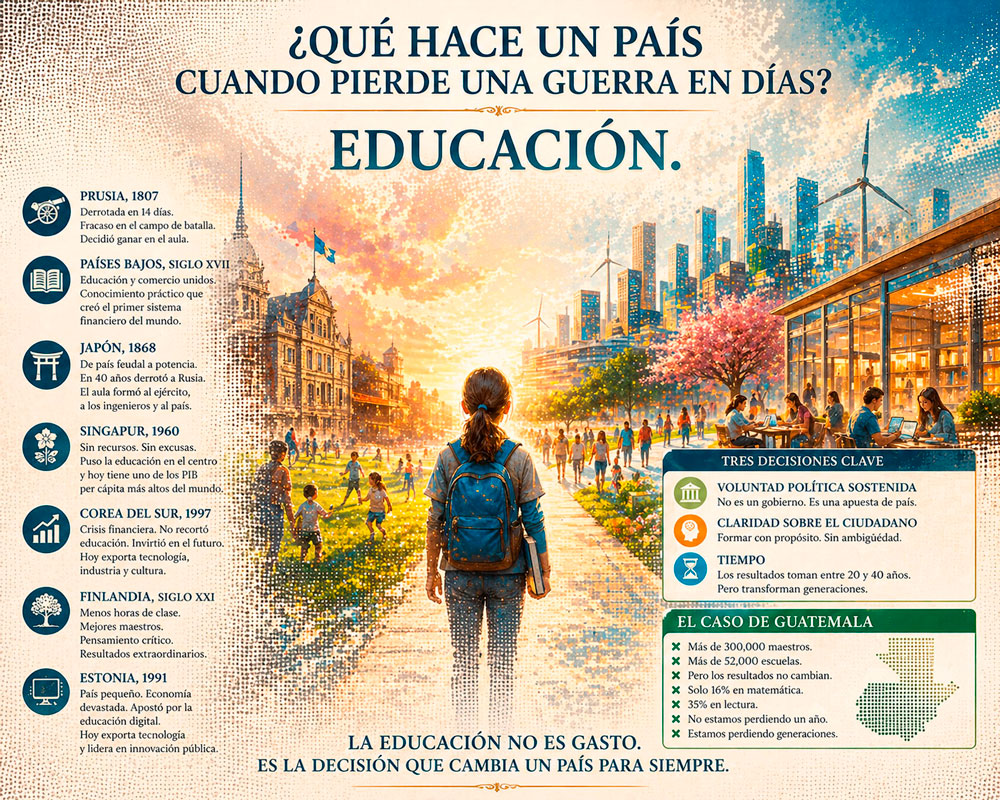
In 1807, Napoleon’s army defeated Prussia in fourteen days. The surrender was humiliating. Berlin fell without resistance. The kingdom was reduced to half its territory and forced to pay an indemnity equivalent to 60% of its annual GDP. It was not a military defeat. It was an educational failure. From that point on, any cold analysis would have concluded that Prussia was doomed to disappear, as Poland had in 1795. But King Frederick William III made a decision that no military strategist would have anticipated: he hired Wilhelm von Humboldt to redesign the kingdom’s educational system from the ground up.
Humboldt did not build schools to teach obedience. He built them to teach thinking. His reform—implemented between 1810 and 1820—introduced compulsory, free, and secular public education. He created universities that combined teaching with research. He trained teachers as state professionals. Sixty years later, in 1866, the Prussian army defeated Austria in seven weeks, and in 1870 it defeated France in just six weeks. Military historians later explained it with a phrase that became famous: the Battle of Sedan was won by the Prussian schoolteacher. The classroom had changed the map of Europe forever.
This is not a historical curiosity. It is a pattern. The countries that understood it changed their destiny. And it has been repeated in such different contexts that it is impossible to attribute it to chance.
The Republic of the United Provinces of the Netherlands in the seventeenth century demonstrates something different from the other cases: transformative education does not always originate from a government decree. In Amsterdam, knowledge and commerce were inseparable. Mathematical and financial training did not come from a state curriculum, but from a practical ecosystem: the rekenscholen—private commercial arithmetic schools active since the sixteenth century—taught trade-oriented mathematics to those who wanted to participate in commerce. That knowledge spread through guilds, families, and urban networks within a society that had exceptionally high literacy rates for its time. It was not the state that spread this economic culture; it was the market that created the incentive and individuals who responded to it. The result was the world’s first stock exchange and one of the most sophisticated financial systems of its era.
Japan offers perhaps the most breathtaking case of all. In 1868, the Meiji Restoration inherited a feudal country that was relatively isolated and technologically behind the Western powers. The new government’s response was to send thousands of young Japanese students to study in Europe and the United States while hiring foreign experts to teach in Japan. Universal compulsory education was decreed in 1872. In less than four decades, Japan militarily defeated Russia in 1905—the first time an Asian nation defeated a European power—decisively crushing its fleet and establishing itself thereafter as a major industrial actor. It was not the army that transformed the country. It was the classroom that trained the soldiers, engineers, and administrators who made it possible.
In the 1960s, Singapore was an island without natural resources, newly separated from the Malaysian federation and populated largely by people with limited formal education. Lee Kuan Yew made a decision that seemed disproportionate to the circumstances: he placed education at the center of state policy. Not merely access, but quality. He trained teachers according to selection standards comparable to those of the most demanding professions. He oriented the curriculum toward mathematics, science, and English. In 1960, Singapore’s GDP per capita was similar to Guatemala’s. Today it exceeds US$90,000, while Guatemala barely surpasses US$6,000. A country with no land, no oil, and no minerals became one of the most prosperous economies on Earth. The only raw material it processed was the talent of its people.
South Korea repeated the formula with astonishing intensity. During the Asian financial crisis of 1997, when its GDP fell by nearly 6%, the government chose not to cut education spending but to maintain it as a priority. Korean families dedicate proportions of their income to their children’s education that are rarely seen elsewhere. That collective sacrifice takes a concrete form: the system of private evening academies known as hagwon, where many students study late into the night. The result is an economy that evolved from producing low-value-added goods to exporting semiconductors, automobiles, and culture to the world.
Finland entered the conversation later, but with a different answer. At the beginning of the twenty-first century, when the Programme for International Student Assessment (PISA) began measuring educational performance worldwide, Finland consistently appeared among the top performers. Its approach was not more class hours or more testing. It was, in many ways, the opposite: fewer instructional hours than the European average, no high-stakes standardized testing before adolescence, and a strong emphasis on teacher training. In Finland, becoming a teacher is as competitive as studying medicine. Only about 10% of applicants are admitted. The country decided that educational quality depended on the quality of those who teach. And it built a system accordingly.
Estonia provides the most modern example. After gaining independence from the Soviet Union in 1991, with a devastated economy and a small population, it chose to digitize its educational system beginning in the 1990s. Today it is one of the most digitally advanced countries in the world. Electronic voting, digital public records, and a government that operates almost entirely without paper. It exports technology. This did not emerge from nowhere; it emerged from a decision made in classrooms when the country was just beginning its journey.
What do all these cases have in common? In every one of them, without exception, three decisions appear.
First, sustained political will: none of these reforms were limited to a single administration. They survived changes in government because there was consensus that education was a national project, not a partisan one.
Second, clarity regarding the type of citizen they sought to form: Prussia emphasized discipline and science, Singapore bilingualism and mathematics, Finland critical thinking, and Estonia digital competence. There was no ambiguity.
Third, time: in every case, results took between twenty and forty years. Education is the only public investment whose returns do not fit within an annual budget or a campaign speech.
That is where Guatemala’s problem lies. The country does not lack teachers: it has more than 300,000. Nor does it lack schools: it has more than 52,000 educational institutions. What it has not had is a structural reform of its educational system with continuity and depth since the 1996 Peace Accords, based on the National Education Law of 1991. Programs change with every government. Ministers last less than a school cycle. The education budget, although nominally high as a proportion of public spending, does not translate into measurable learning. Guatemala has one of the lowest secondary-school completion rates in Latin America. For the graduating class of 2025, just over 16% achieved proficiency in mathematics and 35% in reading. This is not a statistical fact. It is a generation being educated to survive, not to transform. We are not losing a year. We are losing generations.
The cost of this is not merely educational. It is economic. A country whose workforce has low educational attainment does not attract high-value investment, does not build sophisticated export industries, and does not retain the talent it trains. The decisions it can make have limited reach. Every year Guatemala invests in educating professionals who later emigrate because they cannot find conditions here to apply what they know. It is an educational subsidy that ends up benefiting other countries. We train talent… only to export it.
The question that emerges from this historical journey is not whether Guatemala can do what Prussia, Singapore, or Finland did. It is when the clock starts ticking. Because in all those cases, the starting point was a decision. Not a technical report. Not a law that was approved and forgotten. A political decision that the next generation would not inherit the same country that the previous one received.
Prussia took sixty years to see the results on the battlefield. Singapore saw them in thirty. Estonia in twenty. A government term in Guatemala lasts four years. That is not an obstacle to starting. It is the reason to start today. Because every year that passes counts against us.
Ramiro Bolaños, PhD. / President of the Center for Thought and Action: Factoría Libertatis
References:
Prussian Reform — Humboldt
Humboldt, W. von (1810). On the Internal and External Organization of Higher Scientific Institutions in Berlin.
Clark, C. (2006). Iron Kingdom: The Rise and Downfall of Prussia, 1600–1947. Harvard University Press.
Rüegg, W. (Ed.) (2004). A History of the University in Europe, Vol. 3. Cambridge University Press.
Netherlands — Financial Education
De Vries, J., & Van der Woude, A. (1997). The First Modern Economy: Success, Failure, and Perseverance of the Dutch Economy, 1500–1815. Cambridge: Cambridge University Press.
Gelderblom, O., & Jonker, J. (2004). Completing a Financial Revolution: The Finance of the Dutch East India Trade and the Rise of the Amsterdam Capital Market, 1595–1612. Journal of Economic History, 64(3), 641–672.
Schama, S. (1987). The Embarrassment of Riches: An Interpretation of Dutch Culture in the Golden Age. New York: Alfred A. Knopf.
Davids, K. (2008). The Rise and Decline of Dutch Technological Leadership: Technology, Economy and Culture in the Netherlands, 1350–1800. Leiden: Brill.
Japan — Meiji Restoration
Dore, R. (1984). Education in Tokugawa Japan. University of Michigan Press.
Gordon, A. (2003). A Modern History of Japan: From Tokugawa Times to the Present. Oxford University Press.
Singapore
Lee Kuan Yew (2000). From Third World to First: The Singapore Story 1965–2000. HarperCollins.
World Bank (2011). The Challenge of Education and Learning in the Developing World. Washington, D.C.
OECD (2010). Strong Performers and Successful Reformers in Education: Lessons from PISA for the United States. OECD Publishing. (Chapter on Singapore)
South Korea
Kim, E. & Lee, J. (2002). Educational Development in Korea. Korean Educational Development Institute.
OECD (2012). Education at a Glance 2012: Korea Country Note. OECD Publishing.
Seth, M.J. (2002). Education Fever: Society, Politics, and the Pursuit of Schooling in South Korea. University of Hawaii Press.
Finland
Sahlberg, P. (2011). Finnish Lessons: What Can the World Learn from Educational Change in Finland? Teachers College Press. (The definitive reference book on this case.)
OECD PISA Results (2003, 2006, 2009). Programme for International Student Assessment. https://www.oecd.org/pisa/ [Accessed April 23, 2026].
Estonia
e-Estonia (2024). Education. https://e-estonia.com/solutions/education/ [Accessed April 23, 2026].
OECD (2016). Education in Estonia. OECD Reviews of National Policies for Education. OECD Publishing.
Guatemala — Domestic Data
Ministry of Education of Guatemala (2024). Statistical Yearbook of Education. https://estadistica.mineduc.gob.gt/anuario [Accessed April 23, 2026].
DIGEDUCA (2026). General Results of the Educational Assessment. Ministry of Education of Guatemala. https://edu.mineduc.gob.gt/digeduca/documents/resultados/Resultados_generales.pdf [Accessed April 23, 2026].
ECLAC (2024). Social Panorama of Latin America 2024. Santiago: Economic Commission for Latin America and the Caribbean.
UNESCO (2023). Global Education Monitoring Report. Paris: UNESCO.
Other Sources
World Bank (2024). GDP per capita (current US$). https://data.worldbank.org/indicator/NY.GDP.PCAP.CD [Accessed April 23, 2026].
Bolt, J. & van Zanden, J. L. (2024). Maddison-style Estimates of the Evolution of the World Economy: A New 2023 Update. Journal of Economic Surveys, 1–41. Data available at: https://www.rug.nl/ggdc/historicaldevelopment/maddison/releases/maddison-project-database-2023 [Accessed April 23, 2026].