Marcos Antil, a Q’anjob’al child from Huehuetenango, nearly died at the age of five. Severely malnourished, he survived almost miraculously with homemade remedies due to the absence of doctors in his village of Nancultac. At fourteen, he began the journey alone to California, where his family was waiting for him. Along the way, he was captured twice. He evaded walls, detention cells, and immigration checkpoints throughout Mexico and along the U.S. border. His father had been forced to flee during the civil conflict of the 1980s.
He finished high school under difficult circumstances. He managed to enter college and graduated in one of the most sought-after fields of the twenty-first century: computer programming. In 2004, he traded his migrant’s backpack for a software briefcase and founded his company, XumaK. Contracts followed. Over time, XumaK became one of Adobe’s most important global partners, implementing digital marketing and content management solutions for Fortune 500 companies. In 2019, XumaK was acquired by WPP, the world’s largest marketing and advertising services network.
This acquisition was more than a financial success. It was a seal of excellence. A company created by a boy who crossed the border at fourteen years old is now part of the group that manages communications for some of the world’s most powerful brands. But this is not only a success story.
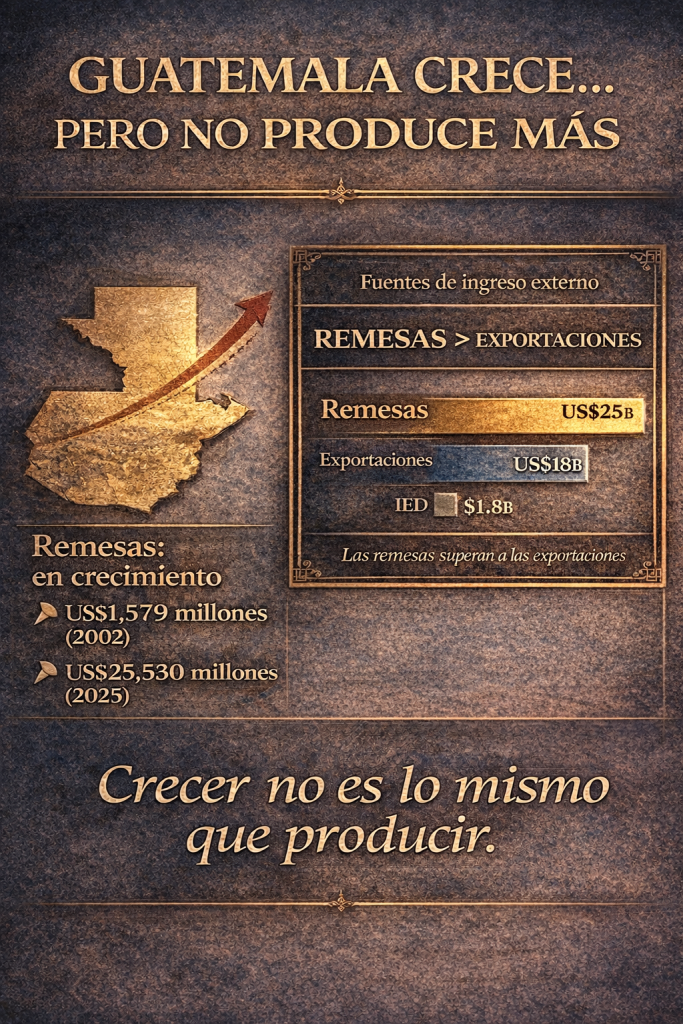
The success of 3.6 million Guatemalans living abroad has translated into an extraordinary flow of remittances. From US$1.579 billion in 2002, Guatemala received US$25.53 billion last year—an amount greater than all of the country’s exports combined. In other words, income generated outside the country now exceeds what the rest of Guatemala produces and exports.
However, this model is a path with an insufficient future. Remittances are private decisions made by millions of migrants. They depend on employment conditions in the United States, migration networks, and family choices—not on policies enacted by the Guatemalan government. And therein lies the fundamental problem: the only source of external financing that is growing strongly is the one that does not depend on the state. The source that does depend on clear rules, a favorable business climate, and strong institutions—foreign direct investment (FDI)—has remained stagnant for a decade.
Today, Guatemala receives fourteen times more dollars from remittances than from foreign direct investment. The country grows more through factors it does not control than through those it is capable of building.
Exports have also lost weight within the economy. In 2011, they represented 27 percent of GDP. By 2024, they had fallen to 16 percent. During the third quarter of 2025, their contribution was even negative. The pattern is clear: rising remittances, stagnant foreign direct investment, and a relative decline in exports. Guatemala is not growing outward. It is consuming inward.
This dynamic also has a clear characteristic: it fuels consumption rather than investment. According to GDP expenditure data, household final consumption accounted for 92.8 percent of GDP during the third quarter of 2025. Sectors such as commerce, services, and real estate are being driven by this trend. In other words, Guatemala’s economic model relies on remittances that stimulate consumption—and on credit that is insufficient to transform that consumption into substantial growth.
Today, the Guatemalan economy rests on a fragile four-legged table: remittances that finance consumption, local investment that follows it, exports that are shrinking proportionally, and foreign direct investment that barely keeps pace. It is not a solid table. It is a table that depends primarily on a single leg. If the remittance leg weakens and productive investment—both domestic and foreign—is not strengthened, annual growth of 4 percent will collapse under its own weight.
What happens when the remittance engine slows down?
The International Monetary Fund notes that the relationship between remittances and consumption in Guatemala is particularly strong. When remittances increase, consumption responds significantly. When remittances slow, the impact is immediate. Put simply, if remittance growth weakens, economic growth could fall from 4 percent to levels closer to 1 or 2 percent annually. In the face of domestic shocks—such as droughts, political crises, or other disruptions—it could fall even further.
Current growth is not guaranteed. It is dependent and fragile.
If the remittance engine slows and no alternative engine of investment and exports has been built, Guatemala’s growth will not merely slow—it will become exposed.
Mexico provides a useful reference point. After more than a decade of sustained growth, remittances to Mexico fell by 4.6 percent in 2025. Yet exports account for roughly 37 percent of Mexico’s GDP, while remittances represent only 3.5 percent. In Guatemala, exports have lost importance, while remittances now account for approximately 20 percent of the economy. Mexico can absorb the shock. Guatemala is not prepared to withstand it.
Because in Guatemala, remittances are not a complement to growth. They are its primary support.
Now that signs of slowing remittance growth are beginning to appear, the time available to build a new economic engine has shortened. Not ten years from now. Now. During this administration.
One of the clearest ways to raise productivity and compete in international markets is through foreign direct investment. Yet, excluding Millicom’s acquisition of Tigo in 2021, Guatemala has not attracted FDI inflows exceeding 2 percent of GDP since 2015. To find higher levels of investment, one must look back to the late 1990s. During the administration of President Álvaro Arzú, Guatemala achieved FDI levels equivalent to 3.5 percent of GDP in 1997, 6.9 percent in 1998, and 5.0 percent in 1999.
It is not impossible. Guatemala has done it before.
There are many ways to attract foreign direct investment, but all share one characteristic: strategic clarity.
Some countries have focused on natural resources and extractive industries. Mozambique (15 percent), Mongolia (12 percent), and Liberia (10 percent) have attracted investment through minerals, oil, and gas. Others, such as Seychelles and The Gambia, both near 10 percent, have developed industries centered on real estate, hospitality, and marine-related activities. A third group has focused on export manufacturing. Cambodia, with nearly 10 percent, achieved this through export-oriented garment production.
Many of these countries face institutional weaknesses similar to Guatemala’s. Yet they all have one thing in common: a clear, defined, and scalable investment product.
Another group of countries has followed a different path: redesigning their tax systems to encourage investment. These models reduce corporate income taxes and tax only distributed profits. As long as companies reinvest earnings, they pay no taxes. This approach, implemented in countries such as Estonia, Bulgaria, and Georgia, attracted foreign direct investment inflows ranging from 7 percent to 31 percent of GDP during various periods between 2003 and 2008.
The result was clear: high growth rates, rapid capital accumulation, and accelerated production expansion.
This is more than tax policy. It is a national decision to signal that investing in the country is attractive.
The time to rethink Guatemala’s economic model has arrived.
The first step is deciding to do so. That responsibility belongs to the government, the private sector, and citizens who must demand it. The second step is creating the conditions necessary to attract productive investment: legal certainty, stable rules, openness to competition, and an industrial policy focused on production and exports.
This requires concrete actions: an investment law that guarantees long-term stability, effective protection of property rights and businesses, expanded mechanisms for priority infrastructure projects, and, above all, a review of the tax system.
Reducing the burden on investment, eliminating distortions such as the ISO tax, and evaluating adjustments to the VAT are not easy decisions. They require agreements, leadership, and political will.
But the alternative is clear.
To continue depending on the sacrifice of millions of Guatemalans who left the country rather than creating opportunities for those who remain.
Ramiro Bolaños, PhD
President, Center for Thought and Action – Factoría Libertatis
References:
- Antil, Marcos. Migrante. Independently Published, 2019. Bank of Guatemala. International Remittances 2002–2026. https://banguat.gob.gt/page/anos-2002-2026 (Accessed April 12, 2026).
- Ministry of Economy of Guatemala. Weekly Economic Report (March 30, 2026). https://mineco.gob.gt/institucion/viceministerio-de-integracion-y-comercio-exterior/direccion-de-politicas-y-analisis-economico-dae (Accessed April 12, 2026).
- World Bank. Exports of Goods and Services (% of GDP), 1960–2024. https://data.worldbank.org/indicator/NE.EXP.GNFS.ZS (Accessed April 12, 2026).
- World Bank. Foreign Direct Investment, Net Inflows (% of GDP), 1960–2024. https://data.worldbank.org/indicator/BX.KLT.DINV.WD.GD.ZS (Accessed April 12, 2026).
- International Monetary Fund. Guatemala: Remittances and Reserves Accumulation in Guatemala (2024). https://www.elibrary.imf.org/view/journals/002/2024/267/article-A004-en.xml (Accessed April 12, 2026).